Any theism that didn’t ultimately point to mystery would not be a very believable world view. So we must not regret our final use of mystery. It is not an unfortunate, desperation ploy but a necessary part of any exalted theism.
— Tom Morris
Geoffrey Berg’s tome, The Six Ways of Atheism, is a small volume but it requires some unpacking to get at the core of what he’s trying to say. I’m going to tackle one argument per post and we should get through the book by Saturday.
Let’s dive in to the first argument, the Aggregate of Qualities Argument:
This argument fails to disprove God as Christians defend him. Berg states repeatedly that there is little chance a being in this universe possesses any of these qualities, let alone all of them. Agreed. But we never argue that God is part of the universe. Which means all of Berg’s statistical analysis and posturing about how language glosses over reality is moot. His rantings only apply to beings originating in and living in the known universe. God transcends that universe, and therefore isn’t subject to laws that define the universe.
Berg anticipated seven potential responses; this was (oddly) not one of them. All of the objections he considered were pathetic and require no rejoinder from me.
So Berg and I agree that God doesn’t exist in the known universe. That is only equal to “God doesn’t exist at all” given metaphysical naturalism.
Geoffrey Berg has written a book with six new or improved arguments against God. I disagree — not one argument is new and nothing is improved. In fact, even atheists make fun of this guy (see Daniel Florien’s post here).
I am only writing on this for one reason, and one reason alone: my new resolution to finish things that I start! I already wrote on the First Way of atheism. Then I said I’d move on with the other disproofs Berg offered. I never did. I gave up, just like I give up on lots of things.
No more.
I am going to finish that which I start from now on. This comes in two parts: previous posts and projects. Regular readers will undoubtedly have noticed the first part of this resolution — I am far more active in the comments section than I ever have been. I’m actually responding to challenges, instead of letting them slide!
The second part is projects — posts that I said I’d write but never actually did. I was saddened when I read back through my blog, deleting posts that I no longer agreed with. Whenever I got to something tagged “Site News,” there would be a list of posts I planned on writing. And none of them ever materialized. I was a tad horrified. To rectify that, I’m going to write some of those posts, and finish some of the projects that I said I’d do.
One of the projects I started long ago was making a website with responses to all of the most popular atheist books. So what I’ll do is continue with this project, and the first victim book I’ll visit is The Six Ways of Atheism.
Before I get started dismantling this piece of crap, I want to address one of Berg’s comments in the introduction. He said:
Nor do I really wish to deal with my own personal status. Essentially the arguments I put are valid or invalid irrespective of whether they are original to me or not. It is the arguments I want to be considered, not the person putting the arguments. (p. 12)
He then goes on to complain about intellectual elitism in philosophy, and how you can succeed in business with no degree, but for philosophy, you need a Ph.D. or they won’t take you seriously.
Well, not surprisingly, I disagree. It all depends on the arguments. If you make good arguments and do your homework, people will take you seriously — even academics with tons of letters after their proper names.
Take me. I have an associate’s degree in business. That’s it. I have no training in theology or philosophy, not even a 101 class. However, I’ve had opponents ask what academic journals I’ve published in. Once, I made a silly (but logically valid) argument to get out of doing something at work, and my boss said snidely, “I can tell you have a degree in philosophy.”
Despite my lack of formal training, I have been recognized as a thinker in philosophy of religion. I have detractors as well — most famously Austin Cline of atheism.about.com said I do not possess the intellectual honesty to even claim the title of “armchair philosopher.” A hit-and-run commenter on this blog said that were I to publish a book on philosophy of religion or Christian apologetics, it would be an insult to people who actually bothered to go to school to get degrees.
There are people who think Plato and Aristotle are hacks, too. As I frequently say, any idiot can start a blog. Any dummy can self-publish a book. My overall point still stands: it doesn’t matter where the argument comes from as long as it is a solid argument. If it’s good, people of all stripes will take notice. Your book will sell. Your blog will gain a following.
In that spirit, I am not going to consider Berg or his qualifications, only his arguments. I will not make any snide comments about how Berg is obviously not a philosopher, because his arguments are as naive as Steve Carrel’s character in 40-year-old Virgin. Nor am I going to make a comment about how arrogant he is; how the hubris drips off of every page leaving you with the same sticky feeling you have after a workout in high humidity. You won’t read about how he would benefit from hiring a better copy editor than his 10 year old nephew who only worked for Mountain Dew.
No sarcasm. No cheap shots. From now on!
I will only consider the arguments. If the arguments stand, then the source won’t matter.
Atheists aren’t the only ones who create memes, but the memes critical of God, the Bible, and Christianity just seem to make the rounds faster.
However, every once in a while, some theist manages to create a meme and it makes the rounds. Today, I found one on Facebook:
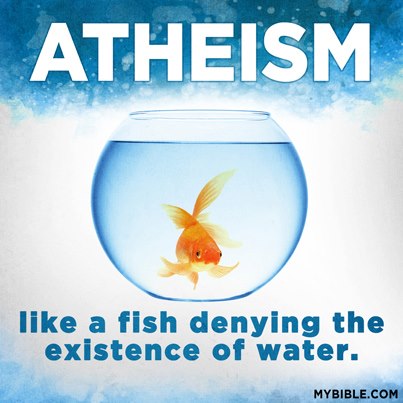
Atheists: thoughts?
For JoeUnseen’s second request, he wants to know how long the law and Prophets last.
In Matthew 5:17, Jesus said, “Do not think that I have come to abolish the Law or the Prophets; I have not come to abolish them but to fulfill them.”
In Luke 16:16, Jesus said, “The Law and the Prophets were until John; since then the good news of the kingdom of God is preached, and everyone forces his way into it.”
Forever? Or until John the Baptist? Let’s look at the context of each passage to find out.
Read the entire passage in Luke 16:
The Pharisees, who were lovers of money, heard all these things, and they ridiculed him. And he said to them, “You are those who justify yourselves before men, but God knows your hearts. For what is exalted among men is an abomination in the sight of God.
“The Law and the Prophets were until John; since then the good news of the kingdom of God is preached, and everyone forces his way into it.But it is easier for heaven and earth to pass away than for one dot of the Law to become void.” (vv. 14-17)
Now read the entire passage in Matthew 5:
Do not think that I have come to abolish the Law or the Prophets; I have not come to abolish them but to fulfill them. For truly, I say to you, until heaven and earth pass away, not an iota, not a dot, will pass from the Law until all is accomplished. Therefore whoever relaxes one of the least of these commandments and teaches others to do the same will be called least in the kingdom of heaven, but whoever does them and teaches them will be called great in the kingdom of heaven. For I tell you, unless your righteousness exceeds that of the scribes and Pharisees, you will never enter the kingdom of heaven. (vv 17-20)
Neither of these actually abolishes the Law; they simply state the difficulty of doing so. The Law is forever (Ps 119:89-90; Is 40:8).
The only hope, therefore, is to fulfill the Law (Mt 5:17). Turn to the apostle Paul:
For God has done what the law, weakened by the flesh, could not do. By sending his own Son in the likeness of sinful flesh and for sin, he condemned sin in the flesh, in order that the righteous requirement of the law might be fulfilled in us, who walk not according to the flesh but according to the Spirit. (Rom 8:3-4)
Put another way, “… Christ is the end of the law for righteousness to everyone who believes” (Rom 10:4). Paul felt he had every reason to rely on the Law for salvation (Phil 3:4b-6), but he wrote to the Philippians that Christ is his salvation:
… whatever gain I had, I counted as loss for the sake of Christ. Indeed, I count everything as loss because of the surpassing worth of knowing Christ Jesus my Lord. For his sake I have suffered the loss of all things and count them as rubbish, in order that I may gain Christ and be found in him, not having a righteousness of my own that comes from the law, but that which comes through faith in Christ, the righteousness from God that depends on faith— that I may know him and the power of his resurrection, and may share his sufferings, becoming like him in his death, that by any means possible I may attain the resurrection from the dead. (Phil 3:7-11)
Christ ends the Law only in the sense that he has fulfilled its requirements on behalf of those who believe. So, like the woman caught in adultery, we may also “… go, and from now on sin no more” (Jn 8:11; see also Prv 28:13; Ez 18:30-32; Rom 2:4, 5:20-21; Eph 4:1; Phil 1:27; 1 Tim 1:15-16).
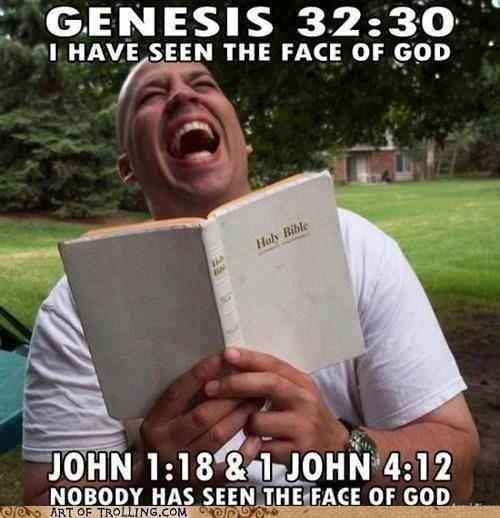
I’ve seen some funny parts in the Bible. I get the feeling this guy is supposed to be laughing AT the Bible, though.
A Twitter follower, JoeUnseen, has requested that I crush a meme on who has seen the face of God: Jacob (Gen 32:30), or No One (Jn 1:18; 1 Jn 4:12)?
There are a host of verses often set against each other in this same fashion. It’s usually a sophomoric understanding of semantics used to cause confusion.
No one has seen God in the sense of the divine glory, or the sense of God the Father (first person of the Trinity). However, people have seen Jesus, the Incarnate Son (second Person of the Trinity), or any number of theophanies.
Let’s start with the new word: a theophany is a manifestation of God, but not the full glory of God. Reading the entire passage of Genesis, we see that Jacob wrestles with a man (probably an angel, vv. 24-28). The stranger is identified as God for the first time in verse 28, then Jacob proclaims he met God face to face and survived (v. 30).
But he didn’t meet God; only a representative. And that is clear from the passage. This is a theophany; a representation of God, but not God in his full glory.
I may have to buy a new pack of Victory Gum …
Any theism that didn’t ultimately point to mystery would not be a very believable world view. So we must not regret our final use of mystery. It is not an unfortunate, desperation ploy but a necessary part of any exalted theism.
— Tom Morris
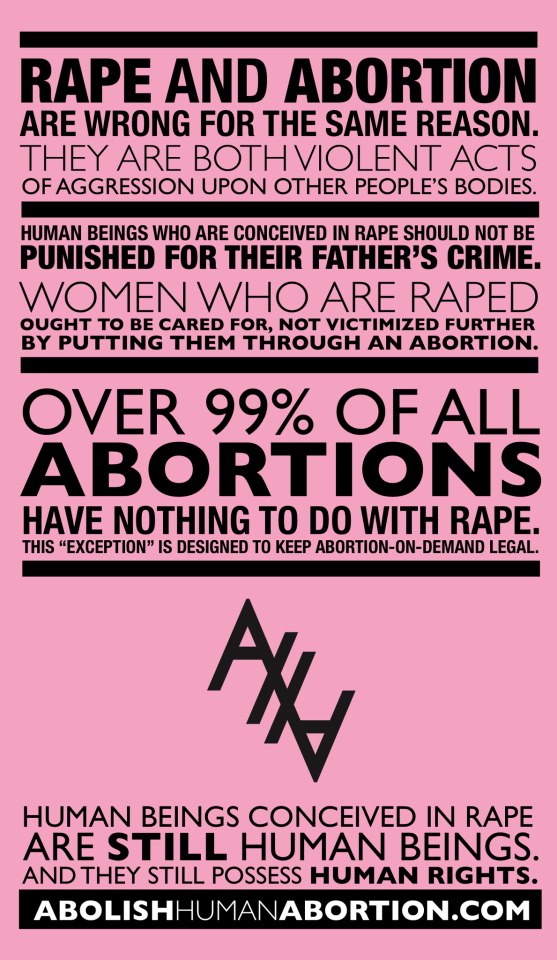 The ignorant comments of Senator Todd Akin add fuel to the already huge fire over the abortion debate. Many conservatives oppose abortion in all forms, even in cases of rape and incest. In an August 19 interview, Senator Akin was asked to clarify why he opposed abortion in cases of rape. The following epic fail issued forth:
If it’s a legitimate rape, the female body has ways to try to shut that whole thing down. But let’s assume that maybe that didn’t work or something: I think there should be some punishment, but the punishment ought to be of the rapist, and not attacking the child. (source)
I want to first address the two periphery issues our Democratic friends like to focus on, then the real issue. The real issue is obscured behind incidental (and I seriously hope unintentional) faux pas in his statement.
Calling them “faux pas” is too kind. I like to keep the blog family friendly, and words like “douchebaggery” run contrary to that; even though it is a more fitting term.
Let’s press on. The Senator’s first faux pas is “legitimate rape.” This seems to suggest that there are cases of illegitimate rape. Of course there are, but rape is under-reported, not over-reported. And it remains under-reported because of ignoramuses like the Senator who blame the victim.
Senator Akin’s comment seems to suggest that if a woman gets pregnant by rape, it isn’t rape. In other words, she must have wanted it. That type of thinking has to sicken feminists to their core. I’m not a feminist and it sickens me!
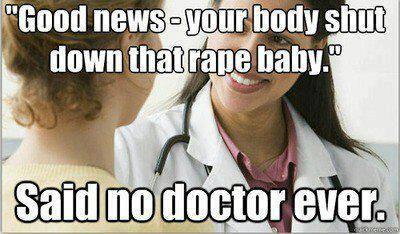 This leads to the second faux pas, suggesting that a woman’s body can somehow shut down a pregnancy if the rape is legitimate. That’s an interesting superpower. Why can’t women just do that for any unwanted pregnancy? It would end the abortion debate and the controversy over government-sponsored contraception in one fell swoop!
And how would the woman’s body know the difference, exactly? One fact I do know about rape is that the body reacts as if the sex is consensual, lubing up the right parts. So the woman is violated by the rapist and betrayed by her own body. That, of course, multiplies the shame exponentially and contributes to the under-reporting of rape.
Now on with the real issue. Viewing this from a pro-life standpoint, abortion is morally wrong; it is murder. In that light, when aborting a child conceived in rape, you punish the innocent child for the crime committed by the rapist.
Senator Akin later clarified:
I recognize that abortion, and particularly in the case of rape, is a very emotionally charged issue. But I believe deeply in the protection of all life, and I do not believe that harming another innocent victim is the right course of action. (source)
This was the point he was making in the first place, skewed by the stupidity of the surrounding context. Liberals pick up on the wrong part of the message — but Senator Akin needs to realize that he gave birth to that monster by spouting the douchebaggery in the first place.
I defend the child conceived in rape as having a right to life. I denounce the ignorance and backwards-thinking of Senator Akin, and join my liberal opponents in shock that he would make these comments. But let’s keep the focus on the right to life, not assbag Senators who thoughtlessly spew epic fails that alienate large portions of their constituency.
This awesome tweet gets the last word:
https://twitter.com/groovychristian/status/240980047329103872
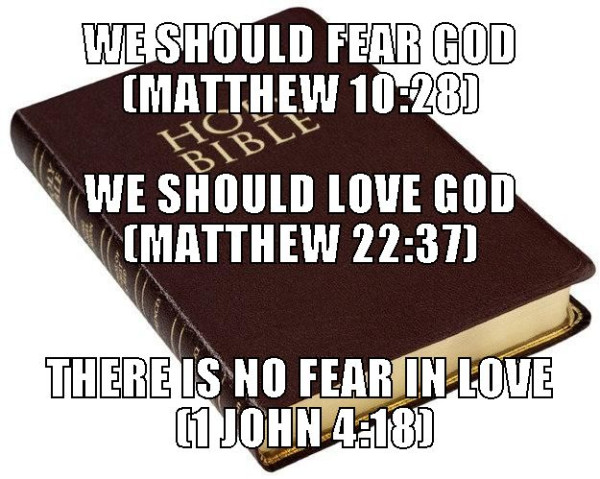 I never intended to crush silly memes as a theme for the past week, but that’s what ended up happening. So when I saw this one, I thought I’d run with the unintended theme.
It’s titled “You should just, like, read the Bible!” Which means, I suppose, that the Bible muddies things up by contradictions such as what we read on the right.
Well, is this a contradiction? To answer that question, we need to go to the context of the verses. I’m interested to see if each passage is making a different point to a different audience. In that case, we’d have no contradiction at all.
In Matthew, the context is persecution by authorities. Jesus is telling his disciples not to worry about the powers that be persecuting or killing them for the sake of the kingdom. Don’t fear them, because they can only hurt the body. Instead, fear the one who can destroy the soul — the real you.
Obey God, not men.
Continuing forward, we receive assurance that God takes care of his own. Therefore, we (in reality) have nothing to fear and God will take care of us — especially if we acknowledge the Son before our tormentors. Though we’re told to fear God, the remainder of the context shows that that isn’t necessary because he will, in fact, take care of us as he does all of creation.
In 1 John, the context is God’s abiding love. God loved us so perfectly, that he sent his Son to an atoning death for our sins. There is no fear in God’s love because God’s perfect love is saving the believers from hell; therefore, we ought to love one another. The perfect love drives out the fear because we are spared of the final judgement, and the fear comes from its punishment. So we need not fear it.
Two passages: different contexts, different messages. They are thematically related only in explaining why we should not fear final judgement — the perfect love of God abiding in us.
Not a contradiction.
And so, having crushed another meme, I shall enjoy a piece of Victory Gum…
I’ve posited that atheists do not want ultimate accountability to God, and that is part of their motivation for denying God’s existence. Atheists try hard to resist that, but a few have been forthright about it. Philosopher Thomas Nagel, for example, wrote:
I want atheism to be true and am made uneasy by the fact that some of the most intelligent and well-informed people I know are religious believers. It isn’t just that I don’t believe in God and, naturally, hope that I’m right in my belief. It’s that I hope there is no God! I don’t want there to be a God; I don’t want the universe to be like that.
Now, the Atheist Camel comes clean as well. When contemplating what the reaction would be to bulletproof evidence that there is a god, he said:
I’ll proffer that it depends on the god’s persona. If it is a hands (or trunk, or tentacles) off god, who created us and lets us live out our lives as independent beings unfettered by its irrational threats and demands; perhaps a fun loving kind of being that finds our behavior amusing or disgusting, but nevertheless nonjudgmental– perhaps asking only for an occasional acknowledgement and thank you now and then I’d have no problem with it. Acknowledge and move on. (source, emphasis added)
So he’s fine as long as there is minimal intrusion in his life. Now, what if this deity was the God of the Bible and did demand certain things?
Where scientists never before bothered to contemplate the supernatural, many of them, and our freethinking brethren, would now kowtow to this God’s demands. But many more would turn their attention toward one objective…find a way to destroy it. An underground movement, an army of partisans, dedicated to freedom of thought, rationality, fairness and conscience battling not only for the freedom to live life free from omnipotent oppression and irrationality, but for the freedom and right to die and fade into oblivion without pain and fear.
If there were a proven God of the Bible in all its horrendous glory man would be compelled to stop killing each other. The thinking among us would turn our undivided attention to find a way to kill this God monster … once and for all. (source, emphasis added)
So the truth comes out. As long as the Atheist Camel gets to live as he chooses, with no interference from a deity, he’s fine. But the moment there is an expectation of behavior and a requisite final judgement, he thinks that humans should join together and kill that God.
What can I say? This confirms my original theory about atheists wanting to avoid final judgment classic-D&D-style — rolling a 20-sider and saying “I disbelieve.” I just wish more atheists were this honest.
 Memes are created by the dozens everyday. I have no idea what makes one meme go viral while others sit and rot. But I’m convinced the anti-religious ones that go viral must do one of two things:
This meme goes in the second group. I would like to point out that it is exactly the same category error discussed with the Scumbag God meme: a failure to distinguish between “kill” and “murder.”
“Kill” is a broad term that refers to the taking of lives. Murder, on the other hand, is the unlawful taking of a life. All murder is killing, but not all killing is murder. For example, the following “kills” are lawful:
No comment on the fairness of those kills, but they are considered lawful in that if you clean a fish, kill an enemy soldier, shoot a horse with a broken leg, or kill to protect your child you won’t face prison time.
Murder represents a case where you killed unlawfully. For example, if you caught your wife in bed with another guy, then beat that guy’s head in with a sharpened stick, you’re going to jail. I’m sure that the jury would sympathize with you, mostly because there’s at least one hotheaded, possessive S.O.B. of a juror who would have done the same thing.
But that doesn’t change the legality of your action. You still killed without a justifiable reason. And that makes it murder. (In the above example, if you had no “cool-down” period, it would likely be charged as manslaughter, but my point still stands that the killing is unlawful.)
Capital punishment is the right of the state, agree or disagree with it, it is still a justifiable killing. As is killing an enemy soldier in combat; soldiers know what they’re getting in to and they know they are risking their lives when they enter the armed forces. Same as any police officer or government Special Agent.
So, you can be pro-life, pro-war, and pro-death penalty while not earning the brand of hypocrite. Some might say that this is special pleading, but it isn’t because I’ve shown the one exception to special pleading — the principle of relevant difference. Lawful killing of enemy combatants and convicted murderers/traitors is vastly different than murdering a baby in the womb.
Okay, I jumped the gun a bit. I haven’t actually proven that abortion is murder. And that’s not my aim. My aim is to show that not all killing is unlawful, and therefore this meme commits a serious category error.
And now, having squashed another ignorant meme, I shall enjoy a piece of Victory Gum…
 Guess who had an adulterous affair, divorced, remarried !
 The sheer arrogance of you guys is stunning, as is your lack of self awareness. You didn’t go lookin
 Regarding "Antar," https://en.wikipedia.org/wiki/Antarah_ibn_Shaddad. Nicolai Rimsky Korsakov based
 Muchas gracias. ?Como puedo iniciar sesion?
 Your rebuttal does not make any sense. They are nothing more than preaching. How about trying little
 This is a fairly obnoxious comic, especially when red herrings are the favourite fish of the religio
 I couldn't refrain from commenting. Exceptionally well written!
 Back Rome Again