Does WWGHA Even Understand Christianity?
If one is going to criticize the viewpoint of another, then one had best understand the opposing view thoroughly. As an example, you will note that I do not enter into Creationism/Evolution/ID debates. I don’t know enough about the three camps to participate intelligently, save for being able to articulate the difference between pure Creationism and ID.
Over at the Blog for WWGHA, in response to this article from a Christian pastor, Thomas opines:
It’s the “infinite wisdom” rationalization. God is too huge and awesome for pipsqueak humans to understand. Never mind that Christians claim to understand God all the time, for example by demanding that homosexuals be discriminated against or even stoned to death, or that foreskins need to be cut off baby’s penises, etc. Christians claim knowledge of all sorts of God’s thoughts, but strangely, the explanation for the atrocities and horrors that we see every day are just too complicated. (source)
It’s simply absurd to suggest that anyone is being inconsistent to say that we know some things about God, but not other things. It is absolutely possible to say you know a person, but not understand everything that they do.
With God, some of his commands are clear, while others aren’t. But to suggest I’m inconsistent when I say that we humans aren’t going to understand some things about God while being able to understand other things is asinine.
Second, let’s set two things straight with the Christian (mis)treatment of homosexuals. We are not “denying” anyone the right to marry. The very makeup of marriage excludes homosexuals. It is a divinely ordered institution of a man joining to a woman, and they become one flesh. Polygamy isn’t specifically prohibited in this fashion, but men can’t marry men and women can’t marry women under this paradigm.
It would be like me saying “My goal is to be the next Pope.” I’m not a practicing Catholic; therefore I’m excluded from consideration for that office.
Or, if I tried to win a Hispanic scholarship. I’m white. I can’t win a scholarship oriented to Hispanic students. It defies the intent of the scholarship and the rules of those who created it and put up the money.
Marriage is a joining of a man to a woman. Period. We can’t deny someone a right that does not exist.
On a personal note to the blog author: Thomas, please find me a Christian who, in the last 20 years, actually called for a gay man to be stoned to death. If you can’t, then please withdraw that ridiculous claim.
On the foreskin question, Christians actually were not circumcised. Christians are exempt from all practices under the Jewish law. Paul makes it explicit:
For circumcision indeed is of value if you obey the law, but if you break the law, your circumcision becomes uncircumcision.So, if a man who is uncircumcised keeps the precepts of the law, will not his uncircumcision be regarded as circumcision? Then he who is physically uncircumcised but keeps the law will condemn you who have the written code and circumcision but break the law. For no one is a Jew who is merely one outwardly, nor is circumcision outward and physical.But a Jew is one inwardly, and circumcision is a matter of the heart, by the Spirit, not by the letter. His praise is not from man but from God. (Rom 2:25-29)
Though there is a clear advantage to circumcision in knowing the oracles of God (Rom 3:2), one shouldn’t seek it:
Only let each person lead the life that the Lord has assigned to him, and to which God has called him. This is my rule in all the churches. Was anyone at the time of his call already circumcised? Let him not seek to remove the marks of circumcision. Was anyone at the time of his call uncircumcised? Let him not seek circumcision. For neither circumcision counts for anything nor uncircumcision, but keeping the commandments of God. Each one should remain in the condition in which he was called. (1 Cor 7:17-20)
What if someone does get circumcised despite the warning? Then:
. . . Christ will be of no advantage to you. I testify again to every man who accepts circumcision that he is obligated to keep the whole law. You are severed from Christ, you who would be justified by the law; you have fallen away from grace. For through the Spirit, by faith, we ourselves eagerly wait for the hope of righteousness. For in Christ Jesus neither circumcision nor uncircumcision counts for anything, but only faith working through love. (Gal 5:2-6)
Circumcision is not a Christian phenomenon.
Okay, now that we’re done with rabbit trails, is there actually an argument or an indictment here worth answering?
Sort of. We’ll talk tomorrow.
I love when people make sweeping generalizations like, “… the epistles of Paul … mention almost none of the alleged facts of Jesus’ life.” Richard Dawkins should stick to biology, as my good buddy Eric Chabot points out in this fine post.


Well, hopefully we all know that Richard Dawkins is not an expert in New Testament studies. His speciality is biology. So he stepped way out of his arena when he made these comments about sources for the life of Jesus:
“[T]he gospels are not reliable accounts of what happened in the history of the real world. All were written long after the death of Jesus, and also after the epistles of Paul, which mention almost none of the alleged facts of Jesus’ life.” “Nobody knows who the four evangelists were, but they almost certainly never met Jesus personally.”-Richard Dawkins, The God Delusion (2006)
At this point, I am not going to spend a ton of time going over the dating of the four Gospels again. There are enough posts/article on this site that cover the topic. See here and here for a couple of places to look at some sources that deal with…
View original post 773 more words
Hanging on to Faith, But Not Liking It
Rachel Held Evans appears to be toying with the notion of dropping the label of “Christian” altogether as she writes with tortured keystrokes:
I am hanging by the tips of sweaty fingers on this ledge of faith, wondering if letting go will bring freedom or death. I’ve hung on before—through the science wars, the gender wars, the Christmas wars, the culture wars—but I’m just so tired of fighting, so tired of feeling out of place. (source)
What’s the cause of this?
The Chik-fil-A controversy.
Rachel, like most in the liberal Christianity camp, rejects the notion that homosexuality is a sin. She even says it is a “right” that we conservatives aim to deny:
I too believe marriage is a civil right in this country, and I too get frustrated when Christians appeal to their faith to withhold this right from their neighbors. (source)
Rachel is clearly agonizing over her fellow Christians with the issue of homosexual marriage. She not only wants to stop praying, but she thinks it might be better for some to be separated from grace:
Suddenly, my religion is alien to me—small, petty, reactive. My faith has lost its bearings. I don’t feel like praying anymore, not even for the mom who begged me to pray for her gay son who vowed yesterday never to return to church again.
Can I blame him? Perhaps it is better if he stays away. (source)
I want to seize just a moment on one statement, which I think is the key to Rachel’s problem: “My faith has lost its bearings.”
Yes, it has. Now let’s examine why that’s the case.
Nick Peters argues, in part, that homosexuality isn’t part of special revelation (the Bible), but a part of general revelation:
. . . [I]n Leviticus 18 and 20, the verses following the list of sins tells us that it is for committing these sins that other nations are being cast out. Other nations were never punished for not following the dietary restrictions or wearing mixed fabrics. Those were practices that set Israel apart from the other nations as a sign they were in covenant with God. The other nations were commanded by Israel to live moral lives, but they were never commanded to follow Jewish practices. Jews could be condemned for trading with other nations on the Sabbath, but the other nations were not condemned for working on the Sabbath.
Note also that this places homosexuality in the category of general revelation. Other nations were cast out because of doing things that we can say that they should have known better. It would not make sense for God to punish a people when they could not have known that they were doing anything wrong. Since this is in general revelation then, you don’t need the Bible. (source)
So that means if you never pick up a Bible, you should still understand that homosexuality violates the natural order of things (see Dave Armstrong and Jennifer Fulwiler for more on this “natural order” argument). If you don’t see a violation of the natural order, then we have a bigger problem.
Why?
In committing any sin, you are essentially suppressing the truth of God through unrighteousness (Rom 1:18). And acting on such evil inclinations without a second thought is a judgment from God:
For this reason God gave them up to dishonorable passions. For their women exchanged natural relations for those that are contrary to nature; and the men likewise gave up natural relations with women and were consumed with passion for one another, men committing shameless acts with men and receiving in themselves the due penalty for their error.
And since they did not see fit to acknowledge God, God gave them up to a debased mind to do what ought not to be done. They were filled with all manner of unrighteousness, evil, covetousness, malice. They are full of envy, murder, strife, deceit, maliciousness. They are gossips, slanderers, haters of God, insolent, haughty, boastful, inventors of evil, disobedient to parents, foolish, faithless, heartless, ruthless. Though they know God’s righteous decree that those who practice such things deserve to die, they not only do them but give approval to those who practice them. (Rom 1:26-32)
Rachel gives approval to those who practice homosexuality, campaigning for their right to legally marry.
Well, no wonder her faith has lost its ground!
She has suppressed the natural law through unrighteous support of sin. Therefore, God is giving her over to these desires — and her faith is slipping because she feels the distance.
There are only two ways to end her cycles of uncertainty. She can let go of the cliff, and therefore fall into the abyss. Or, she can recommit to understanding God in his glory, on his terms (even the decrees she doesn’t like), thus hauling herself back onto the safety of the ledge.
Either option will settle her mind, but only one leads to life. And it’s easier to let go rather than muster the strength to climb back up (Mt 7:13-14).
The Parable of the Year 4500 [PARODY]
A warning to the sarcastically impaired… this post is meant in jest, but it raises a valid point that bears addressing by atheists of OUR time. Before it’s even a question from speed readers or skimmers, I am not de-converting.

By Supportstorm (Own work) [Public domain], via Wikimedia Commons
But I have, at last, thrown off the shackles of Christian oppression and joined the Brights of society, in knowing the truth that there is no God.
I now post my anti-testimony so that others may find the strength to resist the mindvirus of Christianity. But let me start with a little history…
Christians in 4500 point to two incontrovertible “miracles” proving the existence of their god. The first is the so-called Resurrection, when their zombie lord allegedly rose from the dead.
The second allegedly happened five days after an anonymous writer of what they used to call a “blog” wrote this:
If one evening, every star in the sky began to move in unison, and converge to form an illuminated three dimensional Latin Cross that filled the entire void, leaving the rest of the sky utterly black, devoid of any stars or planets; with Jesus’ face superimposed upon it, speaking in all languages at once its expectations of us, and for good measure it simultaneously rained human blood across the planet; and this all lasted for 24 hrs so that every person on Earth could view the event for themselves … I’d buy it. I’d become the worlds greatest Christian. Or if it were equally strong evidence of some other god being, I’d be first in line to at least apologize to it for my denial and happily sacrifice to it, grovel at its hooves, or otherwise demonstrate my reverence.. (source)
Five days after that, it happened. Millions of eyewitnesses saw it, and thousands posted accounts online and newspapers carried stories and the media frenzy was born.
And so was Christian oppression. Because who could argue with an actual appearance of God?
But I echo the arguments of many critics of this so-called “event” of mid-2012. I now do not believe it happened. The facile replies of the Christian so-called apologists lack so much luster as to be incredible. Even fanciful.
So, here are my questions. . .
First, Why did God wait so long? Allegedly, your “savior” rose from the dead in the year 33. Yet, this fictitious event didn’t occur until 2012 — almost 2000 years later. It seems to me that if God truly cared about humanity, he would never let questions about his existence happen, since you go to hell if you don’t believe in him.
So he wouldn’t have waited. He would have made the first great miracle, the Resurrection, more obvious. The Resurrection, in fact, is all he should have needed to prove that Jesus was who he said he was. People would believe then.
The fact that your god needed a second miracle proves he is inept and not worthy of worship.
Second, Where’s the video of this event? Christian apologists claim that as a supernatural event, this couldn’t have been put on video. Therefore, all of the video from the time that shows a typical, non-rearranged night sky is what we’d expect to see.
Well, it seems to me that if God expected this miracle to convince everyone of his existence, that he’d leave more than just a few eyewitnesses. I know that it is claimed the “entire planet” saw this, but that isn’t good enough. The Resurrection was supposedly seen by over 500 people who were still alive at the time of writing, but I can’t question them now, either. Therefore, both miracles suffer from lack of adequate attestation. Which leads us to …
Why do you expect me to take this on eyewitness testimony alone? Eyewitnesses are notoriously unreliable. I can’t question any of these people today, and supposedly there’s no actual video of this event. The hundreds of blog posts that still exist are no proof, since the Church could have put those together and claimed they were authentic.
I bet they even destroyed the counter-testimony, the people of the era who said this event never happened. There was bound to be lots of those, as I understand atheist activism was popular on the Internet of 2012. Where are all of the atheists who would have decried this obvious Christian propaganda?
Destroyed by the Church, that’s where.
So that’s my case. That is why I now stand with the atheists. Go ahead, theists. Prove me wrong.
In other words, given the space of time, people will find old ways to disbelieve new miracles. All of these arguments are repackaged versions of anti-Resurrection arguments. Nice try, Atheist Camel. Believe because of the Resurrection, or move along. It is the only sign you’re getting.
Misguided Questions About Marriage
 The Facebook page Liberal Logic 101 posted the meme at the right as a satirical point about how loose definitions sometimes become in the liberal camp.
For the record, I don’t know either person and I have no idea why they matter to this picture (beyond an educated guess). Neither looks the race claimed, but I’m guessing each claims that race.
The idea, of course, is that the liberal has a loose sense of boundaries within a category. Marriage and race both mean something, and the liberal (says the meme’s creator) is distorting these meanings. One commenter summed it up nicely for the liberals who missed the point in the comments:
I think the point is that they are taking a set definition and turning it on its head. A dog is not a cat no matter how much you may want it to be. Words have definitions. You can create new words to describe things, but you cant change current definitions or they become meaningless. Imagine cops trying to find a criminal described as black when he is clearly caucasion [sic].
But, there’s a further problem with the mindset of the liberal as it pertains to marriage belied by the following questions, asked by a particular commenter:
Does the definition of marriage define the relationship between you and your spouse? How will it change your marriage if gays marry? Will you divorce your spouse if gays marry? Are you guided by hatred or by love?
A question of my own: What word appears in every single question?
Answer: Some form of “you.”
Yes, the focus for the commenter is how this affects you.
But marriage isn’t defined by how its redefinition would affect any specific individual. Marriage is marriage, nothing more or less. There is an ontology to “marriage;” it is the joining of a man and a woman so the two become one. Each gender needs the complimentary characteristics of the other to be whole.
The commenter’s rhetorical questions were meant to show the conservative that he has nothing to fear by letting gays marry each other, for it won’t affect him an iota. But this is the wrong way to think.
Marriage is a divine institution, ordained by God. It isn’t our social construction to be played with as times change. It is to be conformed to God’s expectations — not society’s.
Just like race has a clear and unarguable meaning (not something we can define as we please), so does marriage. We cannot take anything that is ordered in a sense by its ontology and turn it into something that pleases us. No matter how you try to define the words, a marriage will join the genders into one. It cannot join members of the same sex.
Krauss’s Wager
Luke Nix of Faithful Thinkers ruminates on two of Lawrence Krauss’s recent statements:
Recently in a discussion with Justin Brierly (Unbelievable?) and Rodney Holder, Lawrence Krauss made an interesting statement (podcast: 58:01):
“You talk about this god of love and everything else. But somehow if you don’t believe in him, you don’t get any of the benefits, so you have to believe. And then if you do anything wrong, you’re going to be judged for it. I don’t want to be judged by god; that’s the bottom line.”
Earlier in the program Krauss also described himself as an antitheist and made a distinction from being called an atheist. Taken in the context of the quote above this distinction and title makes a lot of sense.
Absolutely: this is something that I’ve seen from atheists before. It’s not that they don’t grant the possibility of God — it’s the judgment of God they would like to deny.
It’s not fair.
I’m just being me.
The second objection is true. You are just being you: a sinful human being deserving of God’s judgment. But the first statement is false. God isn’t being unfair; he, too, is being him.
As apologists, it is not enough to address a worldview as a whole, we must look into the specific views of an individual to appeal to them on both an intellectual level and an emotional level.
And Luke unpacks all of that nicely in this post.
Is There REALLY No Evidence for God?
I know every atheist reader is simply going to say “YES” when they read my title and move on. So be it. For those of you still here, I think that Seth Dillon of Logical Faith sums things up nicely:
Atheists . . . have adopted a naturalistic worldview, which means they believe that every event, no matter how supernatural or miraculous it may seem, can be explained without appeal to the supernatural. Thus their disbelief is not the result of a lack of evidence that God exists, but of a philosophy which, from the outset, denies the possibility of any such evidence. In other words, they’re bringing a ready-made conclusion to the evidence, rather than drawing a conclusion from it. Such backward thinking is begging the question, and is neither reasonable nor scientific.
Despite what atheists would have you believe, Christianity is a self-proclaimed evidence-based faith, with Jesus being the supreme piece of evidence.
Notice This…
A friend on Facebook posted the following graphic:
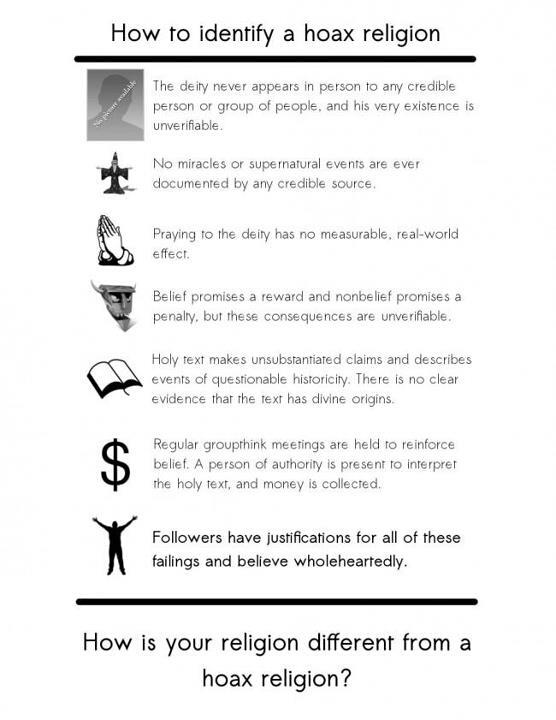 Notice that I can’t actually win? The question at the end is loaded.
If I explain why 1-6 are fallacious, I’ve committed #7 and therefore have a hoax religion.
But I can’t show that Christianity is different from other religions without providing justifications for the first six, which means I (once again) have a hoax religion.
Well, shucks… I lose. But I wonder:
Does the fact that atheists pass this graphic uncritically from one to the next make them guilty of holding a regular groupthink meeting to reinforce belief? Of course not, they can justify that by saying no money is collected and they aren’t meeting in person.
Wait a minute…
The preceding post was meant as satire and not as a serious argument. Please don’t tell me I’m committing a tu quoque fallacy with this post. I already know that. That’s why I’m tagging it as “humor.”
Meeting the Contrarian’s Third Challenge to Believers
I’ve talked about the Contrarian (part 1 | part 2), and his strawman representation of the Christian gospel. As it happens, this guy is a gold mine of article ideas for an apologetics blogger. Sort of a one-stop shopping center for a writer who needs ideas.
Therefore, I couldn’t resist his first challenge to believers. I have no idea why I answered it. Along with the second and third challenges, he proves he is only interested in grandstanding for an atheist audience.
So far, #3 is the final challenge and I hope it mercifully stays that way, even though it is the only one remotely interesting: “unobfuscate the Trinity”:
Lucifer: The trinity has caused divisions amongst various christian denominations for centuries. There are those christians who bellieve that Jesus was god in the flesh and those who say he is the sun of god and an entity distinct from god almighty.
Contrarian: Jesus BLATANTLY said things on numerous occasions that points to the fact that he is a being distinct from god, and not god in human form. Before and after being crucified, Jesus prays to god to let this cup pass from his lips, and to forgive his persecutors because they know not what they do.
Furthermore, Jesus also said that neither the angels in heaven nor he (referring to himself) knows the day of his second coming. But he clearly states that God does and speaks of him as a separate entity.
There are various other cases where Jesus makes it plain as daylight that he is NOT GOD incarnate, such as when he claims to have observed the creation of the world, but was not the one doing the creating.
The Contrarian is actually on to something. His problem is one of equivocation, though I don’t think he realizes that he is the one committing the error.
Let’s see if I can set this straight.
First, in general the doctrine of the Trinity (at it’s most basic) says that the Father, Son, and Spirit share an essence but remain distinct persons. Something like I am simultaneously a husband to Jody, father to Ashleigh, Gabe, and Kayti, and a manager to my staff at work.
Each role is different.
This isn’t a perfect analogy — but it’s a step in the right direction. JP Holding, infamous Internet apologist, explains the Father-Son-Spirit relationship better in this video.
Second, we need to get some definitions straight. “God” sometimes refers to the ontological category of what Jesus and the Father are — in other words, their shared essence. Other times, “God” refers to the Father, the First Person of the Trinity. For our purposes in this post, God always means the essence of deity and Father refers to the person.
With this in mind, let’s see how equivocation derails the Contrarian’s line of thought.
Jesus BLATANTLY said things on numerous occasions that points to the fact that he is a being distinct from god, and not god in human form. Before and after being crucified, Jesus prays to god to let this cup pass from his lips, and to forgive his persecutors because they know not what they do.
Wrong.
Jesus is God, distinct from the Father. He is God in the flesh — not the Father in the flesh. Jesus is praying not to his essence, but his Father.
Furthermore, Jesus also said that neither the angels in heaven nor he (referring to himself) knows the day of his second coming. But he clearly states that God does and speaks of him as a separate entity.
Again, he’s speaking of the Father, not of God in an ontological sense.
There are various other cases where Jesus makes it plain as daylight that he is NOT GOD incarnate, such as when he claims to have observed the creation of the world, but was not the one doing the creating.
Again, he’s observing the Father creating.
Critical reading and a little bit of thought should unobfuscate the Trinity. I hope that I’ve helped.


 Back Rome Again