Category Archives: Morality
Atheists Redefining Morality
I’ve often said that atheists have a penchant for redefining terms. The most frequent use of this tactic is seen by redefining “faith” to mean “belief without supporting evidence.” Faith is trust, no more and no less. It’s repugnant to see former believers continuing that redefinition, even though they know better.
But atheists, by their own reckoning, are also free to not only redefine established terms but also free to redefine morality. This is because they are no longer “shackled to a Bronze Age mythological belief system.” The comments to this post from Daniel Florien serve to show just how far this can be stretched. Read the rest of this entry
Is Masturbation a Sin? A Disagreement with Steve Hays
Steve Hays of Triablogue defends masturbation as a good thing here. Matthew Bellisario responds to that here. I weigh in, siding (for once) with Bellisario here. Hays responds to all three of us in one fell swoop here. I’ll let Dave Armstrong and Matthew Bellisario deal with his retorts to them on their own. I’ll consider Hay’s response to me.
[A] guy named Cory also raised some objections. Unfortunately, he doesn’t offer any arguments to respond to. Just assertions.
So, Hays isn’t going to respond to me at all. Darn.
I already dealt with the “lust” objection, both practically and exegetically. Of course, I could always be wrong, but no counterargument is forthcoming from his end.
Oh, whoops! He is responding to me. I’d better start paying attention. Let’s see. He’s already dealt with the lust objection. Unless I’m missing something, he did not deal with the issue at length. This is what he said:
Traditionally, the church has frowned upon masturbation. One reason is the relation between masturbation and lust. This cannot be denied. On the other hand, lust is also aggravated by the absence of a sexual outlet. That is, indeed, in the nature of sexual tension, of a tension between sexual desire and sexual release. Unrelieved sexual tension only builds.
Interesting. So masturbation is fine as an outlet for sexual tensions because otherwise the tensions would simply build and build. This is interesting because the atheist tends to justify things like pre-marital sex, pornography, and other things I would hope that Hays categorizes as sinful by appealing to the same sort of logic. It relies on the false assumption that you can’t deny yourself sexual pleasure. Read the rest of this entry
This Makes Me Happy
Many theists, myself included, argue that God is self-evident. There is much positive evidence all around us, in the form of creation itself, for the existence of God. The fact that the world operates on natural laws, the evidence for fine-tuning of the universe, and the very fact that there is something rather than nothing all point to the fact of God. Atheism is not a default position that one arrives at for lack of theistic evidence. It is a willful, moral decision that one makes, and then spends the rest of his natural life supressing the knowledge of God in rebellion.
Much of the published critiques of the New Atheism have focused on their arguments. But, Jim Speigel is changing that. In his new book, The Making of an Atheist, Speigel makes the case that I just alluded to: that atheism is a willful and moral choice to rebel against a self-evident God.
The Evangelical Philosophical Society interviews the author and reviews the book.
It makes me happy that an author has finally stopped critiquing atheism’s hollow and unconvincing arguments and attacked the reason why there are atheists at all.
I think that people need to hear some of these things. I think that more authors need to paint atheism as a moral choice. Or, more appropriately, a choice made because the person actually lacks morals to begin with. Rather than learning what is acceptable to God, the atheist desires to go his own way and make his own morals. I see this repeatedly in exchanges with atheists: “Why is homosexuality immoral?” “Rape isn’t a moral issue.” “Adultery is acceptable if both spouses are into it.” “What’s wrong with incest?” (All statements I’ve witnessed atheists making.)
I’ve generally noticed that a common thread runs through most “moral” reasoning that comes from atheists. Freedom to have sex with whomever one chooses, free of any restrictions. For example, the ongoing objection in this post on courting from Daniel Florien seems to be the fact that Mary and Ted will have no sexual contact, including kissing, until they are married. Why is that a bad thing, exactly?
I have two posts in the works related to the thesis of Speigel’s book. One is on the atheist penchant for redefining terms. When did “faith” start to mean belief despite evidence to the contrary? And another specifically relating to the utter decline of sexual morality in the atheistic community is on its way. Can you believe that many atheists think incest is perfectly all right given modern birth control?
Despite statements like that, atheists take exception to the portrayal of atheists as immoral. Now, where would anyone get the idea that atheists are immoral? Certainly those that don’t believe in God, monogamy, or prohibitions on incest are fine and upstanding pillars of morality.
Jim Speigel’s book should be very interesting indeed!
Christian Morality
You really have to love Vjack, proprietor of Atheist Revolution. He has no concept of how to interpret the Bible, as I have shown in numerous previous posts. I’ve proven him wrong about certain specific interpretations of the passages (yet he continues to promulgate the same interpretations of these passages). Now, he has posted an article that shows he has absolutely zero understanding of how Christian morality works. Here’s the highlight:
With the idea of karma, there is a certain inevitability of justice. If one screws up enough in life, there is no forgiveness and no absolution of “sin” gained by repeated hail Mary’s. No deathbed confessions will save your ass. Your fate will be determined by your own behavior, just as it should be. The various Christian denominations seem determined to offer short-cuts – ways to get away with sin.
In a karma-based system, there are no short-cuts. However, there are plenty of second chances. One has an eternity to get it right, but one must change one’s behavior in order to do so. No amount of belief is going to cut it.
In other words, Christians can live whatever sort of life they choose, but if they profess belief in Jesus Christ, they’re going to heaven. That’s crap, and even someone with a Sunday school knowledge of theology knows it.
This leads me to believe that Vjack lacks even a basic Sunday school knowledge of Christianity. He likely wasn’t raised in it, but it seems (from reading his blog) that he has many family and friends that are Christian. It would seem that he should have a deeper understanding of Christianity. But, alas, that doesn’t seem to be the case.
Mere mental assent to the person and work of Jesus Christ is enough to save a person, but not enough to send him to heaven. Satan and his angels mentally assent to the person and work of Jesus Christ, but they are not saved and are not going to go to heaven, as Revelation clearly states.
Paul, the one that many people “blame” for popularizing the idea of salvation by grace through faith, makes reference to judgment based on works and to not continue in sin so that grace may abound. James says that faith without works is dead–it won’t save anyone. The Acts of the Apostles portrays all of the apostles calling for people to repent and be baptized. The Gospels begin with John the Baptist calling for the same thing: repent and be baptized. Paul further declares that we are a new creation in Christ, and urges us to throw off the old and bring in the new, as well as exhorting us to offer ourselves as living sacrifices to God’s service.
Are we faced with a contradiction here? Vjack’s answer would undoubtedly be “Yes, we are.” But we’re not. We are simply confusing one’s salvation with one’s sanctification. Salvation occurs once, the moment when a person makes a sincere profession of faith in Jesus Christ. Sanctification, on the other hand, is an ongoing process that will likely last the rest of the new Christian’s life. Sanctification is the process of becoming more Christ-like; of walking in Jesus’ footsteps, of absorbing his teachings and applying them to everyday life, and of becoming closer to the Father. Jesus as much as promises that this will not be an easy thing. In fact, he predicts that this will bring persecution, much trial, and even split up families.
Christianity, therefore, is about faith in Jesus first and foremost. But it is also about understanding that humans owe loyalty to God and therefore must repent of their former sins and lead righteous lives. Not because of a promised reward in heaven, but because it is the right thing to do while on earth. God commands it, and we must do it.
I was really angry when I first read Vjack’s post. My anger was directed at Vjack himself, for criticizing something he clearly doesn’t understand in the least. But, after a short (very short) cooling off period, I asked myself, “Where would he even get this notion that Christianity teaches something like this?” And it didn’t take long to arrive at the answer: Popular Christian Preachers.
I really can’t be mad at Vjack for believing that this is what Christianity teaches when there are so many popular preachers who mislead thousands of souls into believing that this is what Christianity teaches. They teach that Christianity is, as Vjack put it, a short cut to salvation. The teach easy-believism: once the “heaven ticket” is punched by declaring faith in Jesus Christ, you’re free to live a life of your own choosing and you’ll still make it to heaven in the end because you’re saved.
As Vjack astutely observes, that teaching fits well into United States culture. We are all about short cuts. We are all about finding the fastest way from point A to point B, especially when it doesn’t disrupt anything in our comfortable little lives.
But Christianity is meant to challenge a person outside his comfort zone. It is supposed to disrupt our comfortable existence. That sort of message wouldn’t preach well in the United States, so that’s why so many preachers dumb down the message and completely leave out all components that have to do with repentance and obedience to God. It’s more about filling the pews than it is about offering a life-changing message.
Vjack’s post, more than just exposing his ignorance of the teachings of Christianity, is actually an indictment of modern pop-Christianity. Many of the most popular preachers teach just the sort of easy-believism that fuel Vjack’s uninformed perspective of Christianity.
Are we all Atheists?
Someone posting under the moniker 1minionsopinion has said the following:
Well, I’ll jump in with a paraphrase of some philosopher dude whose name currently eludes me – we’re all atheists when it comes to Zeus and Thor and Ra and Bast and Titan and all those other classic pantheon deities. People who insist on calling themselves “Atheist” simply believe in one less god than you do.
But is that true? I don’t think so. There are implications to believing in one less deity than I do.
First, we are not made in the image of God. We are merely descendants of other primates who have evolved intelligence, and that means that there is no inherent dignity to being human. We are animals (albeit smart ones), pure and simple.
Second, there is no transcendent meaning to anything; things are as they are. Though even atheist philosophers tend to agree that there are transcendent values (called “morality”), believing in “one less god” removes the ground for these transcendent values and renders everything we see simply as it is. Nothing means anything other than what value we assign to it–we become the arbiters of morality. Morality “evolved” the way it did because it was advantageous to the species. Nothing more.
Believing in one less god represents a fundamental worldview divide, and by saying it is a simple matter trivializes this difference.
Homosexuality: Sin or Not?
In my posts on homosexuality, I merely assert that it is a sin without providing theological reasoning for why. Since I have been challenged on that point several times, I will now explain once and for all why I believe that homosexuality is a sin.
I have discussed the nature or nurture question and a theology of homosexuality. In this post, I am only considering the Scriptural evidence on whether or not homosexuality is a sin.
There are five passages of Scripture used to directly condemn homosexuality, and three that are used to indirectly condemn it. Let’s consider the direct condemnations first, then move on to the indirect ones.
The first direct condemnation is Leviticus 18:22: “You shall not lie with a male as with a woman; it is an abomination.” It doesn’t get much clearer than that. This passage clearly has homosexual behavior in view, and it quite plainly condemns the practice by calling it an abomination.
Some argue that this passage is referring only to temple service. But look at the context — every other sexual prohibition listed in chapter 18 is meant as a universal moral precept. After explaining dozens of prohibitions that are still observed today (even by the most libertine among us), the passage concludes:
So keep my charge never to practice any of these abominable customs that were practiced before you, and never to make yourselves unclean by them: I am the Lord your God. (Lev 18:30)
Clearly, all of the listed prohibitions were meant to be universally binding.
Next, we come to Leviticus 20:13: “If a man lies with a male as with a woman, both of them have committed an abomination; they shall surely be put to death; their blood is upon them.” Again, clear as day.
It is important to note that the Levitical laws are part of a larger contract with God and the people of Israel. That contract has been breached by the people of Israel and is therefore no longer in force. Therefore, by bringing this passage up, I am not condoning violence against homosexuals. It is God’s domain to punish sinners, not ours. We should seek to bring them to repentance, not judgment.
Moving on, we find three New Testament passages often used to condemn the practice. First up is Romans 1:26-27:
For this reason God gave them up to dishonorable passions. For their women exchanged natural relations for those that are contrary to nature; and the men likewise gave up natural relations with women and were consumed with passion for one another,men committing shameless acts with men and receiving in themselves the due penalty for their error.
This passage condemns both gays and lesbians. Paul is here making an appeal to the original created order, one man and one woman, as described in Genesis 1-2. Homosexuality is described in this passage not only as a sin, but as a symptom of a deeper problem within society. The problem is described in verses 21-23 — worshiping creation rather than Creator. In all of the responses to blogs I’ve done on homosexuality, I see this time and time again. “God made me this way and I’m not going to change.” That pride is what Paul has in mind here — we are beholden to what we are instead of looking to what we ought to be.
Paul goes on to describe that the guilty are not just practitioners of homosexuality, but those who condone the practice (see Rom 1:32). That means that American society, becoming ever more tolerant of homosexual practice and allowing gay “marriage,” is under God’s judgment. And, as the letter to the Hebrews points out, it is a fearful thing to fall into the hands of the living God (Heb 10:31).
The second passage in the New Testament is 1 Corinthians 6:9-10:
Or do you not know that the unrighteous will not inherit the kingdom of God? Do not be deceived: neither the sexually immoral, nor idolaters, nor adulterers, nor men who practice homosexuality,nor thieves, nor the greedy, nor drunkards, nor revilers, nor swindlers will inherit the kingdom of God.
First Corinthians 6:18a says to flee sexual immorality. So far, I’ve built a very strong case that homosexuality is just that: sexual immorality. But God promises to deliver us:
And such were some of you. But you were washed, you were sanctified,you were justified in the name of the Lord Jesus Christ and by the Spirit of our God. (1 Cor 6:11)
The Corinthians that Paul was addressing were Christians; and God cleansed them. This promise is true for us today. God will wash us of our sins in the name of Jesus.
The final passage in the New Testament is 1 Timothy 1:8-11:
Now we know that the law is good, if one uses it lawfully, understanding this, that the law is not laid down for the just but for the lawless and disobedient, for the ungodly and sinners, for the unholy and profane, for those who strike their fathers and mothers, for murderers, the sexually immoral, men who practice homosexuality, enslavers, liars, perjurers, and whatever else is contrary to sound doctrine, in accordance with the gospel of the glory of the blessed God with which I have been entrusted.
Again, this passage speaks for itself. Homosexuality is a clear sin, and those who practice it are unrighteous along with the other people on the list.
The words translated “men who practice homosexuality” in the ESV are actually two Greek words. One literally means “soft” and the other is untranslatable (some think Paul coined it, but it isn’t unique to him).
Objectors say that since we don’t know what these words mean, then we can’t attribute them to homosexuality. Contemporary scholarship, however, does not side with these objectors. “Soft,” we think, refers to the passive partner in homosexuality (the “bottom” in today’s slang) and the other term refers to the active partner (the “top”). By using both terms, Paul meant to indicate both offenders sinned. He was trying to leave no doubt that homosexuality is a sin.
While the direct condemnations of homosexuality should be enough to prove the practice is sinful, it doesn’t convince everyone. So there are three indirect references that are usually mentioned. Let’s take a peek at those.
We’ve all heard “God created Adam and Eve, not Adam and Steve.” In the original created order, God created male and female in his image (Gen 1:26-27; see also Gen 2:24). From this, we can posit that he did so for a reason because God works everything after the counsel of his will (Eph 1:11) and brings everything to a conclusion he has declared (Is 46:10). The most damning direct condmenation, Romans 1:26-27, assumes male and female as the original created order or it would have no force.
The next indirect condemnation is the story of Sodom (Gen 19:1-29). But the question is often raised, “Was the sin of Sodom really homosexuality?” Critics point to Ezekiel 16:49, which seems to suggest that the real sin of Sodom was unkindness to travelers in need. But that sin is mentioned nowhere in the Law, so it is doubtful that God destroyed the city for that reason. Sexual immorality in general is mentioned as the cause of the destruction of the city in Jude 7, but no specific mention of homosexuality.
Therefore, I would seriously caution Christians not use the story of Sodom to condemn homosexuality. That means the pro-homosexual party has batted down one passage out of seven (so far) to make their case. It doesn’t look good, but we still have one more to look at.
The third indirect condemnation comes from Jesus himself.
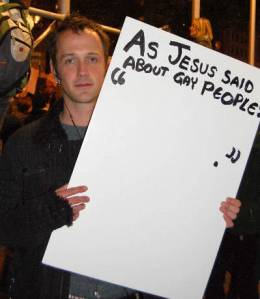
Well, true. But, in Mark 10:1-12 Jesus confirms that the archetype for marriage is one male and one female, as set forth in Genesis 2:24. Though he never made a direct condemnation of homosexuality, he did follow the Genesis teaching of marriage I set out above and that means that he would say marriage is between a man and a woman. Adam and Eve, not Adam and Steve.
The overwhelming biblical evidence is on the side of homosexuality being a sin. Only a dismal one proof text out of eight is found wanting. The person who tries to say that homosexuality is no sin has to ignore an awful lot of Scripture to arrive at that conclusion.
Now we have to consider the obvious objection: These passages are talking about lust; what about homosexual love? To which I say: love is always encouraged in both the New and Old Testaments. The Greatest Commandment is to love the Lord your God with all your heart, soul, and might, and to love your neighbor as yourself (Deut 6:5; Lev 19:18).
All references in the so-called “clobber passages” are references to the act of homosexual intercourse, not to homosexual love. Therefore, homosexual love is acceptable to, even encouraged by, God.
It is homosexual sex that is not accepted. Since it is the act of intercourse that consummates a marriage and homosexual persons can’t lawfully do that, homosexual marriage is not acceptable to God.
It requires ignoring much of the Bible’s passages and underlying assumptions to arrive at the conclusion that homosexuality is not a sin. Therefore, we conclude the act of homosexual intercourse is an abomination to God and homosexual “marriage” is not tolerated by him. The weight of the biblical evidence supports this conclusion. Love between a man and another man, or a woman and another woman, is accepted and encouraged. Leave the lust behind, like all other sins.
Total Depravity at its Finest
Proud Atheists have an interesting post about masturbation. It illustrates that people who are in open defiance of the Lord often misunderstand things to their own destruction.
Before we find out why, we need a truly Biblical perspective on masturbation. For that, let’s look at the Got Questions website’s take on masturbation here. The writers basically agree with my own perspective–masturbation is not a sin, but is often the result of sinful activities. Lustful thoughts, pornography, or anything else that leads to masturbation is what should be dealt with, not masturbation itself.
So let’s just say that masturbation is conduct unbecoming of the Christian and leave it at that. We can argue that any conduct unbecoming of a Christian is sin another time. Masturbation is best left between God and the individual.
That said, it alarms me the number of commenters in the thread who are proud of the fact that they masturbate. They are taking a private matter and making it public knowledge. And they are proud of the fact that they are doing it.
Masturbation, as outlined above, is likely the symptom of a deeper problem. It is this problem that must be dealt with, whether it be lust or pornorgraphy, or something else. Masturbation isn’t the issue that God has in view when he discusses human sexuality; it is those other things that he wants us to abstain from. If those things are dealt with, then suddenly masturbation is no longer a problem.
So if we assume that masturbation is the result of a deeper pathology, then what we have, again, is an example of a culture that has lost its fear of God. People who do not want God to define the rules of human sexuality. These are people who think that they know better than our creator what is for our own good. Masturbation is a sign of sexual sin, and these people are trumpeting from the rooftops that they are involved in it. Not only involved in it, but proud of their involvement.
Total depravity at its finest.
Christian Hypocrisy

Image via US Magazine
It is difficult for me to fathom the blatant hypocrisy that Miss USA contestant Carrie Prejean has engaged in recently.
As a sister in Christ, she has no business being in a beauty pageant to begin with, since the goal of these is to decide which of the oogle-able women is the most oogle-able (to borrow a phrase from Craig French). As I posted previously, beauty contests are nothing more than excuses for guys to stare at beautiful women, and that is specifically condemned by Jesus in Matthew 5:28. Carrie is creating a stumbling block for her brothers in Christ (condemned by Paul in Rom 14:13-23) by entering into such a beauty pageant in the first place.
But now we have another problem:
Do not let your adorning be external—the braiding of hair and the putting on of gold jewelry, or the clothing you wear—but let your adorning be the hidden person of the heart with the imperishable beauty of a gentle and quiet spirit, which in God’s sight is very precious. For this is how the holy women who hoped in God used to adorn themselves, by submitting to their own husbands, as Sarah obeyed Abraham, calling him lord. (1 Pet 3:3-6)
I desire then that in every place the men should pray, lifting holy hands without anger or quarreling; likewise also that women should adorn themselves in respectable apparel, with modesty and self-control, not with braided hair and gold or pearls or costly attire, but with what is proper for women who profess godliness—with good works. (1 Tim 2:8-9)
This call to modesty forbids what Carrie did just recently: she posed nude! I can’t believe that any self-professing Christian would think that it is okay to pose nude. Yet here we are.
The level of hypocrisy that this move demonstrates is unreal. These types of things just add more ammunition to the gun that atheists fire at us all the time: “Christians are nothing but hypocrites.” Moves like this that ignore God strengthen the atheist resolve that there is no God. “For if there was, Christians would obey him without question.” And here is a self-professed sister in Christ disobeying God openly.
Carrie, as a brother in Christ I call you to repent of your sins and to return to a more biblical lifestyle. As Paul pointed out in Romans 8:38-39, no sin is too big that it will separate you from the love of God in Christ Jesus. Repent and God will forgive you.
Moral Landscape
It seems to me that evangelical Christians are afraid of offending people. Look at the recent fiasco with Rick Warren on Larry King Live. Warren is thinking about the numbers in his church, and not the Law of God. We shepherds are not tending our flocks the way that we should, and we are doing everyone a disservice.
This is the point of a very excellent post from James White. Wake up, pastors! It is time to start preaching the gospel, and not the watered-down pop culture crap that passes for Christianity these days!


 Back Rome Again