Blog Archives
New Material Up on God is NOT Imaginary!
I announced redoing God is NOT Imaginary a long time ago, and then just sat on it. Well, I finally got back into the swing of things and have updated four proofs:
- Proof 3: Look at All Historical Gods
- Proof 4: Think About Science
- Proof 8: Think About Near Death Experiences
- Proof 28: Notice How Many Gods You Reject
Looking at my old answers to those questions, I almost cringed. I’ve certainly grown as an apologist and philosopher since I wrote those old answers. The one for proof 3, for example, was absolutely terrible. I literally proved nothing, and I certainly didn’t answer the charge put forth in the original.
My answer to proof #8 was awful as well. What I said boiled down to, “They didn’t prove anything, so neither will I! Besides, NDEs aren’t biblical, therefore I don’t have to answer for them.” Man, I was a really bad apologist for the Christian faith when I first started. I’m glad I’ve grown, and I’m glad that God has shown me that there is more to the riches of knowing him than the intellectual side of things.
I’ve also gotten better at dissecting arguments from the other side, because GII’s argument in proof 3 is totally incoherent and I didn’t notice that the first time around. And proof #8’s conclusion, “NDEs are natural occurrences, therefore there is no spiritual dimension” is just silly to even argue. I didn’t notice that, either.
Good thing I’m doing the updates! I’m going to kill the old site officially, because it is really, really, bad! I’m seriously ashamed of it.
Arguing by Twitter
It’s quite common for atheists to argue by soundbite. They just assert something in a context where it’s difficult to reply at length. That way, they win, because you (the Christian) can’t adequately defend yourself.
Bible contradictions are usually handled this way. The Skeptics Annotated Bible, for example, just points out so-called contradictions and errors without explaining why those would be errors or contradictions. A more recent example is Twitter user @BibleAlsoSays, who tweeted this:
Let’s play which is correct Judges 1:19 or Joshua 17: 17-18 ? Which is correct Psalm 53:1 or Matthew 5:22 ?
I can’t find the original. I only got it as a retweet from @godispretend. I decided to play.
Judges 1:19: “And the LORD was with Judah, and he took possession of the hill country, but he could not drive out the inhabitants of the plain because they had chariots of iron.”
Joshua 17:17-18: “Then Joshua said to the house of Joseph, to Ephraim and Manasseh, “You are a numerous people and have great power. You shall not have one allotment only, but the hill country shall be yours, for though it is a forest, you shall clear it and possess it to its farthest borders. For you shall drive out the Canaanites, though they have chariots of iron, and though they are strong.”
Joshua was talking to the tribe of Joseph in the verses in Joshua. The events of the battle in Judges described things that the tribe of Judah did. If this was a prophecy (I’m not convinced that’s what was happening here–every general, front line supervisor, head coach, etc., tells his team “You will win! You will prevail!”), it applied to the tribe of Joseph, not to Judah. Joshua was, after all, talking to Joseph and not Judah.
Easy enough. Onward.
Psalm 53:1: “The fool says in his heart, ‘There is no God.’ They are corrupt, doing abominable iniquity; there is none who does good.”
Matthew 5:22: “But I say to you that everyone who is angry with his brother will be liable to judgment; whoever insults his brother will be liable to the council; and whoever says, ‘You fool!’ will be liable to the hell of fire.”
 In other words, the Psalmist said that someone was a fool, but Jesus says this is forbidden. The Psalmist sinned! Scandalous. No one in the Old Testament did that, after all! The whole point of Psalm 53:1 is that no one obeys God; i.e. “there is none who does good.” So, if Jesus was giving a blanket prohibition on calling people fools (he wasn’t; keep reading), then the Psalmist sinned in the very song he was composing to say everyone sins, thus proving his own point quite eloquently!
But was Jesus actually giving a blanket prohibition on calling people fools? Look at the context of Jesus’ commands, he specifically says “whoever is angry with his brother,” and repeats “his brother” in the next pronouncement. Jesus is talking about relationships among believers. Many MSS read “whoever is angry with his brother without cause,” which draws some additional lines around the context of this verse. That’s a minority reading, but it appears enough to be worth a mention.
In practice, Jesus himself called many people “fools” and “foolish,” always referring to unbelievers or opponents of his ideology. Brethren, however, in Jesus’ thoughts, deserved more respect than that. Especially in personal, one-on-one exchanges. Public forums are different, which occasionally has to be explained when one Christian calls another out for bad theology (such as the recent James White vs. Ergun Caner situation).
There’s nothing wrong with calling a spade a spade, especially if it grabs the attention of your listener and forces him to see his error. J.P. Holding discusses when parody, sarcasm, or satire is appropriate to use when debating opponents right here. Verses like Matthew 5:22 are not commanding the Christian to become someone’s personal doormat.
Dave Armstrong Nails the Difference Between Denominations
In a conversation with atheist DaGoodS, Dave Armstrong hit a very important truth. DaGoodS highlighted a typical atheist talking point:
Considering one Christian group tells me “that particular Christian group” is wrong, yet “that particular Christian group” tells me the first Christian Group is wrong, and they ALL agree the Mormon Christian group is wrong. The Calvinists tell me the non-Calvinist group is wrong; the Protestants tell me the Catholic group is wrong. The Seventh-day Adventists, Lutherans, Presbyterians, Charismatics…all bickering and fighting as to who the “correct” group of Christians must be.
Every apologist who has engaged with atheists has heard this again and again. Christians have 100 million denominations, each says that the all of the others are wrong, so if you all can’t decide who’s right, how am I supposed to? Dave responds, correctly:
Yes, that is a real problem, and a major reason I am Catholic, but that is not your immediate issue. That comes later. Right now you need to even be convinced of matters that all these groups (apart from rank heretics like the Mormons who reject historic Christianity) hold in common: does God exist; Who Jesus was, etc. First things first.
But in passing, note that Catholics do not claim to be the sole true or correct group. We claim to be the fullness of Christianity, but we don’t deny for a second that other Christians possess large amounts of Christian truth as well. We’re not like the anti-Catholic Protestants who ridiculously deny that we are Christians at all.
And that’s the size of it. Unless they are heretical, all groups of Christianity, from Calvinist to Arminian, from cessationalist to charismatic, all believe in the deity of Christ, the existence of God as a Trinity, and that salvation comes by faith alone in the finished work of the Cross. I believe Dave could attest to everything that I just said.
The atheist has to start there. He has to decide if he believes in God, if Jesus is God Incarnate, and then what to do with that before he can get into doctrinal entanglements. I believe it was C.S. Lewis who urged us to keep our doctrinal entanglements private, as far out of the public view as we can.
Dave Armstrong vs. the Atheists
Dave Armstrong is a braver man than I: he attended a “secular Bible study” in his native Detroit in order to answer questions about the Christian (in Dave’s case, Roman Catholic) position on Scripture. In all, 16 atheists attended to ask Dave questions.
Dave was fortunate to get a good group. They were open to dialog. Not like the group of militant anti-Christian atheists that populate the Why Won’t God Heal Amputees discussion board. (That was a waste of my time; why did I even sign up and post at all?) The majority of Internet atheists are the militant variety who refuse to listen to any Christian response to their nonsense.
Dave had a few great insights into the atheist mindset that are worth a short discussion. First:
DagoodS asked the group (17 including myself) how many believed that miracles occur. I was the only one to raise my hand. Then he asked how many believed that miracles might possibly occur. Jon raised his hand, and possibly one other. Only one or two even allowed the bare possibility. This exactly illustrated the point I was to make.
DagoodS was saying that it is more difficult to believe an extraordinary miracle or event than to believe in one that is more commonplace. True enough as far as it goes. But I said (paraphrasing), “you don’t believe that any miracles are possible, not even this book raising itself an inch off the table, so it is pointless for you to say that it is hard to believe in a great miracle, when in fact you don’t believe in any miracles whatsoever.” No response. . . .
This being the case, for an atheist (ostensibly with an “open mind”) to examine evidence for the Resurrection of Jesus, is almost a farcical enterprise from the start (at least from a Christian perspective) because they commence the analysis with the extremely hostile presuppositions of: (1) No miracles can occur in the nature of things; (2) #1 logically follows because, of course, under fundamental atheist presuppositions, there is no God to perform any miracle; (3) The New Testament documents are fundamentally untrustworthy and historically suspect, having been written by gullible, partisan Christians; particularly because, for most facts presented therein, there is not (leaving aside archaeological evidences) written secular corroborating evidence. Read the rest of this entry
I HATE Cutesy Christian Slogans
Not that long ago, I was driving by a local church and the marquee, appallingly, told passers-by to pray for whatever they wanted, and God would provide it for them. It said this in a cutsey, easy-to-remember slogan. Ironically, I can’t remember the slogan. I had meant not only to blog about it, but to send the pastor a protest letter explaining why that was a bad slogan, and why such propaganda may draw people in for the short term but is very damaging for the long term.
The primary reason for this is simple: what is the pastor of that church going to tell someone who didn’t get what they prayed for? The congregant was “lured” into this church with the promise that God affirmatively answers all prayers, which any student of Bible and/or common sense can tell you is not the case. Any answer given by the pastor is damaging at this point.
If the pastor fesses up to the truth, which is that God will occasionally say “No,” given that God is an agent with a plan of his own that comes before the individual desires of his worshipers rather than an impersonal, wish-granting force, then it appears as though the church is using half-truths to fill pews and get tithe money for its own ends.
If the pastor says that the congregant doesn’t have enough faith in God, that raises the question of how much faith one really needs to receive effective answers to prayer. The congregant immediately concludes he doesn’t have enough faith, wonders what he can do to get more faith, and feels like a failure as a Christian. All the congregant needs to do now is pick up a copy of The God Delusion and guess what happens next.
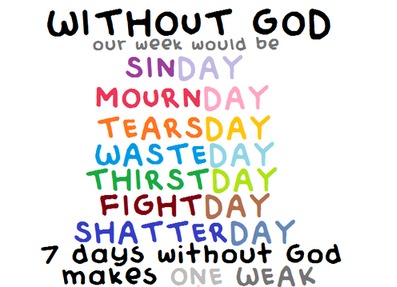 But I never got around to either the post or the letter. What reminded me is a blog post from No Forbidden Questions about a Christian meme that has been making its way around the e-mail circuit, which is pictured to the right. As with all cutesy Christian slogans, I hate this graphic. It only tells a half-truth.
NFQ says this makes it seem as though unbelievers experience these things regularly, while believers are immune to it. Or, as commenter Andrew puts it, “The grass is always browner on the other side of our beliefs.” Read the rest of this entry
Money Quote
I was reading an article from ABC News that profiled two anonymous ministers that, despite their atheism, continue in their positions as senior pastors. That really makes me mad. They are doing their congregations a great disservice, and are being major hypocrites. Atheists talk constantly about the hypocrisy of believers, but it looks as if many of them fare no better with major issues of integrity. But that’s not really the point.
The point is that there is a single money quote from Adam, one of the ministers-turned-atheist, that sums up two things very nicely. First, why he was able to wholly change his worldview so readily. And second, what is wrong with American Christianity and why it is in serious decline:
As I lost my faith … I realized that really had no bearing on who I am and my character and my actions. I live no differently than I did when I was a fervent believer.
Contrast that with the proper attitude of the believer toward his faith, summed up nicely by C.S. Lewis: “I believe in Christianity as I believe that the sun has risen: not only because I see it, but because by it I see everything else.” Adam’s problem is that he isn’t living any differently as an atheist than he did as a Christian.
The reverse is true as well. Christian converts live no differently than they did when they were unbelievers.
If the atheists are right, and there is no God, then a quick look at human history ought to be pretty disturbing. Wars, violence, greed, corruption, and horrible human rights violations permeate history like a cancer. We’ve always been violent and savage, and there’s no hope that we can change ourselves. We’ve tried and it doesn’t work.
But, if the Christian is correct, then God exists and he will recreate civilization so as all the war, violence, greed, corruption, and human rights violations are a thing of the past. That means we have hope. And, both Paul and James exhorted us to live as though we have it.
The problem is that even our ministers don’t seem to be living as if this hope is real, and the proof is this article. They readily abandon a dearly held worldview because, as Adam put it, there’s no difference in how he lives!
That’s really sad.
Nail on the Head
Guest blogging for J.P. Holding, apologist Nick Peters hit the nail on the head with a recent review of Valerie Tarico’s book Trusting Doubt: A Former Evangelical Looks at Old Beliefs in a New Light (Oracle Institute Press LLC, 2010). Peters tells us:
Towards the end, she [Tarico] seems to say that she does not believe in any deity, but the terminology is ambiguous. I see Tarico as simply wanting to have the beliefs that come naturally with a theistic worldview, such as objective morality and reliability of reason, without having that extra annoying baggage (to her) that comes with it, such as God. (source)
I happen to think that this sums up what most atheists think of theistic worldviews. There is no reason to think that free will exists, objective morality, or that our brains are even validly processing information unless you ground all of that in something. Yet, the atheist just kind of shrugs, affirms that it all works without ever giving a reason, and goes on. “It just does” is good enough for them, I guess.
They want to make the same assumptions that a God-centered worldview can make, but without the annoyance of actually submitting to God. Doesn’t work that way, guys. Sorry.
Continuing Discussion With Doug Crews
I did a podcast a while back (part 1 | part 2) where I answered some tough questions for Christians proposed by Doug Crews. My comment policy has comments closed after 30 days, since I’m trying to spend time coming up with new material and normally after that time additional comments tend to rate higher on the ignorance scale than comments left in a more timely fashion.
However, Doug’s discussion is an exception to the rule. I can’t re-open comments on that thread without reopening comments across the board, so I’m going to open this new thread.
And so, the discussion continues: Read the rest of this entry
Can Atheists be Moral Without God?
A few days back, I promised that I would discuss the answer to a question that has been raging in the atheist-theist dialogue for a long time. It stirs up controversy wherever it goes. The question: Can atheists be moral without God?
The short answer: NO, absolutely, unequivocally, not. It is impossible to be moral without God.
I had best get to the long answer before I get flamed by my atheist readership, which actually amounts to 99% (if not 100%) of my overall readership. First, I must explain an important, and oft overlooked, distinction that will bring this entire question into focus: the difference between ethics and morals.
When he was learning the art of the psychological autopsy, NCIS’s Ducky was asked by Mr. Palmer to explain the difference between ethics and morals. Ducky said something akin to “The ethical man knows he shouldn’t cheat on his wife, while the moral man would not.” In other words, ethics govern solely the behavior of an individual, where morals begin with the heart and proceed out, modifying the behavior as a result.
It is quite possible for a man to watch rape porn, read erotica featuring rape or non-consensual scenes, constantly fantasize about raping women, and even request that his consensual partners fight him, beg him to stop, and cry real tears during sex. He literally views women as objects that exist solely for his enjoyment. What holds this individual back from actually raping a woman is the threat of jail time, the looming possibility of having to register as a sex offender, and the associated shame and loss of status all of that would bring.
This person actually quite ethical. He doesn’t act on his impulses. He obeys the law. By all outward appearances, he’s a fine, upstanding citizen. But his hidden dark side poses a problem with calling him “moral.”
Ethics are solely concerned with behavior. A person can be ethical and even appear to bear the good fruit associated with the Kingdom of God, but essentially be a “whitewashed tomb full of dead man’s bones.” If you take care to wash only the parts that people can see, while continuing to live a robust life of mental evils, are you really moral?
If my neighbor, the guy with the really hot wife, the awesome job that I could never get in a million years, who paid off his house because he’s a millionaire in his twenties, and owns three fancy sports cars suddenly got divorced, fired from his awesome job, and totaled two of the three sports cars (in one day), how should I react to that?
Externally, if I offered a shoulder to cry on anytime he needed one and offered to help him financially if he needed to pay some debts or bills (no millionaire is completely without debt), and tried to help him get a job; would I still be good if in my mind I kept thinking silently, “I’m so happy! I want to see this S.O.B. fall further into despair. I’m going to nickname him ‘Job.’ May he total the other sports car, too!”
I’m thinking, “NO.”
That example is perfectly within our fallen natures. It isn’t that we can’t do good. We, in our fallen nature, can’t will good. We may do some (relative) good, but privately, we still entertain impure (or even evil) thoughts. Our behavior conforms to the good, but our minds do not.
Contrast this with a Christian, who is a Christian in both word and deed. I hate to say a “true” Christian, so let’s say a “sincere” Christian. Once his faith has been placed in Christ, a transformation occurs. He is a new creation. His inward thoughts are taken captive, to conform even those to Christ. Our carnal minds, after all, aren’t subject to God’s law (nor indeed can be).
Ethics are external. Those are what people see. However, morals work from the inside out. Instead of just doing good, we are good. That’s a far cry from simply acting ethical. Instead of not stealing thousands of dollars from the bank at which I work, the capability of that theft is no longer in my person. That, in a nutshell, is what it means to be conformed to Christ.
That, however, isn’t something that just happens the day of my altar call. It is part of sanctification, which is a life-long process where I work with God to conform both my actions and my thoughts to Christ’s example.
This is hard. But no one ever said Christianity was supposed to be easy.
Did God Dictate Morals, or Did Morals Evolve?
Custador, one of the bloggers at Unreasonable Faith, thinks he’s solved the problem of morals in a single question:
Are right and moral acts and deeds right and moral because God says that they’re right and moral, or does God say that right and moral deeds are right and moral because they are inherently right and moral? (source)
He believes the answer is hidden option number 3: “Human societal norms are evolved and God has nothing to do with it. Doesn’t that rather neatly solve the problems with options one and two?”
It doesn’t solve anything, because the objection raised is seriously misguided:
Option one (right and moral acts and deeds are right and moral because God says that they’re right and moral) logically leads to the conclusion that God could say that anything is right and moral, including (for example) genocide, child rape, slavery, cruel and unusual punishment… Would anybody ever agree that these things are right and moral? I don’t think so – and yet they’re right there in the Bible – some of them as instructions from God himself. I guess that rules out option one!
God neither commanded child rape (this has been repeatedly demonstrated to be eisegesis) or slavery (laws are in place governing it, but are also in place for murder–are you seriously arguing that because laws exist prescribing penalties for murder that God endorses it?). The protection from cruel and unusual punishment is both a Western ideal and subjective. The problem is really one of nature: nothing uncreated exists apart from God; God created everything. This includes natural laws, i.e. what is inherently good is also under God’s sovereign purview. That means that our own conceptions of goodness, rightness, or morality can’t be used to define or judge God. But that is exactly what Custador is doing in this objection.
Instead, God defines those characteristics by his very nature. Goodness, righteousness, and morality proceed from God’s character and are inviolate characteristics of God’s own nature. Evil, unrighteousness, and immorality are the darkness that try to cover the light; they are the absence of the good traits present in God.
This means that God wouldn’t command an unrighteous act. What may seem capricious or cruel to us serves a divine purpose we either aren’t privy to, or we refuse to entertain because of the darkness within us. The second option is more likely.
The darkness refuses to yield so we can clearly see that the “genocide” of the Canaanites (and others) was a righteous judgment of a sinful people, pronounced by a holy God. We know well the depths of our own depravity, and quickly realize that if held to a holy and perfect standard, we deserve nothing less than what the Canaanites got.
Common to objections raised by atheists, Custador posits a conception of God on the level of the creature: bound by time, space, and constrained by inviolate laws woven into the fabric of the universe. This is a subpar definition of God, and leaves wide open the question of who wove those laws into the fabric of the universe in the first place. If it was a force or being superior to God, then God isn’t God at all.
If you start with God, and realize that he, as the good, defines all that is good in relation to himself (rather than be defined by our faulty conception of it), then you realize that God wouldn’t order an unrighteous act and all that he commands is good and holy. But that requires stepping out in faith (read: trust, not “belief without evidence”). If you trust that God is as he reveals himself in the Bible, then this leap of faith is easy to make.
All that said, can atheists be moral without God? I’ll explain why I don’t think so tomorrow.


 Back Rome Again