Blog Archives
If Life Were Like a Game…
If real life were like Dungeons & Dragons, atheism wouldn’t be an option. Especially if you challenged a god by temple desecration and lynching followers.

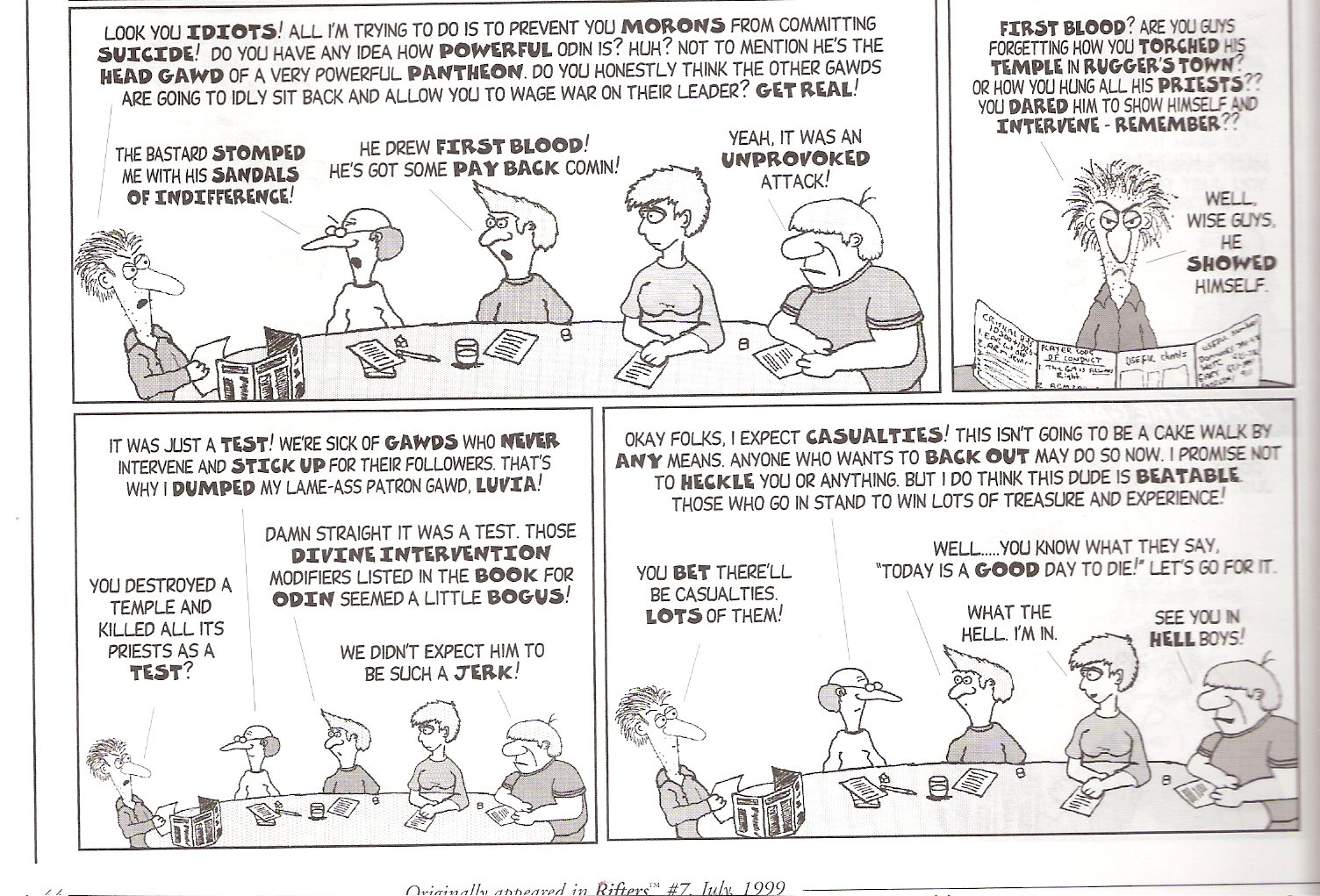
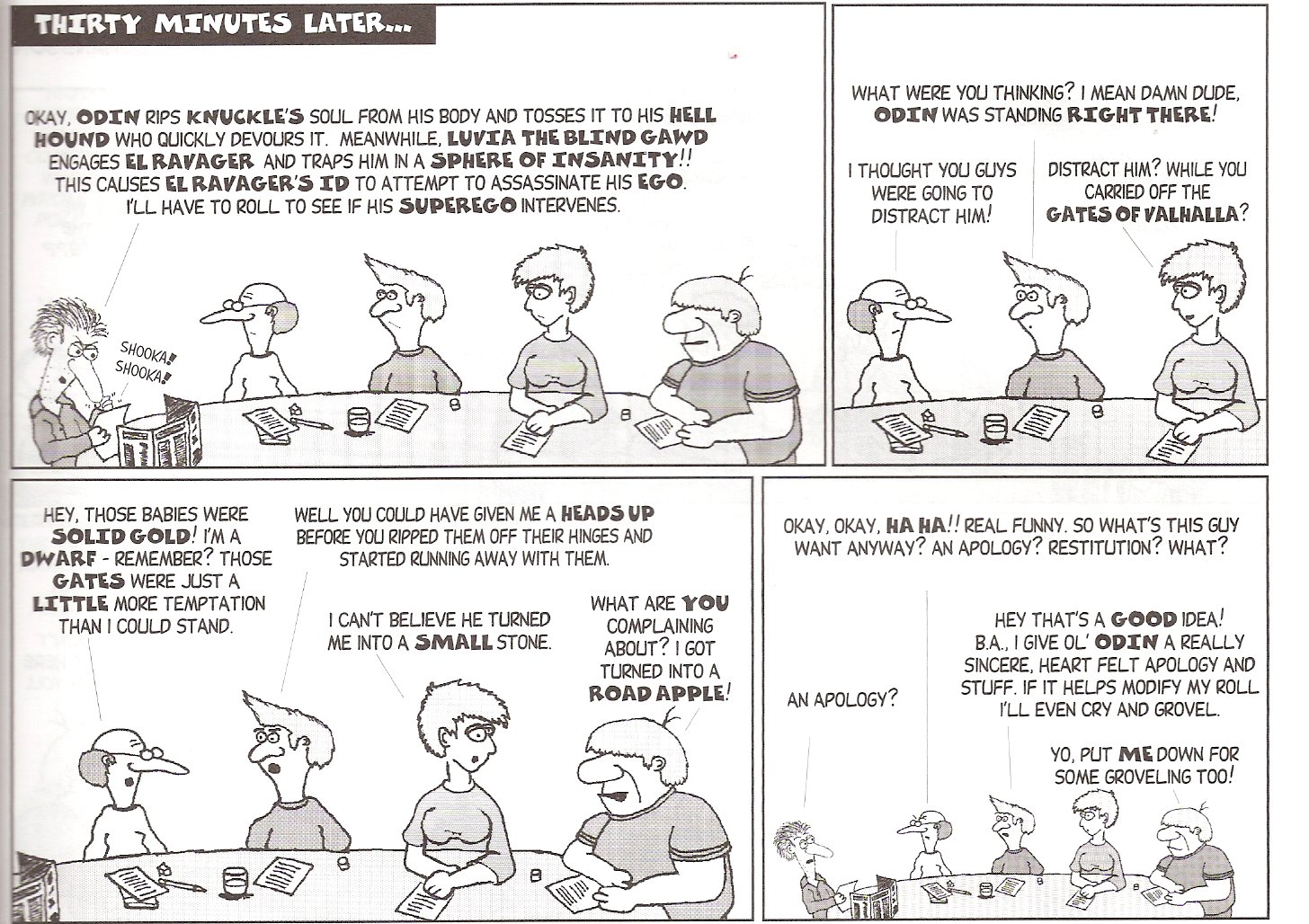
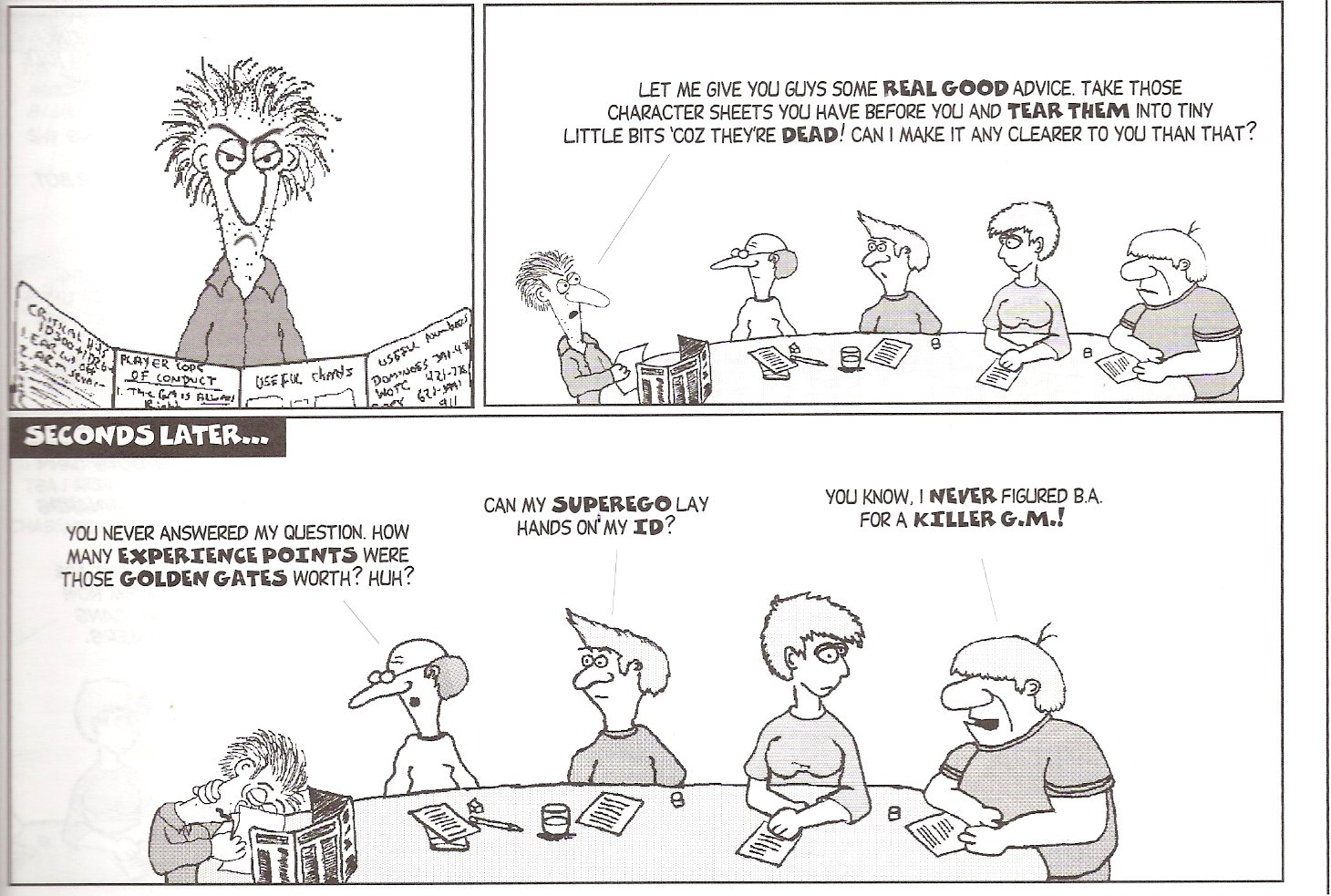
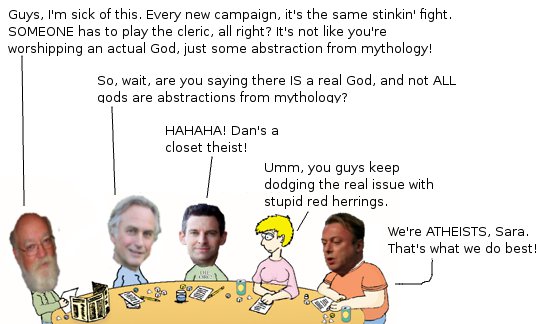
Here’s a novel idea for an awesome web comic. Replace the Knights of the Dinner Table with the Four Horsemen. I bet it would look something like this:
The Moral Bankruptcy of Atheism
Let’s try this thought experiment:
On the side of the road is a man, his wife, and a child. They are holding up a sign that reads, “We lost our home. Help would be appreciated.”
Moved by their plight, I’m compelled to help them. I pull my car over to an out-of-the way place. I exit the vehicle and approach the family.
“Hi,” I call to them.
“Hello,” the man says. His wife and daughter remain silent, though his wife offers me a tenative smile.
“I feel for your plight, sir,” I say. “I’m going to give you $20.”
“Thank you,” the man says. His wife smiles more broadly this time, and she extends a hand to thank me.
“But first,” I say, dangling a twenty dollar bill from my fingertips, “I want you to do a little something.”
The woman drops her hand to her side. The man looks at me, while the woman raises a quizzical eyebrow.
Then I propose my deal. “I have a hula hoop, clown shoes, and a colored wig in my trunk. I want you to strip all of your clothes off–totally naked–and wear nothing but the wig and clown shoes. Then, I want you to spin the hula hoop as many times as you can while chanting, ‘I can’t provide for the basic needs of my family, so I’m begging people for money instead of looking for a job!'”
Awkward silence. I dangle the twenty dollar bill even closer to the man’s face. “I don’t think so,” the man growls.
“I’ll make it $50 if you do this at the busiest mall in town,” I say.
The man just shakes his head vigorously. His wife won’t look at me anymore.
In this example, I think that we can confidently conclude that I’m an asshole who should be shot. Making the homeless jump through hoops for my own amusement is reprehensible behavior. People who engage in it deserve the label “asshole.”
Well, what have we here:
Though no one would praise my actions in the itallicized example, folks on ex-Christian.net are applauding the actions of the maker of that video. Had the asshole done what I did above in the thought experiment, they (hopefully) would have universally condemned him. Yet, when he asks the homeless person to deny God for money, that somehow is awesome.
To recap:
- Make a homeless person jump through sadistic hoops for money = immoral.
- Make a homeless person deny his Creator for money = strong commentary on religion.
Conclusion: Atheists have little moral compass, especially when it comes to making religion look bad. Anything goes. This is so disgusting that I can’t even come up with words for it.
Remember, the spirit is more important than the flesh. Denying God has spiritual consequences greater than the physical consequences of turning down $20 from a complete asshole:
If anyone else thinks he has reason for confidence in the flesh, I have more: circumcised on the eighth day, of the people of Israel, of the tribe of Benjamin, a Hebrew of Hebrews; as to the law, a Pharisee; as to zeal, a persecutor of the church; as to righteousness under the law, blameless. But whatever gain I had, I counted as loss for the sake of Christ. Indeed, I count everything as loss because of the surpassing worth of knowing Christ Jesus my Lord. For his sake I have suffered the loss of all things and count them as rubbish, in order that I may gain Christ and be found in him, not having a righteousness of my own that comes from the law, but that which comes through faith in Christ, the righteousness from God that depends on faith—that I may know him and the power of his resurrection, and may share his sufferings, becoming like him in his death, that by any means possible I may attain the resurrection from the dead. (Phil 3:4-11)
And:
Are not two sparrows sold for a penny? And not one of them will fall to the ground apart from your Father. Fear not, therefore; you are of more value than many sparrows. So everyone who acknowledges me before men, I also will acknowledge before my Father who is in heaven, but whoever denies me before men, I also will deny before my Father who is in heaven. (Mt 10:29, 31-33)
So Far, I Remain Unimpressed
There are two basic classifications of atheist. The negative atheist simply remains unconvinced that God exists. The atheist doesn’t affirm the existence of any deity, but never explicitly denies the possibility one may exist somewhere.
Most folks I argue with here fall into the category of negative (sometimes called “weak”) atheist. It is often asserted that this is the default position in life and one should remain at this point until evidence is presented to the contrary. Of course, every weak atheist I encounter is absolutely unimpressed by any evidence affirming the existence of God. Such evidence is either believed to be faulty or denied outright as having any significance to judging the existence of God.
More interesting is positive (or “strong”) atheism, which is the explicit proposition that God doesn’t exist. As weak atheists remind us constantly, the burden of proof is on the one making the positive claim. Therefore, when the theist encounters a strong atheist, the burden of proof shifts and it is up to the strong atheist to prove that God doesn’t exist.
Not surprisingly, there are few strong atheists. It’s an extremely difficult position to defend, since the strong atheist has given himself a nearly impossible burden of proof. However, I found Geoffrey Berg at my local library when browsing for another title; Berg attempts to defend strong atheism by formulating new and improved proofs that God is incompatible with logic. He published a book called The Six Ways of Atheism: New Logical Disproofs of the Existence of God. I thought it would be interesting, so I picked it up. Read the rest of this entry
Questions Christians Hope No One Will Ask, part 6
Former Christian turned atheist DaGoodS (DGS) has compiled a list of eleven questions that he doesn’t think Christians can answer. I’ve decided to take him on, since I’m a sucker for questions that Christians supposedly can’t answer. Hopefully, DGS and I can learn something from each other.
Question #6, the most foolishly misguided question, is:
If God lied, how would you know?
For some reason, atheists treat faith as a foul word that rivals the f-bomb for words that shouldn’t be used in civil conversation. This is because they are seriously misguided as to what it means.
Here are some skeptical examples representative of how they typically define the concept of faith:
- Voltaire: “Faith consists in believing when it is beyond the power of reason to believe.”
- Nietzsche: “Faith: not wanting to know what is true.”
- Henry Ward Beecher: “Faith is spiritualized imagination.”
- George Seaton: “Faith is believing in things when common sense tells you not to.”
- Even Ben Franklin had issues with faith! He said, “To Follow by faith alone is to follow blindly;” and “The way to see by Faith is to shut the Eye of Reason.”
- Mason Cooley deserves the last word here: “Ultimately, blind faith is the only kind.”
These quotes show us that the atheist believes faith is belief without evidence, or despite all the evidence. That’s not true! D. Elton Trueblood has the real definition of faith: “Faith is not belief without proof, but trust without reservation.” J.P. Holding develops the idea of faith as trust in this must-read article.
Once you realize that faith isn’t a blind step in the dark, taken for no rhyme or reason, then you can understand that the answer to this question is a matter of faith. Faith is trust placed in one who deserves that trust.
As Christians, we have faith in God, and we have faith in the Bible since the Bible is an accurate revelation of God’s character and mission. Indeed, they are one-in-the-same revelation. The Scriptures affirm that God cannot (will not?) lie (Num 23:19; Tts 1:2; Heb 6:18; 1 Jn 1:5).
Having faith in God means having faith that the inspiration of the Scriptures is accurate, and what is in the Scriptures is an accurate representation of the character of God. The Scriptures are clear that God doesn’t lie.
What this means is that there’s no need to consider how to know if God has lied or not. He’s not going to. It’s a moot point.
Questions Christians Hope No One Will Ask, Sidebar on 1 Corinthians
The first of today’s posts on DaGoodS’s (DGS) questions will come a bit later, as I wanted to examine a side issue that was raised. The discussion revolves around a specific interpretation of 1 Corinthians 1:20-21. DGS thinks it supports a rejection of all worldly wisdom. However, I believe that in its proper context, it is trying to argue something far different. Read the rest of this entry
A Question for John W. Loftus
Positively shocking. Loftus cough out a dumb argument? Unheard of.
Referring to this article, where scientists have discovered a gene that predisposes people to promiscuity, Loftus says:
While it isn’t a forgone conclusion that people with this gene will cheat on their mates, the presence of that gene makes such a temptation harder to overcome. Imagine that, some people (half of us) have a harder time overcoming such a temptation and yet God supposedly judges us all equally. That doesn’t seem fair now does it? I wonder if the incarnate Jesus gave himself that gene since he was “tempted in every way, just as we are.” (Hebrews 4:15) 😉 (source)
This argument (if you can call it that) is absurd.
This actually helps my position on homosexuality. I’ve argued that it is probably inborn, but by virtue of being inborn doesn’t automatically make it desirable. Nor should anything become socially acceptable based entirely on the fact that it is inborn.
Infidelity is a negative trait. So are addictive patterns of behavior, like alcoholoism. As is rage. So are many genetic illnesses like Alzheimer’s, certain cancers, emphysema, and heart disease. All of these things are hardwired into genetics, and no one is trying to argue for society to unconditionally accept people subject to those things on the basis of a genetic predisposition.
Things that are inborn, however, are undeniably part of the self. And what does Jesus call us to do when we become his followers? Deny ourselves (Lk 9:23).
And, turning to Paul’s writings, we see that sin itself is inborn: it is nature as well as action. Otherwise, the whole concept of the Christian becoming a new creation in Christ (2 Cor 5:17) is meaningless drivel.
Loftus cranks out lots of posts, and most of them are mindless soundbite arguments. This is the dude who complained at Victor Reppert’s blog (in the comments here) that soundbites were all that comments allowed. Yet, when faced with the unlimited canvas of a blog post, he again argues by soundbite.
Perhaps that’s all he has?
It would seem since one of the arguments that he keeps harping on is that we can’t trust our brains to make sense of the world, since we approach everything with bias and defend that which we prefer to be true.
Which leaves us with a big question for Mr. Loftus:
Why should anyone believe that you offer the truth? You also approach with bias and defend that which you prefer to be true–being that you’re a human and accuse all humans of doing this. You admit it: “I have never claimed that atheists are more rational than believers” (source).
Questions Christians Hope No One Will Ask, part 2
Former Christian turned atheist DaGoodS (DGS) has compiled a list of eleven questions that he doesn’t think Christians can answer. I’ve decided to take him on, since I’m a sucker for questions that Christians supposedly can’t answer. Hopefully, DGS and I can learn something from each other.
Question #2:
What’s your source?
DGS links to this article, and the conversation that ensued when DGS asked the blog author what his source was for Papias.
First, a little background. There is some serious contention about the authorship of the Gospels from critics of Christianity (and only critics of Christianity; neutral scholars never raise questions of this sort). They say we can’t trust the Gospels since they were authored anonymously. Leaving aside the issue of the trustworthiness of anonymous sources (it does not follow that a source is untrustworthy solely because it is authored anonymously; that is grossly untrue and totally ludicrous to even raise as an objection–a work should be judged on its own merits and not dismissed because we don’t know the authorship), are the Gospels really anonymous? Read the rest of this entry
Questions Christians Hope No One Will Ask
Through Dave Armstrong, I’ve found an ex-Christian atheist who goes by DaGoodS (I’ll call him DGS). He runs a blog discussing (naive) critiques of his former faith (don’t all ex-Christian atheists?) called Thoughts from a Sandwich.
Scanning his blog, I discovered this entry from November of last year. He has picked up a book called The Questions Christians Hope No One Will Ask. His description is apt:
The author referred to a survey where 10,000 Christians were asked, “What Questions do you find difficult to answer?” and compiled a list of the top ten; the author kindly provides Christian responses.
DGS doesn’t think that the questions in the book are very good, and I’m also guessing that he finds the answers lacking as well.
Since I’m a sucker for questions that Christians allegedly can’t answer, I thought I’d take a shot at DGS’s list. Starting today, I’ll take a poke at two questions per day, posting one first thing in the morning and one in the late afternoon.
I’m hoping we can learn something from each other. Read the rest of this entry
Two More Proofs are Up on God is NOT Imaginary!
I have rebutted two additional proofs on God is NOT Imaginary. As I referenced them in an upcoming article on questions that we Christians allegedly can’t answer, it would be rather embarrassing if I didn’t actually have them completed:
Read, digest, comment, flame, whatever. Enjoy!
Wow!
I read this post from Anthony Horvath. It is well worth the read, as he covers what atheists should understand before trying to criticize the Bible. I’ve generally found that Bible criticisms stem from a lack of understanding of one or more points that Horvath mentions. Occasionally, however, there are other points that atheists miss. Consistent hermeneutics is one; often they will find a “contradiction” by interpreting one passage one way and interpreting the contradicting passage using a completely different hermeneutic. Progressive revelation is another thing that they fail on regularly. Of the two most misinterpreted passages in the entire Bible, one can be settled by looking at the context:
For truly, I say to you, until heaven and earth pass away, not an iota, not a dot, will pass from the Law until all is accomplished. Therefore whoever relaxes one of the least of these commandments and teaches others to do the same will be called least in the kingdom of heaven, but whoever does them and teaches them will be called great in the kingdom of heaven. For I tell you, unless your righteousness exceeds that of the scribes and Pharisees, you will never enter the kingdom of heaven. (Mt 5:18-20)
Atheists frequently point to that passage as evidence that the Old Testament Law is still in effect. However, if they’d only read verse 17, they’d find something interesting: “Do not think that I have come to abolish the Law or the Prophets; I have not come to abolish them but to fulfill them.” Interesting. Jesus is saying in verse 18 that the Law won’t pass away until it’s accomplished, but he assures us in just the previous sentence that he will do that! Our critics are very careful readers. Yeah, right.
But what I think is the most amazing thing about Horvath’s article is the comment section. In the first comment, he dedicates the post to an atheist reader who doesn’t feel that he needs to read the Bible in order to criticize it. The atheist’s response is very telling:
Indeed I do not need to read the texts of Scientology, the Book of Mormon, the Bible or the ravings of David Koresh to deem them extremely unlikely to be true. Don’t make me break out the “SJ’s Flying Car” analogy…
To which Horvath replies, as I would have, that if you’re going to criticize something, then you ought to give it a read:
No, you don’t need to read them to ‘deem’ them anything. But if you’re going to open your mouth in public to knock them then you should actually know what you’re talking about, first. Why you bother trying to convince people, ie, people like me, that my position is ‘unlikely to be true’ when you don’t know jack about the particulars of the position, is beyond me. There is no way you’d be considered credible. Indeed, you aren’t.
On my shelf: The Book of Mormon, the texts of Scientology, the texts of Christian Science, the JW translation of the Bible, the Satanic Bible, the Koran… to name some that come immediately to mind. Are there things I haven’t researched as much that I have nonetheless formed a general opinion on? Of course. I am a finite creature. But you don’t hear me discoursing on those.
You might want to consider a similar philosophy.
And the atheist replies, “I prefer to have a life.”
This is just sad. I know I’ve said this somewhere before: if you’re going to critique a position, at least know what the proponents of that position are arguing. This is why I don’t critique evolution and why I stay away from church history arguments. I don’t know much about either. If that changes, I might reconsider. Indeed, I plan to immerse myself in church history (particularly early church history) this year. But until then, I’m going to stick to philosophy, which I do know something about.


 Back Rome Again