Another Facebook Meme that Should be Destroyed
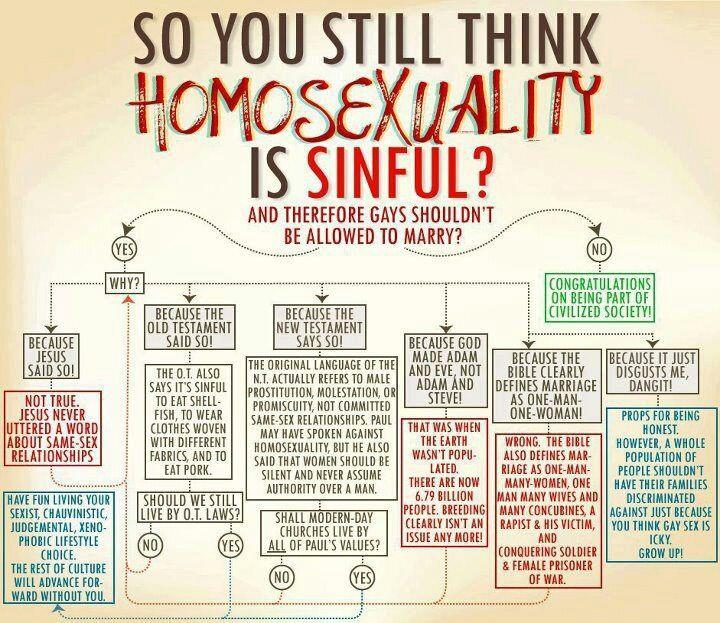
Wow. Just wow. So many things wrong with this graphic. So many problems and inconsistencies of thought. . . . So many half-truths and misrepresentations. . . .
Let’s just start left and travel right. A word of warning — this is longer than my average blog post because it covers a variety of topics related to same-sex marriage. It’s approaching 1800 words and I cut quite a bit of material out. Be warned as you travel below the fold. . . . Read the rest of this entry
How to Miss the Point: A Guide to Dimwitted Discourse
Sarah Geis from Think About These Things has an awesome post that every debater must read. It is a primer on how to argue Internet-style:
People have valued reasoned, fair disagreements and good listening skills for far too long. It is high time we dispense with those boring and outdated formalities! After all, why respect the laws of logic when you can enjoy the adventure of following your own passions? When you get the point, you can only either agree or disagree. How boring! On the other hand, when you miss the point, you open up a fallacy-filled wonderland where conversation and emotions are set free to frolic! If you wish to dispense with the authoritarian laws of logic (which care nothing about you!) and transcend the boundaries of social courtesy, then here are some suggestions for you to try on your entirely subjective journey. These primarily apply to written arguments, but can also apply to listening to a spoken argument.
My personal favorite:
12. Remember that no one has the right to criticize things you like.
Decide right now that all criticisms of anything you like are immediately invalid. After all, we know that things and people that we like are perfect.
Thanks for a wonderful post, Sarah! Keep up the good work.
Quick Post: Ignorant Meme
Most memes that float around are plain ignorant, and thus are fairly easy to decimate. And this one is no different:
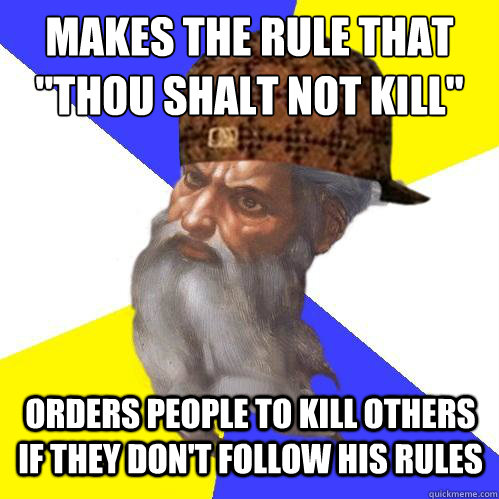
The first thing that we have to understand about God is that he is all three branches of our American government combined — he’s the original theocracy. He is, in fact, referred to by titles that reflect that:
- Lawgiver — Isaiah 33:22, James 4:12 [Congress]
- King of kings — 1 Timothy 6:15, Revelation 17:14 and 19:16 [President]
- Judge — Genesis 18:25, Psalm 7:11, 2 Timothy 4:8 [Courts]
When God enacts a law as Lawgiver, he has the right to be both Judge and Executioner when enforcing said law. God, like the State, can impose the death penalty for people who transgress the law.
The commandment referenced refers to cold-blooded murder. Acts like self-defense or capital punishment imposed by the State are not in view and are not forbidden. So God is not transgressing his own law by imposing the death penalty on a guilty party. God isn’t murdering anyone, he is acting as Judge and Executioner.
So we are done here. Next meme I crush is that lovely FB floater that asks if you still oppose gay marriage, and through a series of poorly-reasoned, badly-exegeted biblical examples shows you’re some kind of bigot. It actually shows anything but that, as we shall soon see.
Why No Archelogical Evidence of the Exodus?
It is a common charge from critics that the Exodus left no archeological evidence behind. The Christian answer, as “convenient” as it sounds to those critics, is pretty true if you actually put on your thinking cap for a moment.
In the words of Charlie Campbell:
Another objection critics raise regarding the Exodus concerns the lack of any Egyptian records mentioning the Israelite’s departure from the land. But a lack of records should not concern us. It is reasonable to believe that the Egyptians had some written record of the Exodus but as British Egyptologist Kenneth A. Kitchen says, voluminous papyrus archives once stored in Egypt have vanished:
In the sopping wet mud of the Delta, no papyrus ever survives (whether it mentions fleeing Hebrews or not)…In other words, as the official thirteenth-century archives from the East Delta centers are 100 percent lost, we cannot expect to find mentions in them of the Hebrews or anybody else. [1]
“Well,” the skeptic says, “perhaps no written record survives on papyrus, but surely there should be something in a wall relief that mentions the Exodus.”
I disagree. As Jeffery Sheler, U. S. News & World Report religion writer, says:
Official records and inscriptions in the ancient Near East often were written to impress gods and potential enemies, it would be quite surprising to find an account of the destruction of pharaoh’s army immortalized on the walls of an Egyptian temple…Indeed, the absence of direct material evidence of an Israelite sojourn in Egypt is not as surprising, or as damaging to the Bible’s credibility, as it first might seem. [2]
“Okay,” the skeptic reasons, “perhaps there wouldn’t be a wall relief telling the story of the Exodus, but surely the Israelites would have left behind some pottery in the Sinai desert during their sojourn from Egypt to Canaan.”
When it comes to archaeological evidence for the Exodus (such as pottery), it is important to remember that the Israelites lived as nomads during their time in the wilderness. Nomads living in a desert like environment, where every utensil and tool is of great value, leave few traces in the archaeological record. The Israelite’s temporary tent encampments from 3000 years ago would not have left much behind in the swirling sands of the desert.
Former Yale professor Millar Burrows agrees: “It is hardly reasonable, in fact, to expect archeological evidence of their sojourn anywhere. We cannot expect much help from archeology in tracing the route of a people’s migration through the desert.”[3] (source)
See this article for more detail. We wouldn’t expect much archelogical evidence to survive. Really, nomadic people leave very little behind. Check JP’s comparison to the Scythians in the article for information on that.
Notes:
- K. A. Kitchen, On the Reliability of the Old Testament, 466. Italics in original.
- Jeffery Sheler, Is The Bible True? 78.
- Millar Burrows, What Mean These Stones? 63.
Bittersweet. I always have a great deal of fun at the Avalanche Youth Ministry co-op, so I hate to see it end. But, we’ll be back in September and that means more fun and more reaching youth for Christ!
Congratulations to the Green Team for winning the gaudy trophy!!!!!!
Atheism and the Burden of Proof
One of the most frequent statements I hear when I talk about God with atheists is that there is “no evidence” that God exists, and that is usually followed by telling me that the burden of proof is on me, the theist, because I’m the one making the positive assertion.
However, an actual atheist, as I covered yesterday, is making a positive assertion — he is positively asserting there is no God. This is framed negatively, but he isn’t withholding judgement on my assertion. He declares it false.
Withholding judgement is agnosticism — not knowing. In which case, I’m obliged to prove my case (or at least make a reasonable argument for it) for the benefit of the undecided person.
But the atheist has gone beyond withholding judgement. He’s made one of his own, and for that he owes an explanation.
Think this through:
If I say, “God exists!” Aside from, “Praise Jesus, I know he does!” there are two potential replies. (Actually, there are more, but let’s just stick with these two for simplicity sake.)
Someone might respond, “I’m not convinced.”
This is your agnostic. I should lay out my case for him. If he remains unconvinced, we can discuss the particulars. He has no specific position, so he owes me no explanation beyond what my argument lacks.
The other potential reply is: “Poppycock! There is no god, you silly Christian. Science disproves him. Besides, there was never any evidence anyway.”
This is your atheist. It is totally disingenuous for the atheist to think I’m the only one with a burden of proof here. I will still lay out my case, however he needs to both rebut my case and lay out his own — merely rebutting my case doesn’t prove anything other than I have a poor case. It only moves us to agnosticism, being unconvinced. The atheist isn’t “withholding judgement”: he’s convinced that I’m wrong. For that, he owes me an argument.
One needs nothing beyond “insufficient evidence” to withhold judgement, but the moment rejection enters the picture, a judgement has been made and a logical argument for why must be presented. Saying “I lack belief in all gods” is a total cop-out and very lazy debating.
UPDATES:
- 8/13/12 at 1:40am EDT because there were a lot of typos. I’m ashamed of that. 1-2 is fine with me because I’m not perfect, but there were probably 4-5!
- 8/19/12 at 12:41am: Another perspective from Steve Wilkinson here.
Defining “Atheism”
A comment, though marked as spam, poses an interesting problem nonetheless:
Some of the ambiguity and controversy involved in defining atheism arises from difficulty in reaching a consensus for the definitions of words like deity and god. The plurality of wildly different conceptions of god and deities leads to differing ideas regarding atheism’s applicability. The ancient Romans accused Christians of being atheists for not worshiping the pagan deities. Gradually, this view fell into disfavor as theism came to be understood as encompassing belief in any divinity.
I had always meant to do a post on the difference, as I see it, between atheism and agnosticism. This seems like as good a time as any.
First, does it matter that there are a plurality of conceptions of God? And I would have to say, for all practical purposes, the answer is no. Atheism, as I will show, isn’t a point of view (as supernaturalism is).
Supernatural is outside of nature. Nature is your context: the container in which you find yourself. Therefore, that which originates in this universe is natural to us. However, that which originates outside the universe is supernatural.
Flip it, and that makes us supernatural to God, since we don’t reside on the same plane of existence.
Atheism is making a claim about how things are ordered, regardless of your particular perspective.
But who (or what) is God, then? True, there have been a plurality of conceptions of God. Accepting one over another doesn’t make all of those who reject your particular deity atheists. Infidels, yes. Atheists, no.
Think of it like this: in an election, I have several candidates to choose from. The front runners are Mitt Romney and Barack Obama. Or I can simply abstain and not vote. The gray area is this: If I vote for Obama, does that mean I think Romney is unfit for the job?
Well, not necessarily.
There’s no meaningful way to vote against Romney without voting for Obama. So if I want to afford Obama the chance to see his economic plan through but think that Romney would do an adequate job if elected, then I’m not anti-Romney per se.
On the other hand, I may think that Romney and Obama are equally wretched as leaders and statesmen, but vote for Obama because he’s currently more experienced.
Bottom line: a vote for one is not necessarily a vote against the other.
Which is an accurate description of agnosticism. Agnostic literally means “without knowledge.” Agnostics really don’t know whether there is a god, but they remain open to finding out. While they don’t see adequate evidence for God, they find no reasons to deny the possibility of God’s existence. They don’t know.
Finally, the burning question: what is atheism? Atheism is the rejection of all God-belief. In our election example, these guys are staying home from the ballot because the actively reject both candidates.
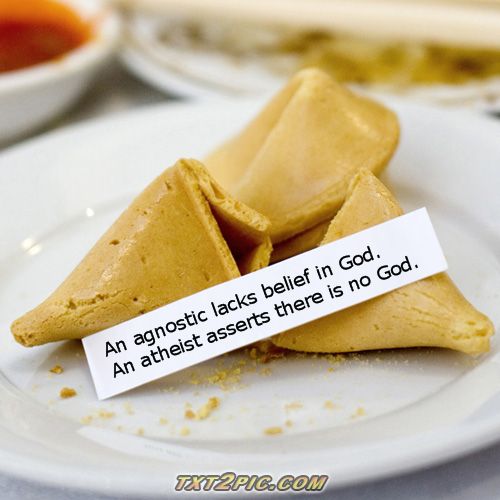 It is not simply “lacking belief in God.” Lacking indicates they could be persuaded with the right evidence. Nothing sways most atheists. Read these comments if you don’t believe me.
Atheism is a rejection of the divine, no matter one’s conception of it. It matters not whether that divine is supernatural (as monotheism posits), or within nature (as paganism posits), or in ourselves waiting to be unleashed (as New Age theology posits). Atheism rejects it all in one fell swoop.
Tomorrow, atheism and the burden of proof. That should both be interesting, and infuriating to my atheist readers. Because, spoiler alert, you guys have a burden of proof!
Why I’m Not Roman Catholic (Redux)
A user at the CARM forums linked to the original version of this post. While I’m happy for the traffic surge that produced, I disagree with a substantial portion of the post and I only addressed that in the comments. So I should correct any misconceptions the original post might produce about my theology, since I’ve come to a much different conclusion about Roman Catholicism in recent months of study.
In fact, I flirted with becoming a Catholic again, chronicling my thought process here:
- The Temptation to Become Catholic Again
- The Centrality of the Church
- The Perpetual Virginity of Mary
The temptation centered around a major problem I have with Protestantism: disagreement and in-fighting. Against classical Reformation theology, I reject sola scriptura and perspicuity of Scripture. I also embrace a high church concept — though that isn’t against Protestant theology, it flies against sola scriptura and makes waves with the world.
So it was tempting to become Catholic. It really wouldn’t be that big of a step, I thought.
But it turns out it is, for I can’t get on board with the Marian dogmas, veneration of saints, and universal primacy of the Pope (including papal infallibility). As I detail in #3 above, the Perpetual Virginity of Mary is largely unsupported and is poorly argued — but is earlier than other dogmas which means it’s one of the best developed.
I’ve found recently in two snippets from the news and the book Justification by Hans Kung that the Roman view of justification is essentially the same as the Reformed view. I admit that I haven’t read Justification carefully enough, but I’m assured that that is the conclusion of the book. Man is justified before God solely on the basis of grace through faith, plus nothing. That is the Reformed view as well as the Catholic view.
However, Catholicism differs from the Reformed view of grace significantly. Grace is dispensed through the sacraments in Catholicism. In the Reformed view, it is God’s discretion upon whom grace is given; in other words, it is a free gift and not of works (Eph 2:8-10). Since grace is unmerited favor, it makes no sense to work for it. Ever. God bestows grace upon whom he will (see Rom 9).
Worshiping anyone or anything other than God is idolatry; Scripture makes that clear (see, for example, this post from TurretinFan). Therefore, I see no justification for the veneration of saints, angels, or the Virgin Mary.
The rubber justification is that latria is paid to God, while dulia is offered to the saints and Mary. Latria is pure worship, while dulia is more like a deep reverence. This is a distinction without a difference. One should err on the side of caution, especially in light of the first commandment’s harsh penalty proscriptions for idolatry.
Consider the severe punishments that God pronounces on the entire nation of Israel for her disobedience and idolatry. Consider the judgments of the pagan nations in the Promised Land due to their idolatry. This is something that God takes very seriously. So should we!
Finally, papal infallibility seems to make Roman Catholicism into a cult. The power of the pope to define doctrine ex cathedra, thus binding all Roman Catholics to that teaching for all time, is too much power to vest in one man. This sort of behavior is seen in all of your finer cults — the power hungry, unquestioned leader. What Velma once referred to as “the Papa Smurf figure” in the first Scooby Doo movie.
Let’s be clear. I do not think Roman Catholicism is a cult. I know that the Popes have all been very careful and reverent about their use of papal infallibility. They ask the Cardinals for opinions. And, since the authority of papal infallibility has been recognized almost 200 years ago, it has only been used twice.
Cults, by contrast, use this unquestionable leader mentality to their advantage.
We don’t see that here.
Also, I have come to respect the Catholic position of natural law and many of the arguments from Sacred Tradition. Catholicism, I find, is closer to the Bible than 99% of modern Protestantism. It deserves not the contempt of our brethren, but respect.
And, of course, I’d be remiss if I didn’t mention excellent Catholic writers like Dave Armstrong (who I was really wrong about — Sorry, Dave!) and Jennifer Fulwiler. And don’t forget one of my favorite Catholic bloggers (and fellow geek) Jimmy Akin.
I’m not a Protestant out of mere preference, as many are. I understand the theological issues that divide us. One day, I pray we are one body as Christ prayed in the garden. But for now, there are many issues to be settled and I caution those who are Catholic out of preference or Protestant out of preference to study those issues and find out what you really believe.
I think I laughed quicker than the Thinking Theist did when I attempted to read The God Delusion years ago. This argument fails on many levels — the main one being that when one infers an explanation, it is NOT necessary to explain the explanation. We need only defend it as the best explanation.

The ultimate Boeing 747 gambit is the central argument of Richard Dawkins’s book “The God Delusion.” I will be going through the premises he lays out and see if they stand up to scrutiny.
- One of the greatest challenges to the human intellect, over the centuries, has been to explain how the complex, improbable appearance of design in the universe arises.
I agree.
2. The natural temptation is to attribute the appearance of design to actual design itself. In the case of a man-made artefact such as a watch, the designer really was an intelligent engineer. It is tempting to apply the same logic to an eye or a wing, a spider or a person.
I agree.
3.The temptation is a false one, because the designer hypothesis immediately raises the larger problem of who designed the designer. The whole problem we started out with was the problem of explaining…
View original post 402 more words
The Indictment Among the Rhetoric
Yesterday, I spoke of the Blog for WWGHA totally messing up Christian doctrine. Mere rabbit trails compared to what the author really wants us to answer for him.
Thomas is asking for a theodicy that makes sense of the events of the last few years:
How can anyone love a “God” who allows hundreds of thousands of people to die in a tsunami, or dozens of people to get shot innocently in a movie theater? What parent would allow you siblings to die while they looked on laughing.
Semantically, Thomas is actually asking for a personal reason Christians can love a God that passively allows tragedy to occur. But I’m going to interpret him charitably here, assuming Thomas is asking for a theodicy: a logically argued resolution to the problem of evil in a world run by an omnipotent, omniscient God who could end evil but doesn’t.
Infinite wisdom, as the author of the target piece argues, isn’t really all that satisfying. Neither is the related “mystery” of God.
I’ve never really been that big a fan of the “free will defense,” since the Bible shows God quashing free will. However, the instances of God upholding free will vastly outnumber the instances of him preventing sin. So I think that free will, while not the answer, is a component of the bigger picture.
Greater good isn’t all that great by itself. Strobel’s Case for Faith has a great analogy about a bear trap. Suppose a bear is caught in a trap and you decide to free it. You can’t possibly do so without causing the animal more pain than he’s in, and there’s no possible way to explain to the animal that his increased pain will actually lead to total freedom. And so he’ll lash out at you while you try to free him in a misplaced effort to defend himself.
We lash out at God for people dying in tsunamis and for innocents getting shot in a movie theater. But what if all this is just part of the ultimate plan designed to free us from this bear trap? What if the pains we see and the suffering we endure are really leading up to the day when none of this pain and strife will be necessary? When the metaphorical hunter finally releases our leg and we can scamper pain-free into the woods?
I don’t think it’s the whole picture, but I think that the greater good defense has some merit to it.
This means I see merit to both free will and the greater good. And I think a synthesis of the two is the answer to all questions related to theodicy. Which leads me toward something I might call the Education Defense for Evil — it is necessary to have evil in this world to reveal God’s full character (wrath, love, and mercy), bring full glory to God at the culmination of history, and to reveal our own nature.
Evil serves a purpose (greater good) without being God’s purpose (free will).
I confess that while I’ve thought about this for a while now, I have little in the way of previous theodicy by any great thinker to back it up. The idea needs more development, but it is something I foresee I will be writing and researching more in the future. This seemed as good a time as any to introduce it, since I could scarcely criticize Thomas from WWGHA in the previous post without actually answering the one conundrum that was worthwhile.


 Back Rome Again