Mega-Facepalm!

Sometimes, some things are so stupid that I don’t think they really warrant a serious reply.  Case-in-point:

Then I remember the horrid truth.  Most people have so little discernment that stuff like this would actually convince them that the critics of religion have made some kind of point.

Does that crucifix qualify as making a god out of cast metal?

In one sense, yes.  Jesus is God, and the maker of the crucifix has manufactured an image of Jesus out of cast metal.  Therefore, he has sinned.  But does that feel right to you?

The passage forbids us from making a god out of cast metal.  The real Jesus, of course, is cut from the same cloth as the Father and as the Spirit.  He’s not made of cast metal, but this crucifix is a symbol designed to remind us of the Savior.

So, what this passage is actually forbidding, for example, would be me designing an elaborate Staunton-style chess king out of brass with some custom engraving and decorations.  Then naming it George.  Then worshiping George as an all-powerful God of Chess, who has endowed me with both the interest and the acumen to play the game of kings.

Get it?

This passage is forbidding inventing a god out of workable materials.  God isn’t a being you manufacture from earthly things, he is one that you seek through heavenly things.  God is to be sought, not invented.

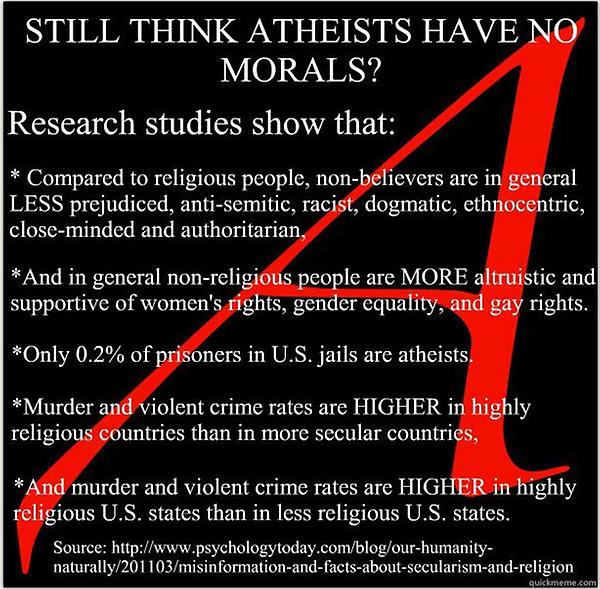
Surprise: Atheists Don’t Lack Morals!

Did I say atheists have no morals? I don’t THINK I said that…

Atheists really like to fight against us ignorant theists who say they have no morals.  We’re the backwards hicks who take instruction from a book written by ignorant goat-herders who believed the earth was flat and that the sky was a dome that contained the sun, moon, and stars (all of which circled the earth!).  What do we know about morality?

Atheists are so enlightened that they’ve thrown off the shackles of God-belief and are doing the right things because they’re the right things, not because some ancient patriarch shakes his finger at you from 1,000 years ago and says, “Do it or I’ll spank you!”

So of course they don’t lack morals!  In fact, they’re more moral than religious people — the vague statistics quoted above don’t lie!

Sensing the sarcasm yet?

I hope so.  Because I don’t know how to lay it on thicker than what I just did.

Atheists are not immoral.  They are amoral.

Difference?

Immoral means acting contrary to established morality.  It is a question of ethics, not ontology or epistemology.

Amoral means lacking morals.  It is a question either of ontology or epistemology, not ethics.

Morality represents the essence of good behavior.  Ethics represent the execution of good behavior — in other words, the pudding that the proof is in.

In Plato’s dialogues, Socrates asks the good priest Euthyphro what piety is.  Euthyphro comes up with several examples, which Socrates says were good but that only covers pious acts.  Socrates wants to know what piety is.

By giving him extensive examples, Euthyphro wasn’t actually answering Socrates’ question.

The above graphic does the same thing — it only shows that atheists behave more ethically than religious people.  But why do they do that?

They can’t tell you — there is no ground for morality given atheistic naturalism.  That’s where the difficulty starts.  Ethics can change; sometimes dramatically.

It was once legal to bet on (or against) your own team in professional sports.  Professional sports also allowed the use of steroids or other performance-enhancing drugs without batting an eyelash.  Now, both practices are deemed cheating in most professional sports.

What we need is something to ground our ethics in; something immutable that we can return to to see what goodness looks like.  That way, when we find something new, we can create a code of ethics for it patterned after that which gave us the example of good ethics in the first place.

If morality is an immovable anchor and ethics are a boat on the rough, unforgiving seas of our culture, the boat is free to move about within the radius of the anchor.  It might go adrift, it might even do something unacceptable, but it will remain in the range of the anchor.  Conversely, without the anchor, the ship is free to be tossed around the sea of possibilities, moving unflinchingly into uncharted, dangerous waters with nothing to bring it back to safety.

The nature of God is that immutable ground of ethical behavior for the theist.  The atheist has none.  We are the boat that will return to safe waters, they are the one that will be tossed out to sea without a guide.

I have no problem with considering atheists ethical; the above examples show they are.  However, they have no ultimate ground for the morality that informs their ethics and that means they will go seriously adrift.

Tim Keller on Apologetics

I’ve heard plenty of Christians try to answer the why question by going back to the what. ‘You have to believe because Jesus is the Son of God.’ But that’s answering the why with more what. Increasingly we live in a time in which you can’t avoid the why question. Just giving the what (for example, a vivid gospel presentation) worked in the days when the cultural institutions created an environment in which Christianity just felt true or at least honorable. But in a post-Christendom society, in the marketplace of ideas, you have to explain why this is true, or people will just dismiss it.

— Tim Keller

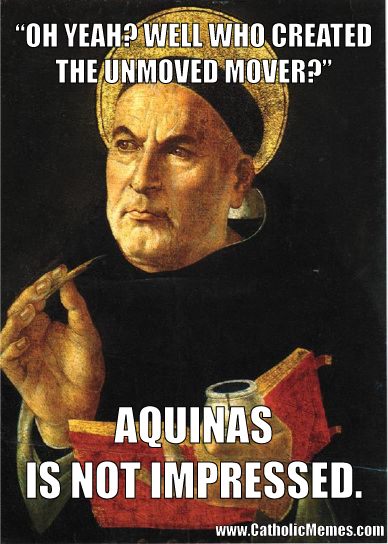
New “Who Created God?” Meme

I shall use this literally every time I get the retort, “Well who created God??”

Despite the fact it has been refuted repeatedly, I still get it quite a lot.

The Six Ways of Atheism: Way the Sixth

The final Way of Atheism from Geoffrey Berg is the Some of God’s Defining Qualities Cannot Exist argument.  After tackling this argument, three things remain with this project.

First, I will contact Geoffrey Berg via his website to see if he is interested in rebutting my points.

Second, I want to reread the Fifth Way just to see if there are any points I missed.

Finally, I will start replying to the comments I’ve received thus far on all Six Ways.

All right, Mr. Berg, so far the arguments are stinkers.  One final shot: impress me…

  1. God must have certain characteristic qualities (such as providing purpose to life), otherwise he would not be God.
  2. But it is impossible for any entity to possess some of these qualities (such as providing purpose for life since we can find no real purpose and therefore in practice we have no ultimate purpose to our lives) that are essential to God.
  3. Therefore since some of God’s essential qualities (such as being the purpose provider to life) cannot possibly exist in any entity, God cannot exist.

I agree with (1).

Ooooh… I have to take some exception with (2).

On pages 156-157, Berg outlines that there is no purpose to life based on the fact that he’s never gotten a good answer from a theist.  That’s a terrible reason to conclude that there is no purpose for life.

The answer, I think, lies in two prongs.  First, we exist because God has purposed an outcome to this universe and we are to play a role in it.  As Isaiah points out, God has declared the end from the beginning (Is 46:10).  Human history is building to a final outcome purposed by and brought about by God.  We are agents of that by God’s design.

We do not know what ultimate part we play, and that leads us to the second reason we exist:  the journey of discovery that is life.  This journey becomes the foundation for our eternity.  If life on earth is a geometric plane, then life in eternity is geometric space.  If our life takes the shape of a circle, then in eternity it will inevitably be a sphere.

Which means that we need to take the time to investigate what it means to live a “good life.”  Because the foundation we are laying now determines the shape of our lives to come.  The foundation is irreversible; we want to lay the best one we can, and that means living right by God’s standards.

As Berg says, “to worship God” isn’t a very good reason to exist.  It is part of what we are to do, but it isn’t the end of the story.  God created the first humans to tend the Garden of Eden — to superintend and care for creation.  We perverted our own purpose when we first chose to disobey God, but the corruption of a thing shouldn’t be confused with the thing.  Meaning, we should recapture our original purpose by realizing that life is (as Berg points out) about the journey as much as the destination.

And, keeping with the superintendence idea, leave the Earth a little better than we found it.

None of this, of course, is possible apart from God.  And that renders premise (2) faulty.  Meaning (3) is not a correct conclusion.

Now, essentially, I’ve left the purpose of life open for each individual to find his or her own.  In so doing, I have actually made an objection that Berg anticipates; though he phrases it quite differently.  His basic answer to reassert that there is no ultimate purpose for life, even if you’re searching.  Berg gives the general objection that each purpose one finds leads one to ask what the purpose of that purpose is.

To that, I remind everyone that there is no need to explain an explanation.  If we would have concluded that the purpose of life is to have kids, then that’s the purpose of life.  Asking, “Why have kids?” is redundant because it’s the purpose of life.

Showing that the purpose of this life is to lay a foundation for an eternal existence, however, does not fall prey to the infinite regress of asking “For what purpose?”  If I’m right, there is no need to ask for additional clarification because starting eternity off right is an end in and of itself.

UPDATED

  • September 25, 2012 @ 10:45pm: Added the proper citation from Isaiah.

The Six Ways of Atheism: Way the Fifth

This might be my favorite argument in Geoffrey Berg’s book, The Six Ways of Atheism.  My favorite, because of how ridiculous it is.

It appears that Berg and I agree on that, for he opens the chapter:

This is my favourite argument against the existence of God and I believe it is a decisive and absolute disproof against the existence of God. (97)

The advance press does not pan out.  This proof is not decisive and can actually be refuted in a single paragraph.  First, the argument:

  1. An uncertain God is a contradiction in terms.
  2. Everything in the universe must be fundamentally uncertain about its own relationship to the universe as a whole because there is no way of attaining such certainty.
  3. Therefore even an entity with all God’s other qualities cannot have the final quality of certain knowledge concerning its own relationship to the universe as a whole.
  4. Therefore God cannot exist because even any potential God cannot know for sure that it is God.

Can you ever REALLY know your relationship to the universe? As a constituent of it, no. But what if YOU created it? You’d be pretty certain, I imagine!

God created the universe.  A creator always knows the relationship it has to its own creation.  Therefore, God may possess a certainty that none of us have since God created the thing about which we are uncertain.

Refuted. Read the rest of this entry

The Six Ways of Atheism: Way the Fourth

The Fourth Way of Atheism (This is Not the Best Possible World Argument) runs thus:

  1. God if he exists must be omnipotent, supremely good, and our ultimate creator.
  2. Therefore an existent God (being supremely good and competent) would have created the best possible world.
  3. As the world is inconsistent (between ages and people) it cannot all be the best possible world.
  4. Therefore as the world is not the best possible world, God cannot exist.

This would be true if not for one pesky little detail that Berg never addresses.  Let’s trace this argument from premise (1) to its conclusion to see where it goes awry.

I absolutely agree with (1).  No doubt that a being who wasn’t omnipotent, supremely good, and our ultimate creator would not be God in any sense of the term.

I agree with (2) in the sense that God did create the best possible world.  See Genesis 1:31 — creation is described as “very good” from God’s perspective.  It is doubtful that an omnipotent, perfectly good being would describe anything but the best possible world as “very good.”

(3) is true, but it skips a step — the Fall!

The man said, “The woman whom you gave to be with me, she gave me fruit of the tree, and I ate.” Then the Lord God said to the woman, “What is this that you have done?” The woman said, “The serpent deceived me, and I ate.” (Gen 3:12-13, emphasis added)

After dealing with the serpent and Eve, God turns to Adam:

Because you have listened to the voice of your wife and have eaten of the tree of which I commanded you, ‘You shall not eat of it,’ cursed is the ground because of you; in pain you shall eat of it all the days of your life; thorns and thistles it shall bring forth for you; and you shall eat the plants of the field.  By the sweat of your face you shall eat bread, till you return to the ground, for out of it you were taken; for you are dust, and to dust you shall return.” (Gen 3:17-19, emphasis added)

So now the world we see today is a punishment because of the transgression of Adam.  So this is not the best possible world; it was, now it is cursed because of the actions of humanity in defiance to God.

Once we understand that God created the best possible world, but cursed it to punish humanity, we realize that this argument doesn’t hold water.

All of the anticipated objections that Berg deals with are softball responses and so require no comment from me.  My objection, as always, is not anticipated.

The Six Ways of Atheism: Way the Third

Next from Geoffrey Berg’s Six Ways of Atheism we have the God Has No Explanatory Value Argument:

  1. God if he exists must be the ultimate being and provide the answers to all of our ultimate questions — otherwise he is not God.
  2. Yet even supposing as a hypothesis that God exists the questions that God was supposed to finally answer still remain (though in some cases God is substituted in the question for the Universe).
  3. Therefore hypothesizing is only unnecessarily adding an extra stage to such problems and has no real explanatory value.
  4. Therefore according to Logic (Occam’s Razor Law — ‘that entities are not to be multiplied beyond necessity’) we should not postulate God’s existence and there is no adequate reason to suppose that God exists.
  5. Therefore we should suppose that God does not exist.

Starting with (1), I agree that God should provide the answers to all of the ultimate questions.  When explaining the argument, however, Berg lists attributes of God (eternal, absolute good, purpose-giver) rather than explaining what big questions he means.  He only ends up asking one: How did the universe arise?

… [T]he answer for theists is, of course, God created it.  How did God arise?  Well, God has always existed.  But, why then, has the Universe not always existed?  Thus God can be cut out as an unnecessary extra.  Poor God, always being cut out as an unnecessary extra that contributes nothing to understanding except complication.  God is no more than a valueless extra intermediary stage in explanation.  (p. 64)

This didn’t work for Richard Dawkins in The God Delusion, and it isn’t going to work for Berg now.  “Who made God?” is not a valid retort. Read the rest of this entry

The Six Ways of Atheism: Way the Second

Geoffrey Berg’s second argument states that since God is so far outside the realm of human experience and comprehension, that he is simply unknowable.  Therefore, you shouldn’t believe in him.

This Man and God Comprehension Gulf Argument is formulated as follows:

  1. Man is finite (in time, space and power etc).
  2. God if he exists in infinite (in time, space  and power etc).
  3. Therefore mankind cannot possibly recognize God or even know that God exists.

I have no issues with either premises.  Man is finite per (1), and God is infinite per (2).  Neither is a problem for me.

As a conclusion, (3) overreaches; Berg should have stuck with the first clause: “Therefore mankind cannot possibly recognize God … .”  That would have been a far more reasonable conclusion given the data.  Still a demonstrably false conclusion, but a much more reasonable one.

As for “… even know that God exists,” that is simply not true.  God is the inference to the best explanation: we see design, order, natural laws — the universe makes sense.  It works together like a machine, and machines are designed and built by an intelligent mind for a purpose.

Therefore, God is a reasonable conclusion from natural philosophy (even if a controversial one).  So I disagree that mankind cannot “… even know that God exists.” Read the rest of this entry

Questionable Biblical Interpretations: Prv 22:6 & Mt 28:10

I should be in bed, but …

In my Twitter feed, I found a disagreement among a few Twitter users.  One Christian was getting pummeled by a group of atheists.  Julie Ann (@__iplay4god) would try to fend off the attacks with logical retorts, and the logical retorts were then rebuffed by the atheists using Scripture.

Supposedly, the Scripture “proved” that she was disobedient to God, or that she was contradicting God’s clear command.  However, in each case, the atheists were twisting the meaning of the passages to “Pants on Fire” proportions.

I will now take on two such questionable interpretations.  First, JoeUnseen on Proverbs:

Interesting way of looking at that.  Now let’s look at the actual wording:

Train up a child in the way he should go; even when he is old he will not depart from it.

That mentions nothing about religion.  King Solomon, the wisest man who ever lived, wasn’t writing a how-to guide on doing religion or evangelism.  He was writing a guide for living.

This is an example of simple wisdom, not a command for indoctrination.  It calls for disciplining your children properly.  Doing so in their formative years means that they will be far more likely to walk the straight-and-narrow.

Second, Jeff Groves on proving God to unbelievers:

Is that what Jesus had in mind?  Again, the actual words:

Go therefore and make disciples of all nations, baptizing them in the name of the Father and of the Son and of the Holy Spirit, …

The question, then, revolves around what it means to “make disciples” — which is literally mentoring people.  As Jesus mentored his disciples, they were to then go into the world and mentor others.  And still today we, the chosen of God, are to disciple others and teach them the Christian faith.

Some might think that implies somehow “proving” God exists, but that’s not it at all.  God is self-evident: no proof needed.  In Twitterspeak:

Those who ask for proof have already gotten all they are going to get in Jesus’ death and subsequent resurrection.  That was all Jesus gave the generation walking the earth in his time, and should be more than sufficient for all time.

Ephesians 4:18 and 2 Peter 3:15-17 suggest that those who are not in Christ cannot rightly understand the Word of God.  Moreover, these enemies of God twist the Scriptures — and do so to their own destruction, unfortunately destabilizing well-meaning Christians.

Peter warned us 2000 years ago.  A warning more timely than ever!

Back Rome Again

News and Views of Catholic Revert and Domincan Hopeful

Skip to content ↓

Design a site like this with WordPress.com
Get started