Category Archives: Apologetics
Meme Crushing by Request #1: Seeing the Face of God
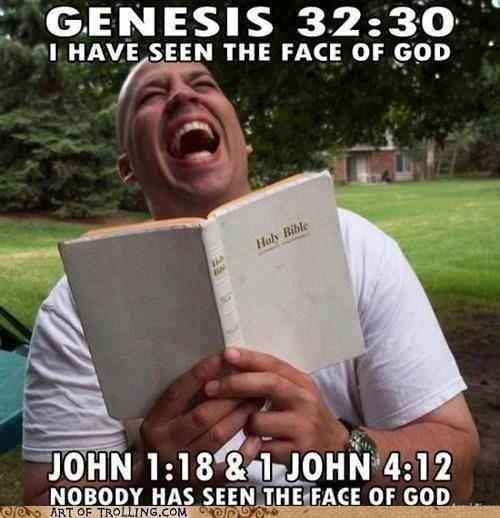
I’ve seen some funny parts in the Bible. I get the feeling this guy is supposed to be laughing AT the Bible, though.
A Twitter follower, JoeUnseen, has requested that I crush a meme on who has seen the face of God: Jacob (Gen 32:30), or No One (Jn 1:18; 1 Jn 4:12)?
There are a host of verses often set against each other in this same fashion. It’s usually a sophomoric understanding of semantics used to cause confusion.
No one has seen God in the sense of the divine glory, or the sense of God the Father (first person of the Trinity). However, people have seen Jesus, the Incarnate Son (second Person of the Trinity), or any number of theophanies.
Let’s start with the new word: a theophany is a manifestation of God, but not the full glory of God. Reading the entire passage of Genesis, we see that Jacob wrestles with a man (probably an angel, vv. 24-28). The stranger is identified as God for the first time in verse 28, then Jacob proclaims he met God face to face and survived (v. 30).
But he didn’t meet God; only a representative. And that is clear from the passage. This is a theophany; a representation of God, but not God in his full glory.
I may have to buy a new pack of Victory Gum …
Crushing Another Meme
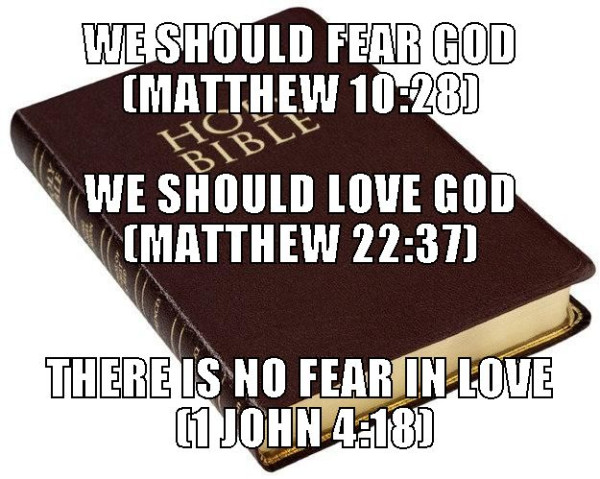 I never intended to crush silly memes as a theme for the past week, but that’s what ended up happening. So when I saw this one, I thought I’d run with the unintended theme.
It’s titled “You should just, like, read the Bible!” Which means, I suppose, that the Bible muddies things up by contradictions such as what we read on the right.
Well, is this a contradiction? To answer that question, we need to go to the context of the verses. I’m interested to see if each passage is making a different point to a different audience. In that case, we’d have no contradiction at all.
In Matthew, the context is persecution by authorities. Jesus is telling his disciples not to worry about the powers that be persecuting or killing them for the sake of the kingdom. Don’t fear them, because they can only hurt the body. Instead, fear the one who can destroy the soul — the real you.
Obey God, not men.
Continuing forward, we receive assurance that God takes care of his own. Therefore, we (in reality) have nothing to fear and God will take care of us — especially if we acknowledge the Son before our tormentors. Though we’re told to fear God, the remainder of the context shows that that isn’t necessary because he will, in fact, take care of us as he does all of creation.
In 1 John, the context is God’s abiding love. God loved us so perfectly, that he sent his Son to an atoning death for our sins. There is no fear in God’s love because God’s perfect love is saving the believers from hell; therefore, we ought to love one another. The perfect love drives out the fear because we are spared of the final judgement, and the fear comes from its punishment. So we need not fear it.
Two passages: different contexts, different messages. They are thematically related only in explaining why we should not fear final judgement — the perfect love of God abiding in us.
Not a contradiction.
And so, having crushed another meme, I shall enjoy a piece of Victory Gum…
Why do People Become Atheists?
I’ve posited that atheists do not want ultimate accountability to God, and that is part of their motivation for denying God’s existence. Atheists try hard to resist that, but a few have been forthright about it. Philosopher Thomas Nagel, for example, wrote:
I want atheism to be true and am made uneasy by the fact that some of the most intelligent and well-informed people I know are religious believers. It isn’t just that I don’t believe in God and, naturally, hope that I’m right in my belief. It’s that I hope there is no God! I don’t want there to be a God; I don’t want the universe to be like that.
Now, the Atheist Camel comes clean as well. When contemplating what the reaction would be to bulletproof evidence that there is a god, he said:
I’ll proffer that it depends on the god’s persona. If it is a hands (or trunk, or tentacles) off god, who created us and lets us live out our lives as independent beings unfettered by its irrational threats and demands; perhaps a fun loving kind of being that finds our behavior amusing or disgusting, but nevertheless nonjudgmental– perhaps asking only for an occasional acknowledgement and thank you now and then I’d have no problem with it. Acknowledge and move on. (source, emphasis added)
So he’s fine as long as there is minimal intrusion in his life. Now, what if this deity was the God of the Bible and did demand certain things?
Where scientists never before bothered to contemplate the supernatural, many of them, and our freethinking brethren, would now kowtow to this God’s demands. But many more would turn their attention toward one objective…find a way to destroy it. An underground movement, an army of partisans, dedicated to freedom of thought, rationality, fairness and conscience battling not only for the freedom to live life free from omnipotent oppression and irrationality, but for the freedom and right to die and fade into oblivion without pain and fear.
If there were a proven God of the Bible in all its horrendous glory man would be compelled to stop killing each other. The thinking among us would turn our undivided attention to find a way to kill this God monster … once and for all. (source, emphasis added)
So the truth comes out. As long as the Atheist Camel gets to live as he chooses, with no interference from a deity, he’s fine. But the moment there is an expectation of behavior and a requisite final judgement, he thinks that humans should join together and kill that God.
What can I say? This confirms my original theory about atheists wanting to avoid final judgment classic-D&D-style — rolling a 20-sider and saying “I disbelieve.” I just wish more atheists were this honest.
Another Ignorant Meme
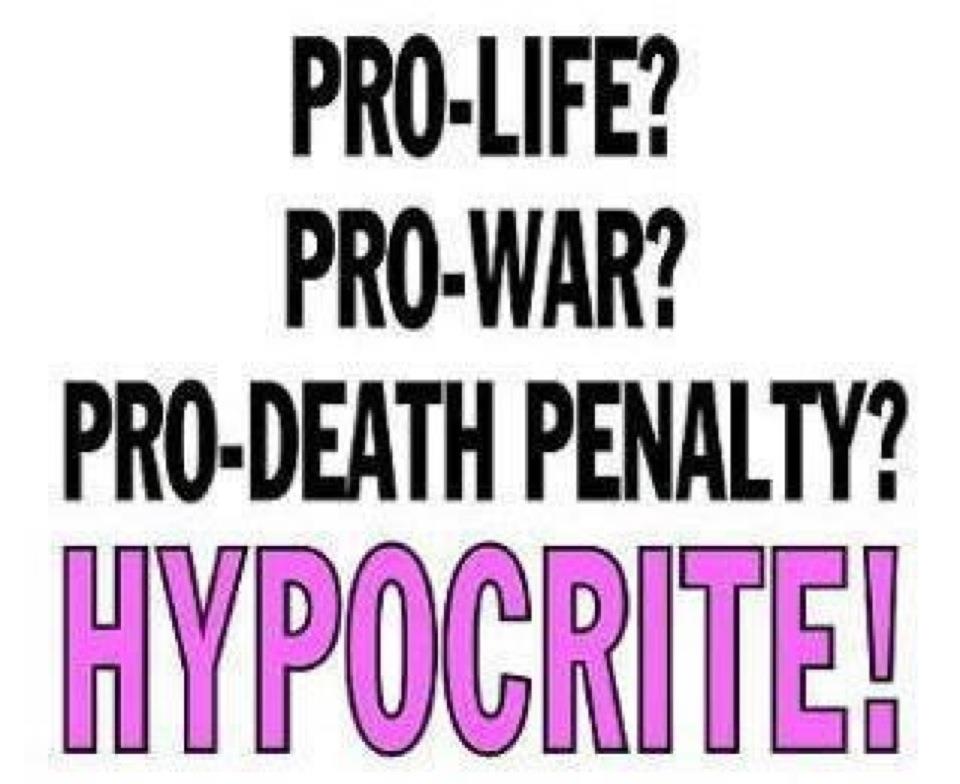 Memes are created by the dozens everyday. I have no idea what makes one meme go viral while others sit and rot. But I’m convinced the anti-religious ones that go viral must do one of two things:
- Commit serious exegetical errors that Average Joe Christian cannot counter because the church sucks at apologetics.
- Commit a serious category error that Average Joe American won’t notice because he’s too busy watching horrid shows like Keeping Up With the Kardashians and not busy enough learning how to think critically.
This meme goes in the second group. I would like to point out that it is exactly the same category error discussed with the Scumbag God meme: a failure to distinguish between “kill” and “murder.”
“Kill” is a broad term that refers to the taking of lives. Murder, on the other hand, is the unlawful taking of a life. All murder is killing, but not all killing is murder. For example, the following “kills” are lawful:
- Hunting
- Trapping
- Euthanizing sick/injured animals
- Butchering animals for food/by-products
- Killing enemy combatants
- Capital punishment
- Self-defense
- Defense of another who is immediate, life-threatening danger
- Killing a person who presents an immediate threat to the community but not directly to you (police officers only)
No comment on the fairness of those kills, but they are considered lawful in that if you clean a fish, kill an enemy soldier, shoot a horse with a broken leg, or kill to protect your child you won’t face prison time.
Murder represents a case where you killed unlawfully. For example, if you caught your wife in bed with another guy, then beat that guy’s head in with a sharpened stick, you’re going to jail. I’m sure that the jury would sympathize with you, mostly because there’s at least one hotheaded, possessive S.O.B. of a juror who would have done the same thing.
But that doesn’t change the legality of your action. You still killed without a justifiable reason. And that makes it murder. (In the above example, if you had no “cool-down” period, it would likely be charged as manslaughter, but my point still stands that the killing is unlawful.)
Capital punishment is the right of the state, agree or disagree with it, it is still a justifiable killing. As is killing an enemy soldier in combat; soldiers know what they’re getting in to and they know they are risking their lives when they enter the armed forces. Same as any police officer or government Special Agent.
So, you can be pro-life, pro-war, and pro-death penalty while not earning the brand of hypocrite. Some might say that this is special pleading, but it isn’t because I’ve shown the one exception to special pleading — the principle of relevant difference. Lawful killing of enemy combatants and convicted murderers/traitors is vastly different than murdering a baby in the womb.
Okay, I jumped the gun a bit. I haven’t actually proven that abortion is murder. And that’s not my aim. My aim is to show that not all killing is unlawful, and therefore this meme commits a serious category error.
And now, having squashed another ignorant meme, I shall enjoy a piece of Victory Gum…
Another Facebook Meme that Should be Destroyed
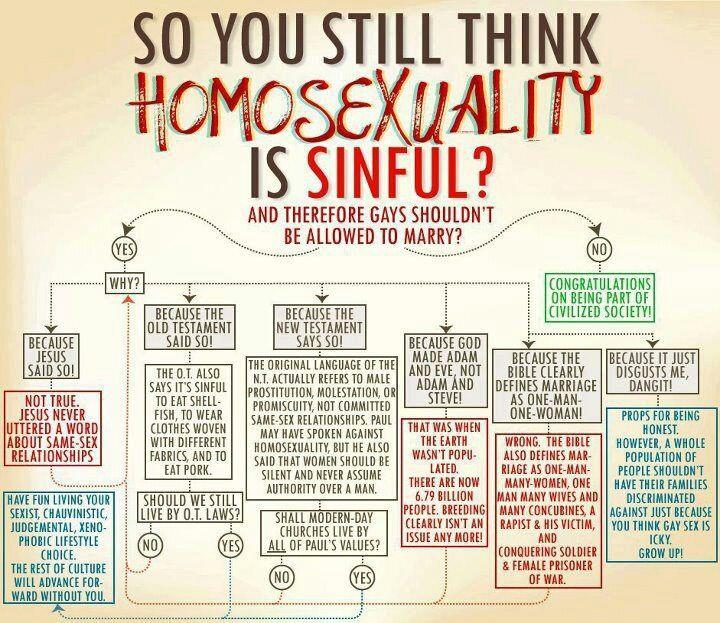
Wow. Just wow. So many things wrong with this graphic. So many problems and inconsistencies of thought. . . . So many half-truths and misrepresentations. . . .
Let’s just start left and travel right. A word of warning — this is longer than my average blog post because it covers a variety of topics related to same-sex marriage. It’s approaching 1800 words and I cut quite a bit of material out. Be warned as you travel below the fold. . . . Read the rest of this entry
Quick Post: Ignorant Meme
Most memes that float around are plain ignorant, and thus are fairly easy to decimate. And this one is no different:
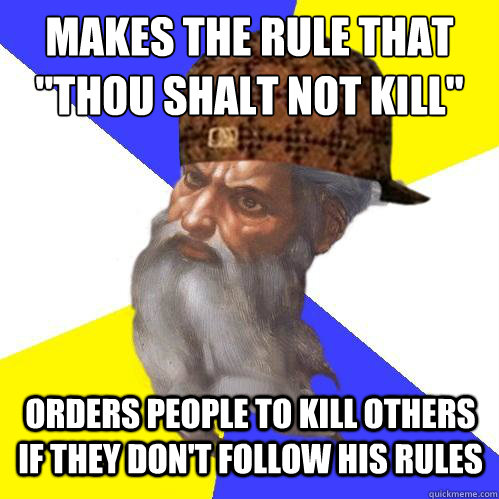
The first thing that we have to understand about God is that he is all three branches of our American government combined — he’s the original theocracy. He is, in fact, referred to by titles that reflect that:
- Lawgiver — Isaiah 33:22, James 4:12 [Congress]
- King of kings — 1 Timothy 6:15, Revelation 17:14 and 19:16 [President]
- Judge — Genesis 18:25, Psalm 7:11, 2 Timothy 4:8 [Courts]
When God enacts a law as Lawgiver, he has the right to be both Judge and Executioner when enforcing said law. God, like the State, can impose the death penalty for people who transgress the law.
The commandment referenced refers to cold-blooded murder. Acts like self-defense or capital punishment imposed by the State are not in view and are not forbidden. So God is not transgressing his own law by imposing the death penalty on a guilty party. God isn’t murdering anyone, he is acting as Judge and Executioner.
So we are done here. Next meme I crush is that lovely FB floater that asks if you still oppose gay marriage, and through a series of poorly-reasoned, badly-exegeted biblical examples shows you’re some kind of bigot. It actually shows anything but that, as we shall soon see.
Why No Archelogical Evidence of the Exodus?
It is a common charge from critics that the Exodus left no archeological evidence behind. The Christian answer, as “convenient” as it sounds to those critics, is pretty true if you actually put on your thinking cap for a moment.
In the words of Charlie Campbell:
Another objection critics raise regarding the Exodus concerns the lack of any Egyptian records mentioning the Israelite’s departure from the land. But a lack of records should not concern us. It is reasonable to believe that the Egyptians had some written record of the Exodus but as British Egyptologist Kenneth A. Kitchen says, voluminous papyrus archives once stored in Egypt have vanished:
In the sopping wet mud of the Delta, no papyrus ever survives (whether it mentions fleeing Hebrews or not)…In other words, as the official thirteenth-century archives from the East Delta centers are 100 percent lost, we cannot expect to find mentions in them of the Hebrews or anybody else. [1]
“Well,” the skeptic says, “perhaps no written record survives on papyrus, but surely there should be something in a wall relief that mentions the Exodus.”
I disagree. As Jeffery Sheler, U. S. News & World Report religion writer, says:
Official records and inscriptions in the ancient Near East often were written to impress gods and potential enemies, it would be quite surprising to find an account of the destruction of pharaoh’s army immortalized on the walls of an Egyptian temple…Indeed, the absence of direct material evidence of an Israelite sojourn in Egypt is not as surprising, or as damaging to the Bible’s credibility, as it first might seem. [2]
“Okay,” the skeptic reasons, “perhaps there wouldn’t be a wall relief telling the story of the Exodus, but surely the Israelites would have left behind some pottery in the Sinai desert during their sojourn from Egypt to Canaan.”
When it comes to archaeological evidence for the Exodus (such as pottery), it is important to remember that the Israelites lived as nomads during their time in the wilderness. Nomads living in a desert like environment, where every utensil and tool is of great value, leave few traces in the archaeological record. The Israelite’s temporary tent encampments from 3000 years ago would not have left much behind in the swirling sands of the desert.
Former Yale professor Millar Burrows agrees: “It is hardly reasonable, in fact, to expect archeological evidence of their sojourn anywhere. We cannot expect much help from archeology in tracing the route of a people’s migration through the desert.”[3] (source)
See this article for more detail. We wouldn’t expect much archelogical evidence to survive. Really, nomadic people leave very little behind. Check JP’s comparison to the Scythians in the article for information on that.
Notes:
- K. A. Kitchen, On the Reliability of the Old Testament, 466. Italics in original.
- Jeffery Sheler, Is The Bible True? 78.
- Millar Burrows, What Mean These Stones? 63.
Bittersweet. I always have a great deal of fun at the Avalanche Youth Ministry co-op, so I hate to see it end. But, we’ll be back in September and that means more fun and more reaching youth for Christ!
Congratulations to the Green Team for winning the gaudy trophy!!!!!!
Atheism and the Burden of Proof
One of the most frequent statements I hear when I talk about God with atheists is that there is “no evidence” that God exists, and that is usually followed by telling me that the burden of proof is on me, the theist, because I’m the one making the positive assertion.
However, an actual atheist, as I covered yesterday, is making a positive assertion — he is positively asserting there is no God. This is framed negatively, but he isn’t withholding judgement on my assertion. He declares it false.
Withholding judgement is agnosticism — not knowing. In which case, I’m obliged to prove my case (or at least make a reasonable argument for it) for the benefit of the undecided person.
But the atheist has gone beyond withholding judgement. He’s made one of his own, and for that he owes an explanation.
Think this through:
If I say, “God exists!” Aside from, “Praise Jesus, I know he does!” there are two potential replies. (Actually, there are more, but let’s just stick with these two for simplicity sake.)
Someone might respond, “I’m not convinced.”
This is your agnostic. I should lay out my case for him. If he remains unconvinced, we can discuss the particulars. He has no specific position, so he owes me no explanation beyond what my argument lacks.
The other potential reply is: “Poppycock! There is no god, you silly Christian. Science disproves him. Besides, there was never any evidence anyway.”
This is your atheist. It is totally disingenuous for the atheist to think I’m the only one with a burden of proof here. I will still lay out my case, however he needs to both rebut my case and lay out his own — merely rebutting my case doesn’t prove anything other than I have a poor case. It only moves us to agnosticism, being unconvinced. The atheist isn’t “withholding judgement”: he’s convinced that I’m wrong. For that, he owes me an argument.
One needs nothing beyond “insufficient evidence” to withhold judgement, but the moment rejection enters the picture, a judgement has been made and a logical argument for why must be presented. Saying “I lack belief in all gods” is a total cop-out and very lazy debating.
UPDATES:
- 8/13/12 at 1:40am EDT because there were a lot of typos. I’m ashamed of that. 1-2 is fine with me because I’m not perfect, but there were probably 4-5!
- 8/19/12 at 12:41am: Another perspective from Steve Wilkinson here.
Defining “Atheism”
A comment, though marked as spam, poses an interesting problem nonetheless:
Some of the ambiguity and controversy involved in defining atheism arises from difficulty in reaching a consensus for the definitions of words like deity and god. The plurality of wildly different conceptions of god and deities leads to differing ideas regarding atheism’s applicability. The ancient Romans accused Christians of being atheists for not worshiping the pagan deities. Gradually, this view fell into disfavor as theism came to be understood as encompassing belief in any divinity.
I had always meant to do a post on the difference, as I see it, between atheism and agnosticism. This seems like as good a time as any.
First, does it matter that there are a plurality of conceptions of God? And I would have to say, for all practical purposes, the answer is no. Atheism, as I will show, isn’t a point of view (as supernaturalism is).
Supernatural is outside of nature. Nature is your context: the container in which you find yourself. Therefore, that which originates in this universe is natural to us. However, that which originates outside the universe is supernatural.
Flip it, and that makes us supernatural to God, since we don’t reside on the same plane of existence.
Atheism is making a claim about how things are ordered, regardless of your particular perspective.
But who (or what) is God, then? True, there have been a plurality of conceptions of God. Accepting one over another doesn’t make all of those who reject your particular deity atheists. Infidels, yes. Atheists, no.
Think of it like this: in an election, I have several candidates to choose from. The front runners are Mitt Romney and Barack Obama. Or I can simply abstain and not vote. The gray area is this: If I vote for Obama, does that mean I think Romney is unfit for the job?
Well, not necessarily.
There’s no meaningful way to vote against Romney without voting for Obama. So if I want to afford Obama the chance to see his economic plan through but think that Romney would do an adequate job if elected, then I’m not anti-Romney per se.
On the other hand, I may think that Romney and Obama are equally wretched as leaders and statesmen, but vote for Obama because he’s currently more experienced.
Bottom line: a vote for one is not necessarily a vote against the other.
Which is an accurate description of agnosticism. Agnostic literally means “without knowledge.” Agnostics really don’t know whether there is a god, but they remain open to finding out. While they don’t see adequate evidence for God, they find no reasons to deny the possibility of God’s existence. They don’t know.
Finally, the burning question: what is atheism? Atheism is the rejection of all God-belief. In our election example, these guys are staying home from the ballot because the actively reject both candidates.
 It is not simply “lacking belief in God.” Lacking indicates they could be persuaded with the right evidence. Nothing sways most atheists. Read these comments if you don’t believe me.
Atheism is a rejection of the divine, no matter one’s conception of it. It matters not whether that divine is supernatural (as monotheism posits), or within nature (as paganism posits), or in ourselves waiting to be unleashed (as New Age theology posits). Atheism rejects it all in one fell swoop.
Tomorrow, atheism and the burden of proof. That should both be interesting, and infuriating to my atheist readers. Because, spoiler alert, you guys have a burden of proof!


 Back Rome Again