Category Archives: Apologetics
December Newsletter
A very short newsletter this month. As always, comments are welcome.
Click here to download.
On Original Sin

Image via Wikipedia
Beowulf2k8 doesn’t believe that the doctrine of original sin is biblical in light of Ezekiel 18:20:
The soul who sins shall die. The son shall not suffer for the iniquity of the father, nor the father suffer for the iniquity of the son. The righteousness of the righteous shall be upon himself, and the wickedness of the wicked shall be upon himself.
Beowulf, in the comment section of this post, says:
Adam’s sin only brings physical death and the inclination towards sin. We do not inherit its guilt so as to be born or conceived damned, nor can we be damned for his sin since God explicitly states “The soul who sins is the one who will die. The son will not share the guilt of the father, nor will the father share the guilt of the son.”
Physical death and the inclination toward sin are only two of the effects of the Fall. The other effect, the effect that Beowulf denies, is imputed sin. Craig French (aka Antipelagian) rightly points out the consequences of such a belief system:
If you want to reject our Fall in Adam, you must also reject our Salvation through the Second Adam. Denying federal representation cuts both ways…you reject original sin, you reject Christ’s atonement.
Let’s take a moment to look at the doctrine of imputed sin, then we’ll see why it is so important for the Atonement. First, we need to understand that we live in a individualist society and that the Bible was written by and to a collectivist society. Collectivist societies have a strong sense of identity with the family unit. This is woven all throughout the Bible. Consider the numerous genealogies that are given. The individual identity was never as important as the family, and the head of the family (the father) gave the entire family its reputation.
In this sort of society, the son would expect to suffer for the sins of his father.
Adam is the federal head of the human race. By blood, all of us are descended from Adam. We take our ultimate family identification from him. This means that, in a collectivist sense, we should expect to suffer the consequences of his sin, since he is the head of our race. In a collectivist society, this would be the norm and no one would have the problem that Beowulf has with it.
Adam’s sin is therefore imputed to us.
Therefore, just as sin came into the world through one man, and death through sin, and so death spread to all men because all sinned—for sin indeed was in the world before the law was given, but sin is not counted where there is no law. Yet death reigned from Adam to Moses, even over those whose sinning was not like the transgression of Adam, who was a type of the one who was to come. (Rom 5:12-14, emphasis added)
Sin and death have entered the world through Adam, and have spread to all men. By both nature and choice, men are sinners. “For if many died through one man’s trespass, much more have the grace of God and the free gift by the grace of that one man Jesus Christ abounded for many” (Rom 5:15, emphasis added). Through that one sin, many died. But there is good news:
Therefore, as one trespass led to condemnation for all men, so one act of righteousness leads to justification and life for all men. For as by the one man’s disobedience the many were made sinners, so by the one man’s obedience the many will be made righteous. (Rom 5:18-19, emphasis added)
Here the apostle is contrasting Adam’s act of disobedience with Christ’s act of obedience. Because of Adam’s disobedience, many were made sinners. But because of one act of obedience by Jesus Christ, many are justified before God and considered righteous. If you reject the first premise, then you are left with no basis for the second premise.
Put another way, if you reject Adam’s imputed sin, you have no basis for accepting Christ’s imputed righteousness. You may stand before God justified on your own merit. The Apostle Paul condemns such thinking when he writes:
For by grace you have been saved through faith. And this is not your own doing; it is the gift of God, not a result of works, so that no one may boast. For we are his workmanship, created in Christ Jesus for good works, which God prepared beforehand, that we should walk in them. (Eph 2:8-10, emphasis added; see also 2 Tim 1:9; Tts 3:6; and Rom 3:20, 28)
On the Logical Impossiblity of God
Vjack, the proprietor of Atheist Revolution, presents the following argument from Atheism: The Case Against God:
To be is to be something as opposed to nothing, and to be something is to be something specific. If a god is to have any characteristics (which it must to exist), these characteristics must be specific – but to assign definite attributes, to say that a being is this as opposed to that, is to limit the capacities of that being and to subject it to the uniformity imposed by those capacities. A supernatural being, if it is to differ in kind from natural existence, must exist without a limited nature – which amounts to existing without any nature at all (p. 41).
In other words:
- To be something is to be something specific
- Characteristics must be specific and to exist something must have them
- Assigning characteristics to something limits it in some fashion
- To be supernatural means to exist without limits
- Therefore, supernatural beings cannot have characteristics, which means that they don’t exist
- God is supernatural
- Therefore, God does not exist
The logic on this one is tight, and Vjack rightly thinks that there are few ways around this one. He says:
The theist who is not ready to concede defeat has one obvious place of retreat. He or she will claim that his or her god is unknowable. Of course! Theists make this claim all the time. Their god is not merely unknown in the present time but unknowable in principle. The human mind simply cannot comprehend their god. (source)
Human beings are made in the image of God, according to Genesis. Therefore, God isn’t completely unknowable. His actions cannot all be understood by human beings, which is understandable given the infinite nature of God and the finite nature of human beings. I would never say that God is unknowable as an apologetic, however.
Vjack goes on:
As Smith suggests, this shifts the discussion away from metaphysics and back to epistemology. However, before making this shift, it is important to understand that the theist is now admitting that his or her god (and any other supernatural entity) is beyond comprehension of the human mind. Is this really what theists believe? Perhaps it gets them around the many metaphysical problems with their god, but it may well come back to haunt them. (source)
He clarifies what he means in an imaginary dialog between an atheist and a theist where the theist is forced to admit that he has no idea what he believes in, since God is unknowable. This trap is exactly why I would avoid simply saying “God is unknowable” as an apologetic.
How do I answer this dilemma? Well, for one thing, I would take issue with statement #4. Why does a supernatural being have to exist without limits? Epistemologically, we only know the natural world. It is impossible for us to perceive the supernatural. So we don’t know that that statement is true. Since #4 cannot be proven, you cannot conclude #5. The rest of the logic chain falls apart.
But this still raises an interesting question. Does God exist without limit? Because if he does truly exist without a limit, then he has no limiting characteristics and therefore exists with no nature at all. And that is a logical impossibility.
Well, we know that God cannot lie (Tts 1:2, Heb 6:18). There’s at least one limiting characteristic. There are other characteristics of God. In fact, I have a book that lists over 100 attributes. Surprisingly, in that book, “Limitless” doesn’t appear. That is because God isn’t limitless, he is infinite.
“Limitless” and “infinite” are distinct from one another. We’ve already seen that a being that exists without limits is a logical impossibility. Infinite, in the sense of everlasting, is not a logical impossibility. It is hard for us to grasp, but it isn’t impossible. God is the Alpha and Omega, the first and the last. He is eternally self-existent. These are not logical impossibilities, but they are hard to for a finite mind to understand.
Beowulf2k8 and Calvinism
Calvinism hater Beowulf2k8 has graced this blog with his anti-Reformed rhetoric. He attacked this post. I think that the comment and his post here speaks for itself, and I won’t answer it directly. Instead, in a few days look for a post defending original sin. That should suffice as a response.
In the meantime, I wanted to answer this post, where Beowulf makes the following claim:
Now that Obama is the President Elect and will be President, the god of Calvinism can finally be satiated with a never ending pile of dead babies to send to hell for no fault of their own. That’s assuming that Obama can get his filibuster proof Democrat Congress to pass pro-abortion laws (which is a given).
I say this not so much to criticize Obama or the Democrat party. I’m not interested in politics today. I say this only to point out what sort of false god the Calvinists serve.
Calvinists teach a god who takes pleasure in broiling innocent infants in hell. Infants who have committed no sin. But their god takes pleasure in roasting them for Adam’s sin.
This is wholly false. Of infants, the Westminster Confession of Faith teaches:
Elect infants, dying in infancy, are regenerated, and saved by Christ, through the Spirit, who works when, and where, and how He pleases: so also are all other elect persons who are incapable of being outwardly called by the ministry of the Word. (10.3)
I don’t happen to like the phraseology, because it indicates that some infants might still go to hell. But it could also mean that all infants are elect and therefore go to heaven. I like to think of it that way. And perhaps that is what really happens, we will never know this side of heaven. The Bible is silent on what happens to infants.
All people are sinners by nature. God elects some to salvation and others he passes over for damnation. Beowulf uses that as an excuse to hate God as he has revealed himself, and instead fashions an idol. The idol he worships is more comfortable for him; this idol doesn’t condemn deserving people.
What Beowulf is doing is taking an extreme situation–the condemning of infants–and using it to argue by outrage. It is uncomfortable for us to think that infants would be condemned to hell. But isn’t it uncomfortable to think that anyone would be condemned to hell? Is Beowulf perhaps betraying this thought?
In any case, Calvinism doesn’t teach that infants are condemned to hell automatically. And Calvinism definitely doesn’t teach that God takes pleasure in the condemnation of sinners–young or old. Scripture reveals otherwise, as Beowulf himself points out.
Beowulf is confusing Calvinism with hyper-Calvinism. Hyper-Calvinism teaches that God hates the reprobate (non-elect). While “hate” is mentioned in some texts (Rom 9:13), it is the Greek word miseo, which actually means “to love less.” God is merely stating that he has no covenant relationship with Esau. As an extension, God has no covenant relationship with the non-elect, but that doesn’t mean that he hates them in the traditional sense of that word. John 3:16, among other texts, is crystal clear–“For God so loved the world. . . .”
If Beowulf believes I am in error, he is welcome to comment on this entry or post it on his own blog. If he can prove me wrong by the traditional documents of the Reformed faith (such as the Westminster Confession or the Baptist Confession), then he is more than welcome to do so.
Pope Acknowledges Protestant Theology
The idea that we are justified by faith alone apart from works of law was solely a Protestant idea. Forwarded by Martin Luther and adopted by the rest of the Reformers, this idea of sola fide has been the subject of ridicule from Catholic lay apologists almost as much as sola scriptura.
Scripture supports sola fide. Catholics believe in a cycle of redemption, but Scripture makes it clear that justification is a finished act: “Therefore, since we have been justified by faith, we have peace with God through our Lord Jesus Christ” (Rom 5:1). “After making purification for sins, he sat down at the right hand of the Majesty on high, having become as much superior to angels as the name he has inherited is more excellent than theirs” (Heb 1:3-4).
Only the book of James seems to dissent from the position that justification comes by faith alone. But it is easy to reconcile this apparent contradiction when you understand the difference between saving faith and empty faith. Saving faith produces good works. An empty faith produces no works. Saving faith saves and produces good works as a fruit of that salvation. Faith without works is dead, as James states.
However, it has always been the Catholic position that works are necessary for salvation. Hence the entire sacramental system that allegedly dispenses God’s grace. According to the Catholic Encyclopedia:
Almighty God can and does give grace to men in answer to their internal aspirations and prayers without the use of any external sign or ceremony. This will always be possible, because God, grace, and the soul are spiritual beings. God is not restricted to the use of material, visible symbols in dealing with men; the sacraments are not necessary in the sense that they could not have been dispensed with. But, if it is known that God has appointed external, visible ceremonies as the means by which certain graces are to be conferred on men, then in order to obtain those graces it will be necessary for men to make use of those Divinely appointed means. (source)
Now, there seems to be a polar shift in the opposite direction. The Pope, in a general assembly dedicated to reflection on the Apostle Paul, said that Luther’s version of justification is correct provided that faith isn’t opposed to charity or love.
It’ll be interesting to see what happens now. Will the Catholic apologists recant? Will Steve Ray remove the question from his questionnaire for Bible Christians that pokes at sola fide? It’s very doubtful.
On Ownership
It is a frequent argument from atheists that Jesus doesn’t want us to own anything; that we are to sell everything and trust God alone to provide for us. This assertion is patently false, as we will soon see. It relies on taking a verse out of context. The Bible supports and defends ownership of property; it is one of the ways in which we are made in God’s image. Our ownership of property mirrors his ownership of the universe, and it pleases him when we are wise with the use of our resources.
First, let’s look at the atheists’ side. They cite Luke 18:18-22 as saying that Christians must sell everything and own nothing in order to get to heaven. They don’t tell you that this is a command given to only a particular ruler who had great treasures on earth. Jesus was trying to send the message not to rely on material possessions.
To refute this point, let’s look at what the Bible has to say about ownership of property. Often, everything goes back to Genesis, so we’ll start there. What we find is God giving the earth to man:
And God blessed them. And God said to them, “Be fruitful and multiply and fill the earth and subdue it and have dominion over the fish of the sea and over the birds of the heavens and over every living thing that moves on the earth.” And God said, “Behold, I have given you every plant yielding seed that is on the face of all the earth, and every tree with seed in its fruit. You shall have them for food. And to every beast of the earth and to every bird of the heavens and to everything that creeps on the earth, everything that has the breath of life, I have given every green plant for food.” And it was so. (Gen 1:28-30, emphasis added)
In this perfect creation, man is to subdue the earth, make it his own, and God has gifted it to him. But we live in a post-Fall world, which we all know isn’t perfect. What does God say after the Fall?
Because you have listened to the voice of your wife and have eaten of the tree of which I commanded you, ‘You shall not eat of it,’ cursed is the ground because of you; in pain you shall eat of it all the days of your life; thorns and thistles it shall bring forth for you; and you shall eat the plants of the field. By the sweat of your face you shall eat bread, till you return to the ground, for out of it you were taken; for you are dust, and to dust you shall return. (Gen 3:17-19)
God doesn’t revoke ownership of the planet. Instead, he curses the ground and makes it grow thorns and thistles. Man has to work to provide himself with food now. Post-Fall, man still owns and cares for the planet.
It’s obvious that corporately, we own the planet. But is there private ownership? It turns out that the Ten Commandments hold a clue to that in the command, “You shall not steal” (Ex 20:14). Obviously, if there are no personal possessions, then you can’t steal. This command makes no sense if personal ownership is forbidden. So individual ownership is biblical by the Mosaic Law.
It is also biblical to enjoy your possessions:
Behold, what I have seen to be good and fitting is to eat and drink and find enjoyment in all the toil with which one toils under the sun the few days of his life that God has given him, for this is his lot. Everyone also to whom God has given wealth and possessions and power to enjoy them, and to accept his lot and rejoice in his toil—this is the gift of God. For he will not much remember the days of his life because God keeps him occupied with joy in his heart. (Eccl 5:18-20)
But it is never biblical to rely on your material possessions (see Mt 6:19-20 and Eccl 5:10-12). Reliance on material possessions takes focus away from God.
Ultimately, God owns everything (Ps 24:1). So really we are stewards acting in his stead. We will have to give an account of how we used the resources that he gave us–time, money, health, and all of our other blessings. So it is important to exercise good stewardship over our little corner of the world. It pleases God when we get it right.
The atheist once again relies on a misreading of the biblical text in order to arrive at an unwarranted conclusion. Ownership of property is biblical and a blessing from God. Admittedly, it offers many temptations to sin. The most obvious temptation is theft. The next most obvious is coveting your neighbor’s PlayStation III. These are corruptions of something that was good from the start, and should not be confused with a biblical picture of ownership.
For more information on biblical ownership, stewardship, and similar subjects, please visit generousgiving.org.
Polytheism?
This is one of the ten most viewed posts of all time. To read all ten, download this free e-book.
The Friendly Atheist alerted me to a cartoon on Atheist Cartoons:
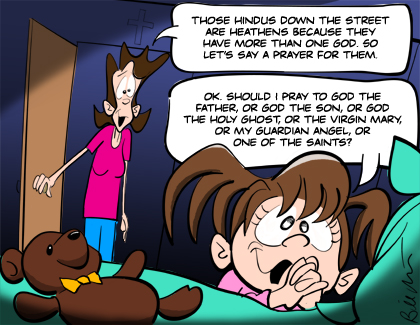
This proves that, no matter how many times an issue is explained to the atheists, they ignore us and move on. I’ve addressed the issue before, and I know that many other apologists have also addressed the issue as well. Here we go one more time:
 Atheists, listen up! Christians are NOT polytheistic. We are monotheists. We believe in one God. The Bible affirms that God is one being. Father, Son, and Spirit are separate persons, functionally different but ontologically the same being. No one understands or can explain the doctrine of the Trinity fully. So no one expects you to understand it. But to repeatedly mock it as polytheism is childish. Just because you don’t understand something doesn’t mean that you get to explain it the most convenient fashion for you, and ignore everything that knowledgeable people keep telling you about it. To do so impedes rational discourse.
Since no one fully understands the Trinity, atheists assume that it must be false. Permit me to draw a parallel. No one understands how life began on this planet. It could have been seeded from outer space says one theory, or it could have originated from non-life says another theory. God could have created it says a third theory. Just because no one fully understands the origin of life doesn’t mean that it never happened. Atheists permit that we will understand this mystery one day, but mock theists who say the same thing about the Trinity. For now, like the origin of life to an atheist, the Trinity remains a mystery to the Christian.
As for praying to angels and saints or the Virgin Mary, praying to anyone other than God is expressly forbidden in the Bible. Only Catholics practice this. Christians pray only to God.
Why is it that no matter how many times it is explained that Christians are monotheists does the charge of polytheism remain?
WWGHA Blog Gets it Wrong… AGAIN!
Regular readers know that I’ve been working out rebuttals to the sites Why Won’t God Heal Amputees and God is Imaginary. I have discovered recently that those sites run a blog where a person going by the moniker “Johnson” posts regularly about religion and all of its “evil.” The focus of the sites WWGHA and GII is, purportedly, all monotheistic religions. But when a person looks at the categories of the blog and the numbers of posts within each category it becomes readily evident that Christianity is the prime, if not only, target.
Recently, Johnson critiqued the newspaper advice column “God Squad” for their answer to this question:
I’m having a hard time keeping my faith. I was raised a Christian, yet we didn’t attend church regularly. I consider myself blessed, yet I’m having trouble accepting that God had anything to do with it.
I can seemingly explain my good fortune by a combination of science and hard work. I very much want to believe and have God be a daily part of my life, but my heart doesn’t feel the same way. Can you help?
Almost Godless in Florida
The God Squad concluded that this person’s real problem was a lack of gratitude for the blessings that God has dispensed upon him rather than a lack of belief in God. Johnson makes this a deeper and more philosophical proposal than it needs to be by reversing the coin: If God blesses some people, it means that he also withholds blessings (or curses) others. Johnson says:
Here is where rationality comes in. According to the God Squad, God is the cause of all blessings. There is no reason to thank God if he is not the cause. Therefore, all the people who live in an unblessed state – the thirty thousand children who will die of starvation today, for example, or the thousands who will die of cancer, or the billions who live in stark, abject poverty – must of necessity be in those situations because God has cursed them. If you happen to live in Ethiopia and starve to death today, it has to be because God has failed to bless you.
In other words, God curses everyone who is suffering on earth. The suffering must come from God’s withholding of his blessings of health, food, rain, etc. Meanwhile, over in the United States, God blessed Bill Gates with another billion dollars today, and Bill should be grateful to God for that since God made it happen.
When you think about it rationally, you cannot escape this obvious problem. If we are supposed to thank God because he is the cause of all blessings, then it means that the lack of blessings (starvation, cancer, poverty, etc.) is caused by God as well. And this means that God is the most twisted, capricious, biased, despicable creature in the universe. 30,000 innocent children will starve to death today specifically because God withheld blessings from them. (source)
 What this assumes is that equality of possessions is the ideal condition. We call that communism, which is not an ideal condition at all, as evidenced by the catastrophic failure of the regimes that used it. Instead, the ideal condition on earth is the inequality of possessions, so argues Wayne Grudem in Business for the Glory of God.
Grudem says that because of the Fall and the curse on the productivity of the earth, inequality of possessions is necessary. Grudem also echoes the biblical teaching that to whom much is given, much is expected. That those who have a lot of wealth and possessions are expected to give a lot to serve the needs of his fellow man.
Now what do we actually see on earth? Do we see those having a lot giving a lot, or do we see the opposite? That the haves horde for themselves and the have-nots just end up with less? Yes, I’m afraid that is exactly what we see.
Inequality of possessions gives people varying levels of accountability, which is exactly what God intends. This means that inequality of possessions in and of itself is a good thing, and is intended by God for his own glorification. What the WWGHA Blog is talking about is the distortion of that good; the hording of wealth by people and the callous evil that the haves display in allowing the have-nots to starve to death. Grudem cautions:
But the distortions of something good must not cause us to think that the thing itself is evil. The evils of poverty and excessive, self-indulgent wealth must not cause us to think that God’s goal is total equality of possessions, or that all inequalities are wrong. Inequalities in abilities and opportunities and possessions will be part of our life in heaven forever, and they are in themselves good and pleasing to God, and provide many opportunities for glorifying him.
The obvious objection to this is that I’m just resorting to the Free Will Defense–man causes his own pain, not God. But I believe that, in some cases, there is something to this Free Will Defense. Not all cases. Obviously, a natural disaster isn’t explained by free will. In his book God’s Problem, Bart Ehrman’s mistake is looking for one answer to satisfy all cases of suffering. I don’t believe that there is one pat answer to suffering, but suffering in all its forms creates opportunities to glorify God. Because of the bondage of our wills to sin (a topic I’ve explored in some detail), we are bound to screw these opportunities up. Sometimes, we screw up royally.
Because of inequality of wealth, the curse on the productivity on earth, and the bondage of our wills to sin, those statistics that atheists often quote are true: 30,000 people will starve to death today. But God created this as an opportunity to glorify his name by giving these people some food from your own plate. But most people, realistically speaking, aren’t going to do that, are they? Why does that become God’s problem? Shouldn’t we make an effort to solve that problem ourselves?
We’re not going to, and we all know this. The 30,000 people dying isn’t what grieves God; the millions of people who are in a position to stop it but don’t give a damn is what grieves him.
Reply to the Reverend
The Homosecular Gaytheist, known to his fans as the Rev. Reed Braden, has graced my blog once again with his trademarked snarkiness. Normally, I don’t answer him because I’m afraid that it will inflate his already overly-large ego, but I don’t want to risk him thinking that he’s won again. I stopped posting during our last round of debating because his tone is too sarcastic, even for me. Not because he demolished my arguments.
I will answer his second comment first, then dive into his meatier first comment.
OH MY GOD! I just realised you’re Cory Tucholski! I had so much fun completely obliterating your arguments last time we met online. So good to see you and smack down your arguments again! Have fun with your six readers!
Six RSS readers. I generate over 1200 hits per month. And my blog has been graced with comments by “famous apologists” such as James White. This statement is just childish. Onto the real argument: Read the rest of this entry
Seen Through an Atheist’s Eyes
Lee Shelton, the Contemporary Calvinist, has an excellent visual post here. It truly demonstrates the bankruptcy of atheist arguments when it comes to explain the design of the universe. Enjoy!


 Back Rome Again