Blog Archives
Do Christians Read the Bible Anymore?
When I see this:
Many women who dress inappropriately … cause youths to go astray, taint their chastity and incite extramarital sex in society, which increases earthquakes. Calamities are the result of people’s deeds. We have no way but conform to Islam to ward off dangers. (source)
And this:
Television and radio evangelist Pastor John Hagee believes the recent eruption of the volcano in Iceland stems from Britain breaking God’s covenant.
The day after Britain’s Advertising Standards Authority said the Western Wall in Jerusalem could not be used in Israeli tourism ads in Britain because it is considered occupied territory, Hagee said, the volcano erupted, shutting down Britain’s economy in one day.
“That’s coincidence, like the flood was a coincidence. That’s coincidence, like the Red Sea was coincidence. That’s coincidence, like the earthquake and the Resurrection was coincidence,” Hagee told about 3,200 people at Lancaster County Convention Center on Thursday night as part of John Hagee Ministries’ Rally and Prophecy Seminar. (source)
I really wonder about the intelligence and the sanity of the preachers ordained by God to minister to his people. I’ve answered this point before, but only in general terms. Since these two are speaking specifically about disasters, I thought I’d take a look at the words of Jesus regarding a disaster in his day, the fall of the Tower of Siloam.
There were some present at that very time who told him about the Galileans whose blood Pilate had mingled with their sacrifices. And he answered them, “Do you think that these Galileans were worse sinners than all the other Galileans, because they suffered in this way? No, I tell you; but unless you repent, you will all likewise perish. Or those eighteen on whom the tower in Siloam fell and killed them: do you think that they were worse offenders than all the others who lived in Jerusalem? No, I tell you; but unless you repent, you will all likewise perish.” (Lk 13:1-5)
It is often the temptation of us ordinary mortals to try to attribute some sort of meaning to the meaningless. But it isn’t always the case, bibically or otherwise, that a disaster leading to death or destruction of a country’s economy is the result of sin. Look at Job; he was righteous in God’s eyes, yet God allowed tragedy after tragedy to befall the poor guy.
Jesus, who would have been in a position to know why God allowed that tower to collapse and kill those 18 people, didn’t ruminate on the sin of those people. Instead, he called his hearers to repentance, asking them if they thought that they were somehow better than those who were caught in the disaster.
Of course they aren’t. No one is better than anyone else; we all are sinners (Rom 3:23).
Instead of being arrogant and acting as if he knows better than Jesus why a particular disaster befell the U.K., perhaps Hagee should follow in Jesus’ footsteps more closely. Use this event to highlight God’s impartiality: “Do you suppose that those caught in the volcanic eruption were worse sinners than you? Repent, or you too will perish.”
Eternal Security
Eternal security, also called “perseverence of the saints” and better known as “once saved, always saved (OSAS)” has drawn the attention of Ben, who goes by kangaroodort on the blog Arminian Perspectives. Ben has noted an item from Jeff Paton on the August of 2009 George Sodini debacle. Ben and Paton both believe that the Sodini is the textbook problem with eternal security.
Sodini, prior to his killing spree, wrote the following on his blog (December 31, 2008):
“Be Ye Holy, even as I have been Ye holy! Thus saith the lord thy God!”, as pastor R— K—- [redacted by raincoaster] would proclaim. Holy shit, religion is a waste. But this guy teaches (and convinced me) you can commit mass murder then still go to heaven. Ask him. Call him at [redacted by raincoaster]. If no answer there, he should still live at [redacted by raincoaster]. In any case, guilt and fear kept me there 13 long years until Nov 2006. I think his crap did the most damage. (cited here)
Note that Sodini states “you can commit mass murder then still go to heaven.” The pastor convinced him of this. A quick scan of his church’s website (the doctrinal statement wasn’t available when I went there, but they did have a table of contents) appears to confirm that it teaches OSAS. So, it is very possible that Sodini believes that his ticket is punched and he will go to heaven regardless of his beliefs and practices leading up to his death.
Paton appears to be blaming the mass murder itself on Sodini’s complete misunderstanding of the OSAS doctrine. Witness: Read the rest of this entry
Plain Stupid
Mark from Proud Atheists (who I’ve bashed in a few recent posts; boy, I need some new reading material!) has just made an argument against the use of billboards to advertise for Christianity. He posts this picture of an atheist billboard contrasted by this video highlighting the use of billboards for Christianity. Then, he asks two questions to close the post:
* We already know about Christianity. Will the Christian billboards prove the divinity of Jesus?
* Will a billboard depicting “The Flintstones” make the show any more valid or real? We know the Geico cavemen on billboards weren’t really cavemen.
My head is reeling from the stupidity. When you argue against something a certain way, you have to first make sure that your own position is immune from the same criticisms. Atheists in many countries have posted billboards. The purpose is to bring more atheists into the fold, to let the unbelieving community know that they are there, and to foster community among unbelievers. And, perhaps, to instill some doubt into the heads of the believers.
Pretty much the purpose of theistic billboards in reverse.
Therefore, the same questions apply in reverse:
- We already know about atheism. Will the atheist billboards prove there is no God?
- Will a billboard depicting atheistic arguments make atheism any more valid or real?
Of course, I’m the theist, I’m making the positive claim, the burden of proof is on me, yada, yada, yada. But I always point the atheist who says that to Romans 1, because it neatly predicts and answers this type of argument:
For the wrath of God is revealed from heaven against all ungodliness and unrighteousness of men, who by their unrighteousness suppress the truth. For what can be known about God is plain to them, because God has shown it to them. For his invisible attributes, namely, his eternal power and divine nature, have been clearly perceived, ever since the creation of the world, in the things that have been made. So they are without excuse. For although they knew God, they did not honor him as God or give thanks to him, but they became futile in their thinking, and their foolish hearts were darkened. Claiming to be wise, they became fools, and exchanged the glory of the immortal God for images resembling mortal man and birds and animals and creeping things.
In their sin and rebellion, atheists are effectively supressing the truth. God is plain in the things that are made, but atheists seem to want more than that. They want to see the hand of God in something. The problem is that they’re not looking for it precisely because of the rebellion against God in the first place! Paul drives that point home in the next part of the passage:
Therefore God gave them up in the lusts of their hearts to impurity, to the dishonoring of their bodies among themselves, because they exchanged the truth about God for a lie and worshiped and served the creature rather than the Creator, who is blessed forever! Amen.
As punishment for their rebellion, God has given them over to their lusts and allows them to continue suppressing the truth. The more times you sin, the easier it gets. The quieter your conscience becomes. Eventually, it seems that God hardens your heart and you become completely immune to further evangelism (2 The 2:11).
But, when someone dares to counter your claims about God with the truth that Jesus is risen, as these billboards are attempting to do, it becomes necessary to attack this campaign. When a Christian does something like this in faith, God will reach out to the hearers of the message and reveal himself. The pangs of conscience that result in unbelievers like Mark are necessary to quiet. Thus, the attack and belittlement of the effort.
Seems like it’s more effort than it’s worth to be an atheist. Let’s pray that they submit to the Lord before it’s too late.
James Hartline Nails It!
I follow James Hartline on Facebook. I’m not necessarily proud of that fact. I could cite numerous problems that I have with the man just from his status updates. But, every once in a while, he posts something that is dead-on. Here is his most recent status update (posted 3/24/10 at approximately 9:30pm EDT):
Jesus already built the kingdom. What He now requires is obedient servants to live in it. The Father in Heaven did not send His only son to become a bloody offering upon the cross so that human beings could claim heavenly benefits while wallowing in demonic rebellion.
Unfortunately, it is often the practice of the so-called “popular” preachers to claim that God wants to help us live better lives (yes, this is a direct reference to Joel Osteen), or that God wants to make known our purpose within the framework of his plan (yes, that’s a direct reference to Rick Warren). But that isn’t necessarily the case. Read the rest of this entry
Atheists Redefining Morality
I’ve often said that atheists have a penchant for redefining terms. The most frequent use of this tactic is seen by redefining “faith” to mean “belief without supporting evidence.” Faith is trust, no more and no less. It’s repugnant to see former believers continuing that redefinition, even though they know better.
But atheists, by their own reckoning, are also free to not only redefine established terms but also free to redefine morality. This is because they are no longer “shackled to a Bronze Age mythological belief system.” The comments to this post from Daniel Florien serve to show just how far this can be stretched. Read the rest of this entry
Is Masturbation a Sin? A Disagreement with Steve Hays
Steve Hays of Triablogue defends masturbation as a good thing here. Matthew Bellisario responds to that here. I weigh in, siding (for once) with Bellisario here. Hays responds to all three of us in one fell swoop here. I’ll let Dave Armstrong and Matthew Bellisario deal with his retorts to them on their own. I’ll consider Hay’s response to me.
[A] guy named Cory also raised some objections. Unfortunately, he doesn’t offer any arguments to respond to. Just assertions.
So, Hays isn’t going to respond to me at all. Darn.
I already dealt with the “lust” objection, both practically and exegetically. Of course, I could always be wrong, but no counterargument is forthcoming from his end.
Oh, whoops! He is responding to me. I’d better start paying attention. Let’s see. He’s already dealt with the lust objection. Unless I’m missing something, he did not deal with the issue at length. This is what he said:
Traditionally, the church has frowned upon masturbation. One reason is the relation between masturbation and lust. This cannot be denied. On the other hand, lust is also aggravated by the absence of a sexual outlet. That is, indeed, in the nature of sexual tension, of a tension between sexual desire and sexual release. Unrelieved sexual tension only builds.
Interesting. So masturbation is fine as an outlet for sexual tensions because otherwise the tensions would simply build and build. This is interesting because the atheist tends to justify things like pre-marital sex, pornography, and other things I would hope that Hays categorizes as sinful by appealing to the same sort of logic. It relies on the false assumption that you can’t deny yourself sexual pleasure. Read the rest of this entry
Bad Denver Archdiocese!
Archbishop Charles Chaput of the Denver archdiocese has recently backed a decision by a local school to expel a child because his parents happen to be a lesbian couple. Jimmy Akin, a staunch defender of Catholic moral theology, naturally sides with the bishop on this and writes his defense here. Of course, good Catholics don’t argue with the bishop once the decision is made.
I’m not Catholic anymore, so I have the luxury of disagreeing, which of course I do. Vehemently.
It is the unfortunate tendency of those who claim to be Christians to treat homosexuality as some sort of super-sin. Cries of “I’m gay!” mean that the crier is immediately ostracized from the Christian community. As if same sex attraction is somehow unforgivable.
Men, haven’t you ever seen a fine specimen of maleness and wondered what it was that drew women to him? Maybe you started to find yourself attracted, too?
I know that women judge the attractiveness of other women, so I’m not even going to as that same rhetorical question for the females.
This type of thing is hardly earth-shaking, and I much doubt that it would be sinful. Perhaps that attraction gets carried to its extreme and then you find yourself experimenting. Then you find yourself liking the results of your dalliance. It could happen to anyone.
Maybe you’re one of those who never found anything attractive about the opposite sex and always gravitated to the same sex. Again, this is hardly earth-shaking. This kind of stuff happens.
Isn’t this how any sin happens? I fantasize about killing my annoying neighbor. The fantasies become more real, and suddenly the opportunity presents itself to make them come true. Next thing I know, I’m on trial because the police found my hairs and a few carpet fibers from my house on the body.
I’ve previously argued that homosexuality is sin, but not a super sin. There is no super-sin that God will not forgive save one. The tendency of the Christian to treat homosexuality as some sort of super-sin and ostracize its practitioners is one of the largest failings of the church to reach sinners badly in need of the grace offered to us through Jesus Christ.
And now, Archbishop Chaput and his defenders are continuing this grave error. By not admitting this child because of his parents’ homosexuality, they are missing a great opportunity to witness to this young man and to teach him that his moms’ behavior is wrong. He will now grow up being taught by example that homosexuality is right and will miss what may be the only opportunity the church may ever have to show him it is sin.
No kudos to Chaput. He is eliminating whatever Christian influence that this boy may have had in his life, and sending the message that we don’t want him because his parents are sinners. Whatever happened to “Come to me, all who labor and are heavy laden, and I will give you rest” (Mt 11:28)? Or, better, Deuteronomy 24:16?
Can a Regenerate Christian be Totally Depraved?
Interesting post over at Arminian Perspectives, asking whether or not John Calvin was a regenerate Christian. Apparently, one Calvinist commenter to an earlier post said that Calvin was still totally depraved, which is why he dealt with Servetus the way that he did.
This immediately creates a problem for the Calvinist. What is total depravity? This is the state that an unregenerate, non-Christian is in prior to his conversion. This is the state that most people stay in their entire lives. People love their sin, now more than ever. So, is Calvin a non-Christian, or can the Christian be totally depraved?
I don’t believe that a Christian can be totally depraved. Total depravity represents a state of complete spiritual death (Eph 2:1-3; Rom 7:5). Total depravity means that the person is unable to know or respond to the things of God (Eph 4:18). But the believer is a new creation (2 Cor 5:17), dead to sin and alive in Christ (Rom 6:11). As Arminian Perspectives asks, “How can one be dead in sin and dead to sin at the same time?”
So why did Calvin treat Servetus the way that he did? Moreover, why do Christians sin, seemingly at the same rate as non-Christians? Because, though we are a new creation, we are still not glorified or made perfect. Only in our new and glorified bodies will we unable to sin. The Westminster Confession of Faith sums it up:
This corruption of nature, during this life, does remain in those that are regenerated; and although it be, through Christ, pardoned, and mortified; yet both itself, and all the motions thereof, are truly and properly sin. (VI.5, see 1 Jn 1:8, 10; Rom 7:14, 17-18, 23; Jms 3:2; Prv 20:9; Eccl 7:20)
This sanctification is throughout, in the whole man; yet imperfect in this life, there abiding still some remnants of corruption in every part; whence arises a continual and irreconcilable war, the flesh lusting against the Spirit, and the Spirit against the flesh. (XIII.2)
Is God the Author of Sin in Calvinism?
This has been the subject of much debate in the comments section. As one pointed out, what is described here can’t be considered “free will” by any definition. After re-reading this post and some personal reflection, I agree with the commenters that this isn’t a very good argument.
I’m leaving this up, however, as a thought experiment. Think of it like this: What if God did decree every last detail of our actions? Would that still make him the author of sin? Since intent appears to be what God judges, then the answer is still no on that principle.
Frequently, we hear the charge leveled against Calvinism and its insistence on meticulous divine sovereignty that makes God the author of sin. The typical argument goes something like this:
- God foreordained all that happens in the world.
- Sin is part of this foreordained world.
- Therefore, God foreordained sin.
- Therefore, God is the author of sin.
Does this argument hold? I don’t think so. Read the rest of this entry
Homosexuality: Sin or Not?
In my posts on homosexuality, I merely assert that it is a sin without providing theological reasoning for why. Since I have been challenged on that point several times, I will now explain once and for all why I believe that homosexuality is a sin.
I have discussed the nature or nurture question and a theology of homosexuality. In this post, I am only considering the Scriptural evidence on whether or not homosexuality is a sin.
There are five passages of Scripture used to directly condemn homosexuality, and three that are used to indirectly condemn it. Let’s consider the direct condemnations first, then move on to the indirect ones.
The first direct condemnation is Leviticus 18:22: “You shall not lie with a male as with a woman; it is an abomination.” It doesn’t get much clearer than that. This passage clearly has homosexual behavior in view, and it quite plainly condemns the practice by calling it an abomination.
Some argue that this passage is referring only to temple service. But look at the context — every other sexual prohibition listed in chapter 18 is meant as a universal moral precept. After explaining dozens of prohibitions that are still observed today (even by the most libertine among us), the passage concludes:
So keep my charge never to practice any of these abominable customs that were practiced before you, and never to make yourselves unclean by them: I am the Lord your God. (Lev 18:30)
Clearly, all of the listed prohibitions were meant to be universally binding.
Next, we come to Leviticus 20:13: “If a man lies with a male as with a woman, both of them have committed an abomination; they shall surely be put to death; their blood is upon them.” Again, clear as day.
It is important to note that the Levitical laws are part of a larger contract with God and the people of Israel. That contract has been breached by the people of Israel and is therefore no longer in force. Therefore, by bringing this passage up, I am not condoning violence against homosexuals. It is God’s domain to punish sinners, not ours. We should seek to bring them to repentance, not judgment.
Moving on, we find three New Testament passages often used to condemn the practice. First up is Romans 1:26-27:
For this reason God gave them up to dishonorable passions. For their women exchanged natural relations for those that are contrary to nature; and the men likewise gave up natural relations with women and were consumed with passion for one another,men committing shameless acts with men and receiving in themselves the due penalty for their error.
This passage condemns both gays and lesbians. Paul is here making an appeal to the original created order, one man and one woman, as described in Genesis 1-2. Homosexuality is described in this passage not only as a sin, but as a symptom of a deeper problem within society. The problem is described in verses 21-23 — worshiping creation rather than Creator. In all of the responses to blogs I’ve done on homosexuality, I see this time and time again. “God made me this way and I’m not going to change.” That pride is what Paul has in mind here — we are beholden to what we are instead of looking to what we ought to be.
Paul goes on to describe that the guilty are not just practitioners of homosexuality, but those who condone the practice (see Rom 1:32). That means that American society, becoming ever more tolerant of homosexual practice and allowing gay “marriage,” is under God’s judgment. And, as the letter to the Hebrews points out, it is a fearful thing to fall into the hands of the living God (Heb 10:31).
The second passage in the New Testament is 1 Corinthians 6:9-10:
Or do you not know that the unrighteous will not inherit the kingdom of God? Do not be deceived: neither the sexually immoral, nor idolaters, nor adulterers, nor men who practice homosexuality,nor thieves, nor the greedy, nor drunkards, nor revilers, nor swindlers will inherit the kingdom of God.
First Corinthians 6:18a says to flee sexual immorality. So far, I’ve built a very strong case that homosexuality is just that: sexual immorality. But God promises to deliver us:
And such were some of you. But you were washed, you were sanctified,you were justified in the name of the Lord Jesus Christ and by the Spirit of our God. (1 Cor 6:11)
The Corinthians that Paul was addressing were Christians; and God cleansed them. This promise is true for us today. God will wash us of our sins in the name of Jesus.
The final passage in the New Testament is 1 Timothy 1:8-11:
Now we know that the law is good, if one uses it lawfully, understanding this, that the law is not laid down for the just but for the lawless and disobedient, for the ungodly and sinners, for the unholy and profane, for those who strike their fathers and mothers, for murderers, the sexually immoral, men who practice homosexuality, enslavers, liars, perjurers, and whatever else is contrary to sound doctrine, in accordance with the gospel of the glory of the blessed God with which I have been entrusted.
Again, this passage speaks for itself. Homosexuality is a clear sin, and those who practice it are unrighteous along with the other people on the list.
The words translated “men who practice homosexuality” in the ESV are actually two Greek words. One literally means “soft” and the other is untranslatable (some think Paul coined it, but it isn’t unique to him).
Objectors say that since we don’t know what these words mean, then we can’t attribute them to homosexuality. Contemporary scholarship, however, does not side with these objectors. “Soft,” we think, refers to the passive partner in homosexuality (the “bottom” in today’s slang) and the other term refers to the active partner (the “top”). By using both terms, Paul meant to indicate both offenders sinned. He was trying to leave no doubt that homosexuality is a sin.
While the direct condemnations of homosexuality should be enough to prove the practice is sinful, it doesn’t convince everyone. So there are three indirect references that are usually mentioned. Let’s take a peek at those.
We’ve all heard “God created Adam and Eve, not Adam and Steve.” In the original created order, God created male and female in his image (Gen 1:26-27; see also Gen 2:24). From this, we can posit that he did so for a reason because God works everything after the counsel of his will (Eph 1:11) and brings everything to a conclusion he has declared (Is 46:10). The most damning direct condmenation, Romans 1:26-27, assumes male and female as the original created order or it would have no force.
The next indirect condemnation is the story of Sodom (Gen 19:1-29). But the question is often raised, “Was the sin of Sodom really homosexuality?” Critics point to Ezekiel 16:49, which seems to suggest that the real sin of Sodom was unkindness to travelers in need. But that sin is mentioned nowhere in the Law, so it is doubtful that God destroyed the city for that reason. Sexual immorality in general is mentioned as the cause of the destruction of the city in Jude 7, but no specific mention of homosexuality.
Therefore, I would seriously caution Christians not use the story of Sodom to condemn homosexuality. That means the pro-homosexual party has batted down one passage out of seven (so far) to make their case. It doesn’t look good, but we still have one more to look at.
The third indirect condemnation comes from Jesus himself.
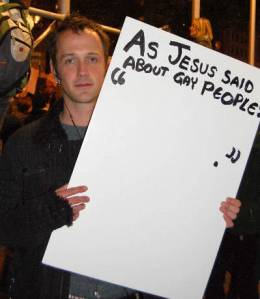
Well, true. But, in Mark 10:1-12 Jesus confirms that the archetype for marriage is one male and one female, as set forth in Genesis 2:24. Though he never made a direct condemnation of homosexuality, he did follow the Genesis teaching of marriage I set out above and that means that he would say marriage is between a man and a woman. Adam and Eve, not Adam and Steve.
The overwhelming biblical evidence is on the side of homosexuality being a sin. Only a dismal one proof text out of eight is found wanting. The person who tries to say that homosexuality is no sin has to ignore an awful lot of Scripture to arrive at that conclusion.
Now we have to consider the obvious objection: These passages are talking about lust; what about homosexual love? To which I say: love is always encouraged in both the New and Old Testaments. The Greatest Commandment is to love the Lord your God with all your heart, soul, and might, and to love your neighbor as yourself (Deut 6:5; Lev 19:18).
All references in the so-called “clobber passages” are references to the act of homosexual intercourse, not to homosexual love. Therefore, homosexual love is acceptable to, even encouraged by, God.
It is homosexual sex that is not accepted. Since it is the act of intercourse that consummates a marriage and homosexual persons can’t lawfully do that, homosexual marriage is not acceptable to God.
It requires ignoring much of the Bible’s passages and underlying assumptions to arrive at the conclusion that homosexuality is not a sin. Therefore, we conclude the act of homosexual intercourse is an abomination to God and homosexual “marriage” is not tolerated by him. The weight of the biblical evidence supports this conclusion. Love between a man and another man, or a woman and another woman, is accepted and encouraged. Leave the lust behind, like all other sins.


 Back Rome Again