Blog Archives
Why Christians Can’t Have a Meaningful Debate About Homosexuality
Many conservative Christians do not adhere to these verses [Lev 19:18 and Mt 22:39]. If they did then gays would have the same rights as heterosexuals to lawfully join in union. It is because of American Christians hatred of homosexuality that gays cannot legally bond in most states. Some Christian parents have been known to disown their children who happen to be homosexual. (source)
Mark (proprietor of Proud Atheists) has demonstrated the reason that Christians can’t have a meaningful debate with social liberals over homosexuality. We consider, with good reason, homosexuality to be a grave sin. However, calling it that causes the other side to immediately label us “homophobes,” “bigots,” or other nice names.
It is because we love our neighbors that we try to communicate that homosexuality is a sin. If we didn’t care about our neighbor’s eternal fate, then we’d just shut up and allow homosexual marriage to take place.
Mark is doing serious violence to the definition of love by making his initial claim. He’s saying that if we loved our neighbors, then we’d leave them be to express their individuality. But that’s absolutely absurd.
If my neighbor asserted his individuality by playing with matches and lighter fluid and I didn’t stop him, one could hardly make a case for me being “loving.” If another neighbor asserted his individuality by keeping 14 year old girls for sex slaves before killing them, I would hardly be called “loving” if I allowed him to continue unabated. If another neighbor decided that gambling and drinking were more important than his wife and kids, I would not be considered “loving” if I didn’t try to reason with him and show him that he’s losing his family and ruining his future.
The radio station K-Love once ran a spot where several criminals who had committed crimes of increasing severity appeared before a judge. Each time, the judge said to the offender that he was forgiven, and he could go free to sin no more–never once punishing him. The end of the spot asked, “Do you consider this judge loving?”
Of course not. We might describe that judge as apathetic, but not loving. Same as my behavior in the three hypothetical examples above.
Returning to the homosexuality example, since we consider it to be a grave sin, we would be apathetic if we allowed people to walk in it unabated. It would be no different than if we failed to denounce murder. Where we are failing to communicate is that society doesn’t think that there is anything wrong with homosexuality.
Rather than listen to what we’re trying to communicate about homosexuality, however, we are simply labeled bigots or homophobes. Emotionally loaded terms. There is no meaningful debate after that.
UPDATE:
Daniel just did the exact same thing over at Unreasonable Faith: he’s not considering that homosexuality is a sin, or that Christians should speak against it like any other sin. He’s just calling the pastor a bigot. No argument. Just name calling.
This is Just . . . WOW! (part I)
 Mark from Proud Atheists does it again! He manages to prove his general and willful ignorance of religion even while attempting to mock it. His latest diatribe is a thoughtful post titled “Dear Christians, ‘I Simply Do Not . . . .‘” It’s a fascinating line of crap from start to finish. Let’s see what we can make of it: Read the rest of this entry
Reasons Christians “Dislike” Atheists
I think it’s unfair to say that Christians dislike atheists, as Mark of Proud Atheists seems to think.
Rather, Christians are attempting to speak the truth in love to our atheist friends. We are trying to communicate to them that God is real, not an outmoded concept that science has killed. We are trying to communicate the message that humble repentance before God is the only action that can save your soul.
I don’t think that hell is the best way to evangelize. While the topic shouldn’t be avoided all together, neither should it be our first resort. Christians are accused of being judgmental, holier-than-thou, or just plain unloving to even think that someone will go to hell for living life without repenting before God.
The idea of hell should motivate us to evangelize more out of love. When George Carlin died, I read a memorial thread on TheologyOnline where the Christians were rejoicing that Carlin is now in hell. That is unloving. We should never rejoice over a soul in hell. We should mourn the lost opportunity.
“Threatening with hell” seems to be a common reason that atheists think Christians dislike atheists. But we really don’t. We care enough about someone’s eternal soul to speak the truth of hell in love, to try to give that person a chance to avoid the inevitable results of a rebellious lifestyle.
Mark, however, thinks that we Christians dislike atheists and offers the following suggestions as to why: Read the rest of this entry
Comedy from Search Engine Traffic
Like all WordPress users, I get a readout of what Internet searches led users to my blog. While most of them make sense, every once in a while I get a doozy that makes me laugh.
The one that made me laugh today was “Who is coming out of the closet this Wednesday?” Why would anyone search for a specific day of the week for that? This search was conducted on Monday, which begs the question: Does the gay community now plan ahead who is coming out on specific days?
That makes no sense. There’s no “gay agenda” such as groups like Focus on the Family claim. Right? There isn’t, right?
Coming Out of the Closet, part II
 In my previous post, I discussed the fact that Christian singer Jennifer Knapp has come out as a lesbian. I gave commentary on two of her statements to the press, one given on Larry King Live and the other appearing in Christianity Today. Knapp is, very sadly, trying to justify her homosexuality. She is speaking far above her level of knowledge, and she admits that she is doing so.
Knapp said that she is no Greek scholar, yet that doesn’t stop her from weighing in on the debate about the meaning of malakos and arsenokoites from Paul’s letters. Gay theologians are the only ones who try to debate that these words mean anything other than homosexuality. Modern etymologists agree that Paul has homosexuality in view when he wrote those words.
Knapp also said that she is no theologian, but she argued that since Christians eat shellfish and wear mixed fabrics (both of which are prohibited by the Bible), that we should also be allowed to engage in homosexual acts. She is ignoring the fact that eating shellfish and wearing mixed fabrics are ceremonial in nature, while homosexuality is read as a universal moral precept. With the Mosaic Law, the universals always apply while the ceremonial regulations have been superseded by Jesus. Read the rest of this entry
Coming Out of the Closet, part I
 It appears as though Christian singer Jennifer Knapp has recently come out of the closet. She’s been involved in a same-sex relationship for the last eight years.
ABC News and Christianity Today both broke the story, and Bob Botsford wrote the definitive post on the topic, as well as joined Knapp on Larry King Live (commentary by Mariano beginning here).
I’ve written numerous times on homosexuality in the past. I’ve discussed the proper treatment of homosexual persons (and indicted the church for its shoddy treatment of such persons) and I’ve tried to answer the controversy on whether or not homosexuality is even a sin.
My conclusion is that homosexuality is inescapably condemned by Scripture, but Knapp has refused to see that. During the Larry King interview, she said:
I haven’t gone to seminary. I haven’t gone to Bible school. Yet, I’m aware of the fact — I’m deeply aware of the fact that we’re relying on the translations of Greek and that we’re translating from a language, you and I, that is not originally our own… There are a lot of well-studied academics — both believers and seekers of God and those who are just purely trying to understand what the sacred text means to all of us — that really put question on how we’ve interpreted the words, what is it malikos and arsenokitai. There are two Greek words that we have substituted in our English language as homosexuality, which didn’t actually exist in my understanding of a lot of Greek language experts in the manner in which we use it.
The Greek words malakos and arsenokoites are mentioned. Knapp says that their exact meanings are debated by etymologists. That’s slightly misleading, as I’ve discussed here. Linguistic scholarship is unified that those words refer to homosexuals. She admits that she’s no Greek scholar, then she proceeds to discuss the meaning of Greek words. She must have heard this argument from someone and decided to latch on to what was said (even though it is demonstrably wrong) in order to justify her sin.
I’ve done that before! Haven’t all of us, at one time or another, come up with extremely lame justifications for sins that we just don’t want to let go of? I’ve since repented, and I pray that Knapp does, too. Read the rest of this entry
Bad Denver Archdiocese!
Archbishop Charles Chaput of the Denver archdiocese has recently backed a decision by a local school to expel a child because his parents happen to be a lesbian couple. Jimmy Akin, a staunch defender of Catholic moral theology, naturally sides with the bishop on this and writes his defense here. Of course, good Catholics don’t argue with the bishop once the decision is made.
I’m not Catholic anymore, so I have the luxury of disagreeing, which of course I do. Vehemently.
It is the unfortunate tendency of those who claim to be Christians to treat homosexuality as some sort of super-sin. Cries of “I’m gay!” mean that the crier is immediately ostracized from the Christian community. As if same sex attraction is somehow unforgivable.
Men, haven’t you ever seen a fine specimen of maleness and wondered what it was that drew women to him? Maybe you started to find yourself attracted, too?
I know that women judge the attractiveness of other women, so I’m not even going to as that same rhetorical question for the females.
This type of thing is hardly earth-shaking, and I much doubt that it would be sinful. Perhaps that attraction gets carried to its extreme and then you find yourself experimenting. Then you find yourself liking the results of your dalliance. It could happen to anyone.
Maybe you’re one of those who never found anything attractive about the opposite sex and always gravitated to the same sex. Again, this is hardly earth-shaking. This kind of stuff happens.
Isn’t this how any sin happens? I fantasize about killing my annoying neighbor. The fantasies become more real, and suddenly the opportunity presents itself to make them come true. Next thing I know, I’m on trial because the police found my hairs and a few carpet fibers from my house on the body.
I’ve previously argued that homosexuality is sin, but not a super sin. There is no super-sin that God will not forgive save one. The tendency of the Christian to treat homosexuality as some sort of super-sin and ostracize its practitioners is one of the largest failings of the church to reach sinners badly in need of the grace offered to us through Jesus Christ.
And now, Archbishop Chaput and his defenders are continuing this grave error. By not admitting this child because of his parents’ homosexuality, they are missing a great opportunity to witness to this young man and to teach him that his moms’ behavior is wrong. He will now grow up being taught by example that homosexuality is right and will miss what may be the only opportunity the church may ever have to show him it is sin.
No kudos to Chaput. He is eliminating whatever Christian influence that this boy may have had in his life, and sending the message that we don’t want him because his parents are sinners. Whatever happened to “Come to me, all who labor and are heavy laden, and I will give you rest” (Mt 11:28)? Or, better, Deuteronomy 24:16?
Homosexuality: Sin or Not?
In my posts on homosexuality, I merely assert that it is a sin without providing theological reasoning for why. Since I have been challenged on that point several times, I will now explain once and for all why I believe that homosexuality is a sin.
I have discussed the nature or nurture question and a theology of homosexuality. In this post, I am only considering the Scriptural evidence on whether or not homosexuality is a sin.
There are five passages of Scripture used to directly condemn homosexuality, and three that are used to indirectly condemn it. Let’s consider the direct condemnations first, then move on to the indirect ones.
The first direct condemnation is Leviticus 18:22: “You shall not lie with a male as with a woman; it is an abomination.” It doesn’t get much clearer than that. This passage clearly has homosexual behavior in view, and it quite plainly condemns the practice by calling it an abomination.
Some argue that this passage is referring only to temple service. But look at the context — every other sexual prohibition listed in chapter 18 is meant as a universal moral precept. After explaining dozens of prohibitions that are still observed today (even by the most libertine among us), the passage concludes:
So keep my charge never to practice any of these abominable customs that were practiced before you, and never to make yourselves unclean by them: I am the Lord your God. (Lev 18:30)
Clearly, all of the listed prohibitions were meant to be universally binding.
Next, we come to Leviticus 20:13: “If a man lies with a male as with a woman, both of them have committed an abomination; they shall surely be put to death; their blood is upon them.” Again, clear as day.
It is important to note that the Levitical laws are part of a larger contract with God and the people of Israel. That contract has been breached by the people of Israel and is therefore no longer in force. Therefore, by bringing this passage up, I am not condoning violence against homosexuals. It is God’s domain to punish sinners, not ours. We should seek to bring them to repentance, not judgment.
Moving on, we find three New Testament passages often used to condemn the practice. First up is Romans 1:26-27:
For this reason God gave them up to dishonorable passions. For their women exchanged natural relations for those that are contrary to nature; and the men likewise gave up natural relations with women and were consumed with passion for one another,men committing shameless acts with men and receiving in themselves the due penalty for their error.
This passage condemns both gays and lesbians. Paul is here making an appeal to the original created order, one man and one woman, as described in Genesis 1-2. Homosexuality is described in this passage not only as a sin, but as a symptom of a deeper problem within society. The problem is described in verses 21-23 — worshiping creation rather than Creator. In all of the responses to blogs I’ve done on homosexuality, I see this time and time again. “God made me this way and I’m not going to change.” That pride is what Paul has in mind here — we are beholden to what we are instead of looking to what we ought to be.
Paul goes on to describe that the guilty are not just practitioners of homosexuality, but those who condone the practice (see Rom 1:32). That means that American society, becoming ever more tolerant of homosexual practice and allowing gay “marriage,” is under God’s judgment. And, as the letter to the Hebrews points out, it is a fearful thing to fall into the hands of the living God (Heb 10:31).
The second passage in the New Testament is 1 Corinthians 6:9-10:
Or do you not know that the unrighteous will not inherit the kingdom of God? Do not be deceived: neither the sexually immoral, nor idolaters, nor adulterers, nor men who practice homosexuality,nor thieves, nor the greedy, nor drunkards, nor revilers, nor swindlers will inherit the kingdom of God.
First Corinthians 6:18a says to flee sexual immorality. So far, I’ve built a very strong case that homosexuality is just that: sexual immorality. But God promises to deliver us:
And such were some of you. But you were washed, you were sanctified,you were justified in the name of the Lord Jesus Christ and by the Spirit of our God. (1 Cor 6:11)
The Corinthians that Paul was addressing were Christians; and God cleansed them. This promise is true for us today. God will wash us of our sins in the name of Jesus.
The final passage in the New Testament is 1 Timothy 1:8-11:
Now we know that the law is good, if one uses it lawfully, understanding this, that the law is not laid down for the just but for the lawless and disobedient, for the ungodly and sinners, for the unholy and profane, for those who strike their fathers and mothers, for murderers, the sexually immoral, men who practice homosexuality, enslavers, liars, perjurers, and whatever else is contrary to sound doctrine, in accordance with the gospel of the glory of the blessed God with which I have been entrusted.
Again, this passage speaks for itself. Homosexuality is a clear sin, and those who practice it are unrighteous along with the other people on the list.
The words translated “men who practice homosexuality” in the ESV are actually two Greek words. One literally means “soft” and the other is untranslatable (some think Paul coined it, but it isn’t unique to him).
Objectors say that since we don’t know what these words mean, then we can’t attribute them to homosexuality. Contemporary scholarship, however, does not side with these objectors. “Soft,” we think, refers to the passive partner in homosexuality (the “bottom” in today’s slang) and the other term refers to the active partner (the “top”). By using both terms, Paul meant to indicate both offenders sinned. He was trying to leave no doubt that homosexuality is a sin.
While the direct condemnations of homosexuality should be enough to prove the practice is sinful, it doesn’t convince everyone. So there are three indirect references that are usually mentioned. Let’s take a peek at those.
We’ve all heard “God created Adam and Eve, not Adam and Steve.” In the original created order, God created male and female in his image (Gen 1:26-27; see also Gen 2:24). From this, we can posit that he did so for a reason because God works everything after the counsel of his will (Eph 1:11) and brings everything to a conclusion he has declared (Is 46:10). The most damning direct condmenation, Romans 1:26-27, assumes male and female as the original created order or it would have no force.
The next indirect condemnation is the story of Sodom (Gen 19:1-29). But the question is often raised, “Was the sin of Sodom really homosexuality?” Critics point to Ezekiel 16:49, which seems to suggest that the real sin of Sodom was unkindness to travelers in need. But that sin is mentioned nowhere in the Law, so it is doubtful that God destroyed the city for that reason. Sexual immorality in general is mentioned as the cause of the destruction of the city in Jude 7, but no specific mention of homosexuality.
Therefore, I would seriously caution Christians not use the story of Sodom to condemn homosexuality. That means the pro-homosexual party has batted down one passage out of seven (so far) to make their case. It doesn’t look good, but we still have one more to look at.
The third indirect condemnation comes from Jesus himself.
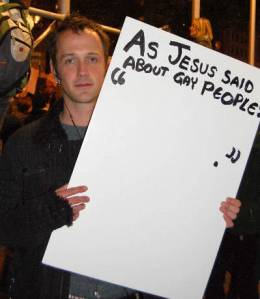
Well, true. But, in Mark 10:1-12 Jesus confirms that the archetype for marriage is one male and one female, as set forth in Genesis 2:24. Though he never made a direct condemnation of homosexuality, he did follow the Genesis teaching of marriage I set out above and that means that he would say marriage is between a man and a woman. Adam and Eve, not Adam and Steve.
The overwhelming biblical evidence is on the side of homosexuality being a sin. Only a dismal one proof text out of eight is found wanting. The person who tries to say that homosexuality is no sin has to ignore an awful lot of Scripture to arrive at that conclusion.
Now we have to consider the obvious objection: These passages are talking about lust; what about homosexual love? To which I say: love is always encouraged in both the New and Old Testaments. The Greatest Commandment is to love the Lord your God with all your heart, soul, and might, and to love your neighbor as yourself (Deut 6:5; Lev 19:18).
All references in the so-called “clobber passages” are references to the act of homosexual intercourse, not to homosexual love. Therefore, homosexual love is acceptable to, even encouraged by, God.
It is homosexual sex that is not accepted. Since it is the act of intercourse that consummates a marriage and homosexual persons can’t lawfully do that, homosexual marriage is not acceptable to God.
It requires ignoring much of the Bible’s passages and underlying assumptions to arrive at the conclusion that homosexuality is not a sin. Therefore, we conclude the act of homosexual intercourse is an abomination to God and homosexual “marriage” is not tolerated by him. The weight of the biblical evidence supports this conclusion. Love between a man and another man, or a woman and another woman, is accepted and encouraged. Leave the lust behind, like all other sins.
Homosexuality: Nature or Nurture?
Though it has long been my position that homosexuality is nature, there is new scientific evidence to suggest otherwise. There may, in fact, be more environmental factors than genetic factors in the homosexual lifestyle.
More to the point, it appears that there is simply a lack of evidence to prove that there is a so-called “gay gene,” and that same sex attraction (SSA) is an environmentally induced decision. At least that is what Joseph Nicolosi, founder and director of the Thomas Aquinas Psychological Clinic says.
His message to gays: You can change. He has had success in reparative therapies for homosexual persons, and believes that we, as Christians, should witness to our gay brothers and sisters and let them know that they don’t have to be homosexual. That homosexuality is nature rather than nurture is actually a political statement by the American Psychological Association (APA), and has no basis in scientific fact.
Read the entire article here.
Sins of Scripture IV: Homosexuality
Former Episcopal bishop John Shelby Spong (or is it bishop emeritus?) writes next about the treatment of gays in his book The Sins of Scripture. I agree that the church has treated gays and lesbians unfairly. But I disagree with Spong that homosexuality is no sin. Clearly condemned in multiple places, the sin of homosexuality has become some sort of “super-sin” to evangelicals.
The only “super-sin” is blaspheming the Holy Spirit.
Homosexuality, therefore, should be treated as any other sin. The sinner should be confronted about it, and walked through the Scriptures that condemn the practice. If he or she refuses to repent, I don’t think that ostracizing the poor chap is the answer–although a case could certainly be made for it. I think that prayer is the answer, like we would do for any other sin. Of course such a person would be excluded from church leadership, again, the same as with any sin.
Bishop Spong, however, believes that homosexuality is an inborn characteristic and as such is perfectly acceptable. What Spong fails to deal with, however, is that rage and alcoholism are also inborn characteristics. But no one would ever seriously argue that those two things are good, so why is homosexuality any different?
I also happen to believe that we are born with our sexual orientation. It fits perfectly with Jesus’ teaching to deny ourselves in order to follow him. Everyone has sin in their lives that they must deal with. The homosexual person has an orientation that is offensive to God, and he or she must deal with that sin just as the rest of us deal with ours. They shouldn’t get a free pass just because society is coming around to accept homosexuality for the first time in 10,000 years of human history.
Spong deals with three texts of the Bible that are used to condemn homosexuality: the holiness code of Leviticus, the story of Sodom, and Paul’s letters. Throughout his treatment, Spong uses emotionally loaded terms like “bigotry” and “homophobia” to describe people that hold to the Bible’s clear teaching that homosexuality is a sin. He often states that Bible-defenders get angry or upset when confronted with arguments in favor of homosexuality. What he never does is present an argument, or even a concise summary of his opponents’ views.


 Back Rome Again