Blog Archives
I HATE Cutesy Christian Slogans
Not that long ago, I was driving by a local church and the marquee, appallingly, told passers-by to pray for whatever they wanted, and God would provide it for them. It said this in a cutsey, easy-to-remember slogan. Ironically, I can’t remember the slogan. I had meant not only to blog about it, but to send the pastor a protest letter explaining why that was a bad slogan, and why such propaganda may draw people in for the short term but is very damaging for the long term.
The primary reason for this is simple: what is the pastor of that church going to tell someone who didn’t get what they prayed for? The congregant was “lured” into this church with the promise that God affirmatively answers all prayers, which any student of Bible and/or common sense can tell you is not the case. Any answer given by the pastor is damaging at this point.
If the pastor fesses up to the truth, which is that God will occasionally say “No,” given that God is an agent with a plan of his own that comes before the individual desires of his worshipers rather than an impersonal, wish-granting force, then it appears as though the church is using half-truths to fill pews and get tithe money for its own ends.
If the pastor says that the congregant doesn’t have enough faith in God, that raises the question of how much faith one really needs to receive effective answers to prayer. The congregant immediately concludes he doesn’t have enough faith, wonders what he can do to get more faith, and feels like a failure as a Christian. All the congregant needs to do now is pick up a copy of The God Delusion and guess what happens next.
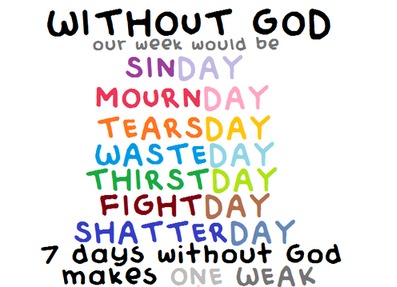 But I never got around to either the post or the letter. What reminded me is a blog post from No Forbidden Questions about a Christian meme that has been making its way around the e-mail circuit, which is pictured to the right. As with all cutesy Christian slogans, I hate this graphic. It only tells a half-truth.
NFQ says this makes it seem as though unbelievers experience these things regularly, while believers are immune to it. Or, as commenter Andrew puts it, “The grass is always browner on the other side of our beliefs.” Read the rest of this entry
Money Quote
I was reading an article from ABC News that profiled two anonymous ministers that, despite their atheism, continue in their positions as senior pastors. That really makes me mad. They are doing their congregations a great disservice, and are being major hypocrites. Atheists talk constantly about the hypocrisy of believers, but it looks as if many of them fare no better with major issues of integrity. But that’s not really the point.
The point is that there is a single money quote from Adam, one of the ministers-turned-atheist, that sums up two things very nicely. First, why he was able to wholly change his worldview so readily. And second, what is wrong with American Christianity and why it is in serious decline:
As I lost my faith … I realized that really had no bearing on who I am and my character and my actions. I live no differently than I did when I was a fervent believer.
Contrast that with the proper attitude of the believer toward his faith, summed up nicely by C.S. Lewis: “I believe in Christianity as I believe that the sun has risen: not only because I see it, but because by it I see everything else.” Adam’s problem is that he isn’t living any differently as an atheist than he did as a Christian.
The reverse is true as well. Christian converts live no differently than they did when they were unbelievers.
If the atheists are right, and there is no God, then a quick look at human history ought to be pretty disturbing. Wars, violence, greed, corruption, and horrible human rights violations permeate history like a cancer. We’ve always been violent and savage, and there’s no hope that we can change ourselves. We’ve tried and it doesn’t work.
But, if the Christian is correct, then God exists and he will recreate civilization so as all the war, violence, greed, corruption, and human rights violations are a thing of the past. That means we have hope. And, both Paul and James exhorted us to live as though we have it.
The problem is that even our ministers don’t seem to be living as if this hope is real, and the proof is this article. They readily abandon a dearly held worldview because, as Adam put it, there’s no difference in how he lives!
That’s really sad.
Great Quote from Facebook
A friend of mine on Facebook posted a great status that I thought I’d steal–I mean, share:
Nothing is random in His Kingdom. Everything that happens fits into a pattern for good, to those who love Him. Instead of trying to analyze the intricacies of the pattern, focus your energy on trusting Him and thanking Him at all times!
I try to keep things intellectual here at all times, but there’s something to be said for having a child-like faith that doesn’t need a complicated apologetic defense. The problem with most skeptics that I talk to is that they “psych themselves out,” so to speak.
They look at things like starving children in Africa, the candiru parasite, or anything else they don’t like about the world and conclude, “God didn’t make this. No good god would make a world like this one!” Well, there’s an apologetic defense for that (hint: it’s called “the Fall”), but why do I have to recite it? Yes, there are problems in the world. Making me (or any other Christian apologist) defend God against everything in the world that sucks is “analyzing the intricacies of the pattern.”
Instead, let’s trust God to work it out. The world as we know it is a giant Tower of Siloam. What did Jesus say to those trying to analyze the pattern?
Or those eighteen on whom the tower in Siloam fell and killed them: do you think that they were worse offenders than all the others who lived in Jerusalem? No, I tell you; but unless you repent, you will all likewise perish. (Lk 13:4-5)
Focusing on minutia for which I readily admit that I don’t have an answer to is beside the point. Instead, let’s fix our eyes on God, who will work all of these things out for the good of his elect (Rom 8:28). This comes back to the real definition of faith: trust. Trust God to be who he has revealed himself to be in Scripture.
Missing the Point
When a person hates something so deeply, like religion and everything that it stands for, then said person can see something that paints the object of his hatred in a positive light and completely, totally, utterly miss it. Especially when this “something” seems to paint the object of hatred negatively at first.
This clip from the TV series Firefly seems to be painting religion (specifically, the Bible) in a very negative light:
River, always logical to a fault, is trying to “fix” the broken parts of the Bible. At least what she perceives to be broken. Shepherd Book, on the other hand, tries to explain something that uber-logical River probably isn’t equipped to understand: what it means to actually have faith in something intangible yet bigger than yourself.
I like what Book tells her: “You don’t fix faith. Faith fixes you.”
 Book points to a deeper truth about faith: that it is meant to fix our broken human condition. We who have faith acknowledge that our condition is flawed and that it requires fixing. We also realize that we aren’t capable of doing that on our own: God is required to heal our souls. That’s where faith–that is, trust–comes in. We have to trust that God is capable of doing that, that God is willing to do that, and that God will do that (see Rom 8:29-30).
In the end, this clip gives an excellent definition of what it means to have faith in something larger than ourselves–faith in the divine. At first blush, this scene seems to be making a negative comment about the Bible itself, and religion in general. In reality, it is driving home what Christianity has always taught: that we are broken and in need of a Savior who accomplishes our salvation through faith. The faith we have fixes our broken human condition.
The real point of this clip is utterly lost on the atheists. If you don’t believe me, read the comments below the clip:
“faith fixes you” my a**. faith breaks you down and then makes you into an unthinking zombie, at least our current faiths act as such.
the only way to “fix” the bible is to burn it and p*** on the ashes. (edited for content, by “theeyeisblind” with four “thumbs up” from other users as of this writing)
Related Articles
- Faith is the Means (joshharris.com)
Great Quote

Cover via Amazon
“I suspect that most of the individuals who have religious faith are content with blind faith. They feel no obligation to understand what they believe. They may even wish not to have their beliefs disturbed by thought. But if God in whom they believe created them with intellectual and rational powers, that imposes upon them the duty to try to understand the creed of their religion. Not to do so is to verge on superstition.”
– Mortimer J. Adler
Mortimer J. Adler, “A Philosopher’s Religious Faith,” in Kelly James-Clark (ed.), Philosophers Who Believe: The Spiritual Journeys of Eleven Leading Thinkers
H/T to Apologetics 315.


 Back Rome Again