Blog Archives
Another Argument by Twitter
I hate argument by Twitter. Atheist @Monicks tweeted the following on Jan 5, 2011:
If there really were a god, nobody would need faith!
Faith = Trust. Sorry, but you FAIL–once we see that God exists, then we would still need to trust him. That trust is informed by reason (not opposed to it), by virtue of God’s past dealings with humanity. Those dealings are described in the Old Testament, and the sovereignty of God is re-enforced in both Testaments. God has ordained the end as well as the means: he is in total control. As Jesus aptly put it, “Whoever is not with me is against me, and whoever does not gather with me scatters” (Lk 11:23).
The issue is your definition of “faith.” It is most emphatically not “blind faith,” or “belief in spite of overwhelming evidence.”
Questions Christians Hope No One Will Ask, part 3
Former Christian turned atheist DaGoodS (DGS) has compiled a list of eleven questions that he doesn’t think Christians can answer. I’ve decided to take him on, since I’m a sucker for questions that Christians supposedly can’t answer. Hopefully, DGS and I can learn something from each other.
Question #3 embodies two typical atheist objections to Christianity, which I’ve answered in my reply to God is Imaginary here and here. DGS asks:
If you believe your God has phenomenal cosmic power, and is able to sustain the universe, why do you have savings accounts, pension plans, insurance, college funds, stock portfolios and locks? Just in case?
DGS links to his previous article on that topic, which I will now specifically address. The post talks about how a church had armed guards in place, and one managed to halt a tragedy in progress (see this news item).
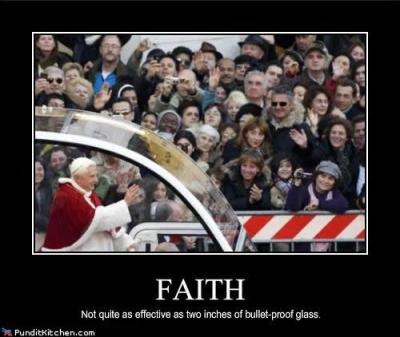 DGS says that when churches put things like this place, they are not acting as if God exists. Kind of like the sarcastic picture on the right. More to the point:
Stores and business put locks on doors. We would say that is wise of them to do so. But is a Christian demonstrating a lack of faith by doing the same thing the world does?
I don’t think that the Christian is. I think that the Christian is displaying good stewardship. More on that in a minute; first, let’s take a look at the so-called biblical support that DGS feels refutes some possible counterarguments.
Christians might say we aren’t called to be stupid. To that, DGS says:
Every church I have ever attended had locks on the door. Every church I attended in the past two decades also has an alarm system.
If God was in control—why would there need to be locks? Oh, we can claim God doesn’t want us to be stupid, and we should use common sense and wisdom, yet this flies in the face of 1 Cor. 1:20-21 which says the wisdom of the world is foolishness.
First Corinthians 1:20-21 is part of a larger argument (1:18-2:16) and isn’t a call to reject all wisdom of the world. It is an argument for accepting Jesus as Messiah despite the fact that he died the most shameful and disgraceful death that a person could die. In the ANE, a crucifixion all but guaranteed a type of public humiliation that we have no equivalent for in the modern world: everything the crucifixion victim did and everyone he was related to suffered disgrace, humiliation, and was ostracized from society. Paul was arguing that God often uses foolishness to shame the wise and worldly. Therefore, I don’t find that this verse particularly supports DGS’s argument that churches shouldn’t need door locks if the faithful who worshiped there truly trusted God.
Just what is God’s wisdom on protecting earthly things, then? Jesus very often told parables where a rich landowner trusts possessions to a steward (usually a servant of some sort). The rich landowner represents God, and the servants (stewards) represented humans. Using this imagery, Jesus is teaching us to be good stewards. Ultimately, everything belongs to God, and he will ask for it back some day. Better to return in better condition than we found it, for God won’t accept it in the same condition (and that probably means he will be outraged if it is worse condition!).
The Parable of the Talents (Mt 25:14-30) is a good illustration. Here, a landowner goes on a journey and entrusts talents to three different servants (v. 15). The first two invest the money wisely and return the original talents with dividends to the landowner (vv. 20-23). The third, however, buried his and thus was only able to return the original talent (vv. 24-25). This enraged the landowner. He told the servant he should have at least put the talent in the bank, that way at least it would have accumulated interest (v. 27).
The point is that God expects us to be good stewards of what he has given us–and it all comes from him, the spiritual (Eph 1:3-4) and the material (Jms 1:17) blessings. In order to fulfill that calling, we must take measures to protect what God has given us; not burying it like the slothful servant in the Parable of the Talents, but locking the door and alarming the building.
Accidents do happen, and therefore the church should take an insurance policy out for fire, theft, or other contingencies. Could the God of the universe stop a fire from hitting a church? Of course he could! But trials come (Jms 1:2-4), and it is through those trials that our faith is made stronger (Jms 1:12). We are just fools if we don’t think it could happen to us.
This isn’t showing a lack of faith in God’s ability to protect us, but is showing our obedience to him in safeguarding what he gave rightfully to us to use. We are the servants who are investing our talents and paying God back the original plus dividends.
Next:
Ever attend a church which has a building project? Perhaps needs a new roof? The same thing—a chart is put up in the lobby in the form of a thermometer, with each “goal” of contribution being a mark, and as the money comes in from the members, it is slowly filled in with red. Does the church say, “We need a new roof—don’t worry—God will provide”? Nope. The church says, “We need a new roof. Let us pray, and pass the plate.”
While the thermometer picture is overused, that’s not really the point here. The tithe is frequently brought up as a lack of faith in God. In reality, the tithe is a test. It is often said that God loves a cheerful giver (2 Cor 9:7). This is true, and we (as Christians) aren’t giving 10% compulsively, under duress or penalty of hell. Rather, we are giving as an act of worship some of which God has given us so that the wealth can be spread. And we don’t have to give 10%; we may give what our hearts (and budgets) allow, proportionate to the wealth God has given us. We could give less, or (better) we could give more.
I’m not Pat Robertson or Paula White. I am not suggesting that giving more than 10% will give you yet more wealth in return. That isn’t promised anywhere in the Bible. Instead, I want to unequivocally say that I believe that the tithe isn’t limited to 10%, nor is it a 10% minimum. Giving what we can afford is the mark of responsible stewardship. This isn’t to reap a material reward, but to reap a spiritual one.
Churches do more than just build buildings: they fund missionaries and assist needy families in the area. All of that is made possible by the tithing of the faithful.
Yes, churches also pay bills and staff members’ salaries out of that tithe, but those are necessary and worthy expenses. The bills enable the building to have heat, running water, and other amenities that a person would expect from a quasi-public building. Which could work to bring in people, and in some cases (as is egregiously demonstrated in a TV spot for a church local to me) keep people coming. (My wife and I were both struck by this TV ad, which asks members of that church why they come to services. Only one of the half-dozen or so interviewees mentioned Jesus. One touted the fact that the church has a rock-climbing wall!)
As for staff salaries, the staff members are domestic missionaries, charged by God with spreading the gospel. Even Paul agrees that paying a church minister is a worthy use of the tithe (1 Cor 9:1-14; yet he himself does not by choice vv. 15-18).
While DGS sees health insurance and requests for tithe money as faltering on the part of the faithful, I believe that both are examples of the faithful’s obedience to God. We give tithes not out of compulsion or fear of hellfire and damnation, but out of love for God–to see the work of the gospel, spread by faithful ministers, continue to touch lives in our local community and abroad. Insurance of all sorts protect what we have, showing that we are good stewards in preparing for the inevitable destruction of earthly goods.
Much more could be said about stewardship. It is a lifestyle, not a formula for managing money. Time, talents (like singing, not the money in the above parable)–everything that is a gift from God should be used for his glory, proportionate with what the Christian can give. This is true obedience, not cowering in fear and lack of faith.
Questions Christians Hope No One Will Ask, Sidebar on 1 Corinthians
The first of today’s posts on DaGoodS’s (DGS) questions will come a bit later, as I wanted to examine a side issue that was raised. The discussion revolves around a specific interpretation of 1 Corinthians 1:20-21. DGS thinks it supports a rejection of all worldly wisdom. However, I believe that in its proper context, it is trying to argue something far different. Read the rest of this entry
Questions Christians Hope No One Will Ask, part 2
Former Christian turned atheist DaGoodS (DGS) has compiled a list of eleven questions that he doesn’t think Christians can answer. I’ve decided to take him on, since I’m a sucker for questions that Christians supposedly can’t answer. Hopefully, DGS and I can learn something from each other.
Question #2:
What’s your source?
DGS links to this article, and the conversation that ensued when DGS asked the blog author what his source was for Papias.
First, a little background. There is some serious contention about the authorship of the Gospels from critics of Christianity (and only critics of Christianity; neutral scholars never raise questions of this sort). They say we can’t trust the Gospels since they were authored anonymously. Leaving aside the issue of the trustworthiness of anonymous sources (it does not follow that a source is untrustworthy solely because it is authored anonymously; that is grossly untrue and totally ludicrous to even raise as an objection–a work should be judged on its own merits and not dismissed because we don’t know the authorship), are the Gospels really anonymous? Read the rest of this entry
More on PrayerMarket.com
In a previous post, I spoke of a new website called PrayerMarket.com in which users traded prayers for reward money. Basically, I thought the whole idea was reprehensible. I’m not alone; other bloggers who were directly contacted by the site’s founder have pretty much agreed with that sentiment:
- “PrayerMarket–Pay for Pray? Um, No” (on Equus Nom Veritas)
- “Pay for Prayer? Not on my Blogs!” (on Faith of the Fathers)
- “Prayermarket.com” (on The Orthodox Pathway)
The first two are Catholic websites and both used a term that’s new to me, but the concept it describes isn’t. The word is simony: the act of exchanging money for spiritual goods. The origin of the story is Simon the Sorcerer, which is described in Acts 8:9-25. The crux of the sin is found in verses 18-19:
Now when Simon saw that the Spirit was given through the laying on of the apostles’ hands, he offered them money, saying, “Give me this power also, so that anyone on whom I lay my hands may receive the Holy Spirit.”
Offering money to obtain the gifts of God, rightfully obtained solely by God’s grace is not a sign of a penitent heart. The apostle Peter told Simon that his heart wasn’t right before God, and commanded the sorcerer to repent (verse 21-22).
Someone suggested Steve Colbert do a story on it. Not a bad suggestion; there is much to be mocked.
John Wilson, founder of the site, has agreed to an interview with me. I will reprint the interview below in Q&A format, with some further comments from me. Read the rest of this entry
Questions Christians Hope No One Will Ask
Through Dave Armstrong, I’ve found an ex-Christian atheist who goes by DaGoodS (I’ll call him DGS). He runs a blog discussing (naive) critiques of his former faith (don’t all ex-Christian atheists?) called Thoughts from a Sandwich.
Scanning his blog, I discovered this entry from November of last year. He has picked up a book called The Questions Christians Hope No One Will Ask. His description is apt:
The author referred to a survey where 10,000 Christians were asked, “What Questions do you find difficult to answer?” and compiled a list of the top ten; the author kindly provides Christian responses.
DGS doesn’t think that the questions in the book are very good, and I’m also guessing that he finds the answers lacking as well.
Since I’m a sucker for questions that Christians allegedly can’t answer, I thought I’d take a shot at DGS’s list. Starting today, I’ll take a poke at two questions per day, posting one first thing in the morning and one in the late afternoon.
I’m hoping we can learn something from each other. Read the rest of this entry
Ever Wonder Why Atheists Have Certain Misconceptions About the Faith?
Atheists have the misconceptions that they have because believers have them, too. I follow several blogs attached to the website XXXChurch.com. Why? Because both implicitly and explicitly I have made mention that my spiritual weakness is pornography and lust. So I read the Confessions Blog and follow the Couples, Men, and Parenting Blogs from that site for moral support to stay away from that stuff.
One of the misconceptions that atheists often have is that God will take care of everything for you and make your life easy. Since that never seems to materialize, the atheist then concludes God doesn’t exist. The problem? God never once promises to make life easy.
After Adam ate the forbidden fruit, God cursed the ground, the earth, and all of creation. God decreed that, instead of living in the lap of luxury, we would now toil and labor to get anything from the earth. That hasn’t changed just because Jesus hung on the Cross. Our sins are now forgiven, but that doesn’t mean that we automatically get a gold ticket.
Atheists think that we should, and argue in that manner. Prime example: God is Imaginary, proof #28. The author (Marshall Brain?) states:
A rational person rejects all human gods equally, because all of them are equally imaginary. How do we know that they are imaginary? Simply imagine that one of them is real. If one of these thousands of gods were actually real, then his followers would be experiencing real, undeniable benefits. These benefits would be obvious to everyone.
He states that all prayers would be answered affirmatively, and followers would live longer, be healthier, and be wealthier. In other words, God is somehow obligated to bless us with vast material wealth, even though this same God warns us repeatedly not to rely on or accumulate excessive material wealth. (Here’s my full rebuttal to proof #28).
Where are atheists getting misconceptions like this? God has blessed us with all of the heavenly blessings (Eph 1:1-3), which are far greater than any earthly things (Heb 8:1-13). Why must God give us earthly blessings as well?
What’s the source of the misconception? Believers. Believers also seem to think that God will provide everything for them . He will take care of our needs, but he is not going to bow to our every desire. Just because we want something doesn’t mean we automatically get it (Phil 3:19).
Here’s a prime example from the Men’s Confessions Blog of XXXChurch.com of a Christian who should know better nonetheless having the idea that God is going to do everything for him:
Um well my first introduction to porn was about when I was 12. But it was nothing serious or anything, just a curious mind. I thought it was just normal at first. But that first time turned into hundreds of times.
That’s how it works. Trust me. I didn’t even like my first exposure to pornography. I couldn’t understand what was so hot about looking at a girl without clothes. Naked people look kind of silly, I thought. Oh, how my opinion changed. And changed quickly, I might point out!
It is really sad because I am a very strong Christian, in fact I am a minister. Even further than that I am the youth minister and director of my church.
Well, not surprising. He may be a minister, but he’s also a guy. Guys like to see women in nothing or next to nothing. Human sexuality creates some powerful urges, but it’s all in how one directs and uses them because they won’t stop and God doesn’t take them away. Hold that thought, and remember it; etch it on your forehead with an Xacto knife if you must: God doesn’t take sexual urges away. It would do more harm than good.
It used to be just a fun thing to do but now it is consuming my free time, even my life.
I can relate, unfortunately. Porn consumed a lot of my time and untold amounts of my money. And it starts out as just something fun to do every once in a while.
And I know God is able to remove the desire from me, but I have been praying for so long and still not seeing any change.
This guy’s a minister? Doesn’t this situation sound familiar to him at all?
I have the faith that He will do it for me, . . .
He didn’t for the apostle Paul, why would God do it for this guy? I’m not knocking his ministry, because he probably does quite a bit of good, but I’m pretty sure Paul was a lot more important in the grand scheme of God’s plan than this one church. If God used a persistent sin to humble Paul into the realization that the grace of God is sufficient for all sins, then he’s probably going to do the exact same thing for this guy.
. . . it’s just why does it have to take so long. I really am tired of doing it. I’m tired of living this double life. I want to be completely and totally sold out for God. Please continue to pray for and with me.
If he wants to be free, then be free. God has already given all Christians the resources needed to live a spiritually fulfilled life:
Blessed be the God and Father of our Lord Jesus Christ, who has blessed us in Christ with every spiritual blessing in the heavenly places, even as he chose us in him before the foundation of the world, that we should be holy and blameless before him. (Eph 1:3-4)
Notice the present tense: “who has blessed us in Christ.” It’s not a future blessing we’re expecting. It’s a present tense blessing we receive!
Stop waiting for God to remove the desire. He’s not going to do that. Instead, look for more productive ways to channel the desire. Redirect it. Celibacy is a discipline; here’s Jimmy Akin on that topic, with several distinctions of confusing terms.
One of My Pet Peeves
I have a friend who read the title and thought of a great Taco Bell story immediately. One that involved a cellphone, a rude customer, and me expressing my anger in an unhealthy way. But that’s not what I’m here to discuss.
Rude cellphone use, when it interferes with one’s ability to properly interact with people physical present in one’s environment, is one of my pet peeves still today. But the pet peeve under discussion goes by a few names. I think the most common one is spin.
Spin is when you’re asked a fairly direct question and your answer to it fails to actually answer it. It’s commonly employed by politicians. People who use it generally come off as having something to hide.
An example of spin can be seen in this video. William Lane Craig asks Christopher Hitchens a simple question: “What variety of non-theist are you?” Hitchens won’t answer, because none of the choices are convenient for his argument.
Spin isn’t limited to unbelievers. Christians do it to, especially where soteriology is concerned. Religious pluralism is a fairly hot topic right now, and many Christians, fearing reprisal from the culture, don’t want to adopt the “wrong” view according to culture. Yet we want to adopt the right view according to God, not the view that is going to win us the most points in the culture.
Dr. Randal Rauser, in this article, has been asked a direct question about soteriology: “So… what is it one must believe or trust [to be saved]? And how does it lead to works?” But does he answer it? Nope. He spins. Read the rest of this entry
Things That Should be Free: PrayerMarket.com
In a previous post, I’ve lamented that there are few resources for Christian churches that are 100% free of charge. Most charge some sort of membership fee, either lifetime or monthly. The ones that are free are, regrettably, extremely limited in quality and quantity of resources.
I think someone ought to open up a website that enables users to download high quality sermon resources for free. The site should subsist entirely on donations and/or PPC advertisement.
I would love to look into the feasibility of something like that, and perhaps trying to collect sermons, sermon series, scripts, videos, and other resources that match or exceed the quality of SermonSpice.com or the Skit Guys, but will be available free of charge to the public.
That’s just a dream. Perhaps it could become reality one day. We shall see!
As a follow up to my rant on resources that ought to be free, I thought I’d examine a few resources that exist out there that ought to be free, but really aren’t. This post fits in with my study theme of the month: prayer!
I’ve recently stumbled on to a site called PrayerMarket.com. It’s exactly what it sounds like. The site buys and sells prayers. That is absolutely reprehensible. The very concept is outright offensive. Read the rest of this entry
Wit and Wisdom of Facebook
For some reason, one of my Facebook friends inspires quite a few blog entries. So I would like to send a shout out to Domonique–thanks for staying my friend even though we don’t work together anymore. I swear I’ve been getting half my material from your posts recently.
The chatter on Domonique’s recent status update gives us some insight as to why many people refuse to bow the knee to our Lord.
I used to work with Domonique, so I’m confident that she’s a Christian and the deeper meaning I’m drawing from this doesn’t apply specifically to her.
I have no idea what Domonique’s friend Taylor’s religious leanings are. There is nothing on her Facebook profile to suggest that she’s a Christian, but nothing that would suggest she isn’t. No Atheist As or links to anti-Christian/anti-Bible propaganda sites.
The conversation is typical for young, single women. Domonique is moaning that all the good men seem to elude her, and Taylor agrees. Taylor also says that even good men lie to their women. Then Domonique makes the following comment:
I know, i wish i could marry jesus.
To which Taylor replies:
Jesus had a big beard. I do not find big beards very attractive. perhaps if he were to shave i would be happy 🙂
I don’t know if the insight I’m about to offer from this applies to Taylor or not. This insight is meant generally, and I’m not directing it to Taylor personally. Taylor, if you’re reading this and I come off as though I’m personally attacking you, please forgive me because that isn’t my intent! But if you see yourself in this as a Christian and can profit from it, then please consider it a gentle rebuke from a brother in Christ.
Taylor’s comment is interesting in that it reflects the typical desire that underlies most attacks on prayer and original sin. Here, Taylor wants Jesus to change something about himself in order to make him more palatable to her.
The reality, for the Christian, is that we (as humans) are repugnant to God. We must realize this as a prerequisite for saving faith. Once that realization is made and we receive Christ in faith, then begins the long process of sanctification: making ourselves more palatable to God. Taylor (and most skeptics that I’ve dealt with) reverse the formula. Reversing the formula is idolatry.
Again, this isn’t meant as a personal attack on Taylor, and if it was perceived as such then I apologize. I only meant to convey an important insight.
For more information on just how repugnant we humans are to God, please see my essay on total depravity.


 Back Rome Again