Happy Easter!
It’s Easter, the celebration of the Resurrection of Jesus Christ. The disciples had no idea what was coming. The first reports came in: they didn’t believe it. But then more reports. Soon, they saw for themselves.
The importance of Easter cannot be overstated. Paul said it like this:
Now if Christ is proclaimed as raised from the dead, how can some of you say that there is no resurrection of the dead? But if there is no resurrection of the dead, then not even Christ has been raised. And if Christ has not been raised, then our preaching is in vain and your faith is in vain. We are even found to be misrepresenting God, because we testified about God that he raised Christ, whom he did not raise if it is true that the dead are not raised. For if the dead are not raised, not even Christ has been raised. And if Christ has not been raised, your faith is futile and you are still in your sins. Then those also who have fallen asleep in Christ have perished. If in Christ we have hope in this life only, we are of all people most to be pitied. (1 Cor 15:12-19, emphasis added)
Fortunately, that is not the case!
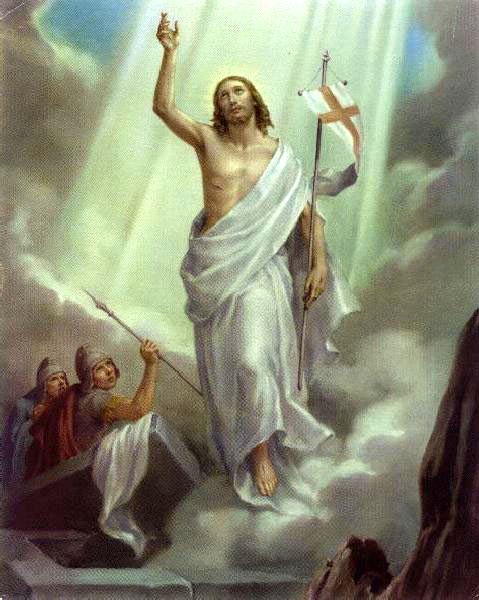
But in fact Christ has been raised from the dead, the firstfruits of those who have fallen asleep. For as by a man came death, by a man has come also the resurrection of the dead. For as in Adam all die, so also in Christ shall all be made alive. But each in his own order: Christ the firstfruits, then at his coming those who belong to Christ. Then comes the end, when he delivers the kingdom to God the Father after destroying every rule and every authority and power. For he must reign until he has put all his enemies under his feet. The last enemy to be destroyed is death. For “Godhas put all things in subjection under his feet.” But when it says, “all things are put in subjection,” it is plain that he is excepted who put all things in subjection under him. When all things are subjected to him, then the Son himself will also be subjected to him who put all things in subjection under him, that God may be all in all. (1 Cor 15:20-28)
Holy Week (Saturday): What’s Going On Here?
Holy Saturday is a day of waiting for our Lord to be raised. Many times, he predicted this. Yet, the disciples cowered and hid, not sure of what was going to happen. Their teacher was disgraced. Did they believe a lie?
They certainly didn’t believe the predictions, or else they had no idea what the predictions meant at the time Jesus was making them.
So the Jews said to him, “What sign do you show us for doing these things?” Jesus answered them, “Destroy this temple, and in three days I will raise it up.” The Jews then said, “It has taken forty-six years to build this temple, and will you raise it up in three days?” But he was speaking about the temple of his body. When therefore he was raised from the dead, his disciples remembered that he had said this, and they believed the Scripture and the word that Jesus had spoken. (Jn 2:18-22)
They only realized later what Jesus meant. Jesus predicted his death and Resurrection at other times:
Then some of the scribes and Pharisees answered him, saying, “Teacher, we wish to see a sign from you.” But he answered them, “An evil and adulterous generation seeks for a sign, but no sign will be given to it except the sign of the prophet Jonah. For just as Jonah was three days and three nights in the belly of the great fish, so will the Son of Man be three days and three nights in the heart of the earth. The men of Nineveh will rise up at the judgment with this generation and condemn it, for they repented at the preaching of Jonah, and behold, something greater than Jonah is here. The queen of the South will rise up at the judgment with this generation and condemn it, for she came from the ends of the earth to hear the wisdom of Solomon, and behold, something greater than Solomon is here. (Mt 12:38-42)
On the final trek to Jerusalem, Jesus predicted his death and Resurrection three times:
From that time Jesus began to show his disciples that he must go to Jerusalem and suffer many things from the elders and chief priests and scribes, and be killed, and on the third day be raised. And Peter took him aside and began to rebuke him, saying, “Far be it from you, Lord! This shall never happen to you.” But he turned and said to Peter, “Get behind me, Satan! You are a hindrance to me. For you are not setting your mind on the things of God, but on the things of man.” (Mt 16:21-23)
Then:
As they were gathering in Galilee, Jesus said to them, “The Son of Man is about to be delivered into the hands of men,and they will kill him, and he will be raised on the third day.” And they were greatly distressed. (Mt 17:22-23)
Again:
And as Jesus was going up to Jerusalem, he took the twelve disciples aside, and on the way he said to them, “See, we are going up to Jerusalem. And the Son of Man will be delivered over to the chief priests and scribes, and they will condemn him to death and deliver him over to the Gentiles to be mocked and flogged and crucified, and he will be raised on the third day.” (Mt 20:17-19)
The disciples didn’t believe a lie. They just failed to understand the necessity of a suffering and dying Messiah. Tomorrow is when we will get a full handle on what is going on this Holy Week.
Holy Week (Friday): Death of Jesus
After a kangaroo court and an undeserving death sentence, Jesus walks his cross (with some help) to the hill at Calvary:
As they went out, they found a man of Cyrene, Simon by name. They compelled this man to carry his cross. And when they came to a place called Golgotha (which means Place of a Skull), 34 they offered him wine to drink, mixed with gall, but when he tasted it, he would not drink it. And when they had crucified him, they divided his garments among them by casting lots. Then they sat down and kept watch over him there. And over his head they put the charge against him, which read, “This is Jesus, the King of the Jews.” Then two robbers were crucified with him, one on the right and one on the left. And those who passed by derided him, wagging their heads and saying, “You who would destroy the temple and rebuild it in three days, save yourself! If you are the Son of God, come down from the cross.” So also the chief priests, with the scribes and elders, mocked him, saying, “He saved others; he cannot save himself. He is the King of Israel; let him come down now from the cross, and we will believe in him. He trusts in God; let God deliver him now, if he desires him. For he said, ‘I am the Son of God.'” And the robbers who were crucified with him also reviled him in the same way.
Now from the sixth hour there was darkness over all the landuntil the ninth hour. And about the ninth hour Jesus cried out with a loud voice, saying, “Eli, Eli, lema sabachthani?” that is, “My God, my God, why have you forsaken me?” And some of the bystanders, hearing it, said, “This man is calling Elijah.” And one of them at once ran and took a sponge, filled it with sour wine, and put it on a reed and gave it to him to drink. But the others said, “Wait, let us see whether Elijah will come to save him.” And Jesus cried out again with a loud voice and yielded up his spirit.
And behold, the curtain of the temple was torn in two, from top to bottom. And the earth shook, and the rocks were split. The tombs also were opened. And many bodies of the saints who had fallen asleep were raised, and coming out of the tombs after his resurrection they went into the holy city and appeared to many. When the centurion and those who were with him, keeping watch over Jesus, saw the earthquake and what took place, they were filled with awe and said, “Truly this was the Son of God!” (Mt 27:32-54)
He is then buried in the tomb of Joseph of Arimathea. It really seems as though this small “cult” around Jesus is doomed. After all, once your leader has been shamed, humiliated, and put to death, what else can you do?
So the disciples secreted away in wait. But they didn’t know for what!
Holy Week (Thursday): The Last Supper
In the final year of Jesus’ life, he celebrated Passover with his disciples and initiated Communion, the Lord’s Supper. I discussed the mechanics of this in a previous post, where an atheist from that horrid Reddit thread so naively asked if eating Jesus’ flesh was cannibalism.
Now, let’s put aside asinine discussions of cannibalism and mediate on the initiation of the New Covenant at the Lord’s Supper:
Now on the first day of Unleavened Bread the disciples came to Jesus, saying, “Where will you have us prepare for you to eat the Passover?” He said, “Go into the city to a certain man and say to him, ‘The Teacher says, My time is at hand. I will keep the Passover at your house with my disciples.'” And the disciples did as Jesus had directed them, and they prepared the Passover.
When it was evening, he reclined at table with the twelve. And as they were eating, he said, “Truly, I say to you, one of you will betray me.” And they were very sorrowful and began to say to him one after another, “Is it I, Lord?” He answered, “He who has dipped his hand in the dish with me will betray me. The Son of Man goes as it is written of him, but woe to that man by whom the Son of Man is betrayed! It would have been better for that man if he had not been born.” Judas, who would betray him, answered, “Is it I, Rabbi?” He said to him, “You have said so.”
Now as they were eating, Jesus took bread, and after blessing it broke it and gave it to the disciples, and said, “Take, eat; this is my body.” And he took a cup, and when he had given thanks he gave it to them, saying, “Drink of it, all of you, for this is my blood of thecovenant, which is poured out for many for the forgiveness of sins. I tell you I will not drink again of this fruit of the vine until that day when I drink it new with you in my Father’s kingdom.” (Mt 26:17-29)
And so the Lord’s Supper was instituted, to replace Passover. By this, we remember what our Lord did for us until he returns to the earth to judge the living and the dead.
Later this night, betrayed with a kiss, Jesus is arrested. Tomorrow, he faces the Sanhedrin and later, Pontius Pilate. It seems Christianity’s darkest hour.
Monica’s Longer Arguments No Better Than the Tweets, part 3
Yesterday, I promised that we would see how shallow the typical atheist seems to read the Bible. I actually learned that long ago with my failed foray into the forums of Why Won’t God Heal Amputees. It didn’t take long for the crew to harp on one of their favorite passages in the Bible, where Jesus says that if we pray for a mountain to move, that it will get up and move (Mt 17:20).
Obviously, if I pray for Mt. Everest to levitate over the ocean and land in the Appalachian Mountains, we know that won’t happen. Which leads to two general conclusions about that passage. Either Jesus was speaking metaphorically, or the Bible is total bull. WWGHA concludes the latter without even considering the former.
If a Christian argues that Jesus was speaking metaphorically, then the whole forum membership throws a collective fit and claims it is impossible to discern metaphors and literary devices in the Bible from the literal parts. Which leads them to believe that the entire Bible is to be taken at 100% face value, no matter what.
The TV series Police Squad! was a straight-laced cop drama that took place in an alternate universe where there is no such thing as figurative language. If someone said that a name “rings a bell,” then a distant bell would ring. A running gag was for Lt. Drebin to offer a witness a cigarette by holding it to them and simply saying it’s name.
“Cigarette?” he would ask.
The witness would make eye contact with Drebin and reply, “Yes, it is!”
This is how the atheists of WWGHA read the Bible–as though it were absent figurative language. This atheist looks at an obvious example of metaphor and says, “Well, the Almighty God said it, he would be clear about it, so it must be true that you can move a mountain as Jesus says here!” They realize that you can’t, because no one can move a mountain like that. So, they force the conclusion that the Bible is completely false, based only upon their erroneous interpretation of the text.
This is an example of the same sort of fallacy. Here, Monica (Twitter user @Monicks) is reading and interpreting a passage correctly. However, she isn’t thinking deeply enough about what the ramifications of it really are. Read the rest of this entry
Monica’s Longer Arguments No Better than the Tweets, part 2
Monica, who goes on Twitter as @Monicks, has thousands of followers. Why? Her arguments are even more vacuous than most. I think I got hooked into this for the same reason I follow @antitheistangie (Angie Jackson)–not for intellectual arguments or deep thinking, but because she’s really, really hot.
That said, let’s examine one of the remaining two commands of the Bible that no one follows. It’s interesting that I mentioned I’m following Angie because she’s super hot, since divorce (Mk 10:8-12) is today’s topic.
I agree that divorce is forbidden; so what? The people that God declares righteous in the Bible: were they perfect and without sin? No! Abraham lied numerous times. Jacob deceived his brother and his father to be the heir of promise. David slept with another man’s wife, then conspired to have the husband killed. Peter denied Jesus three times. Paul killed and tortured Christians to get them to renounce their faith in Jesus.
If we had to come before God with our works, we’d all be screwed. Especially me! I just admitted to a sin in the introduction of this post–looking at a woman besides my wife with lust! The righteous live by faith.
So, at the end of the day, the truth of Christianity doesn’t rise or fall on the actions of its practitioners. If it did, this religion would never have gotten off the ground.
But that’s getting away from the central issue of ignoring divorce. We’ll come back to the idea that the actions of Christians isn’t the arbiter of the truth of Christianity in a moment. First, let’s look at the parallel passage in Matthew 19:9, which reads, “And I say to you: whoever divorces his wife, except for sexual immorality, and marries another, commits adultery” (emphasis added). This is a twist on our story.
The translation “sexual immorality” really isn’t the best way to capture the Greek word that Matthew used. The NET Bible translates it simply “immorality.” The word is properly understood as separating parts from the whole or destroying the union or fellowship of [something]. I take this to mean that anything that destroys the fellowship of marriage (beating your wife, gazing with lust upon Angie Jackson, creating an unsafe home environment, physically or emotionally abusing your children) should be grounds for divorce. Sexual immorality is only the tip of the iceberg.
So, divorce is permissible if one of the partners destroys the solidarity of the marriage. Other passages confirm this (check 1 Cor 7:10-16).
Do I think that all Christian divorces are taking place because someone broke up the solidarity of the marriage? No! I’m not naive. I know that some Christian divorces occur for the same frivolous reasons as the unbelievers’ divorces: “We’re not compatible anymore;” “I didn’t know he snored that loud!” “She nags me everyday.”
That brings us full circle: the truth of Christianity doesn’t rely on the actions of its practitioners. If it did, this religion wouldn’t have survived for very long, because all of us are sinners–whether we lie about our marital status to save our own skin, deceive our closest family to wrongfully obtain an inheritance, or secretly wish Angie was wearing something skimpier in the latest video.
Tomorrow, we shall show that atheists truly don’t think very deeply about possible meanings of biblical texts. They read what is there and that’s it.
Monica’s Longer Arguments no Better than the Tweets!, part 1
Recently, I posted that Twitter user Monicks made a supremely ignorant statement about God and moral responsibility. In that post, I specifically mention the trouble with arguing via Twitter; namely, you get only 140 characters to make your point.
So I thought that, perhaps, Monica would argue better if she had unlimited characters to work with. And so I checked her blog, and read the most popular post on it.
So much for that idea. All unlimited words did for her was give her more rope with which to hang herself.
So let’s look at these 11 things that the Bible forbids, yet we do anyway. First, Monica intelligently anticipates the main objection that will be raised, to which she unintelligently replies:
As a final note, I know that nine of these 11 cite the Old Testament, which Christianity doesn’t necessarily adhere to as law.
To which I say: If you’re going to ignore the section of Leviticus that bans about tattoos, pork, shellfish, round haircuts, polyester and football, how can you possibly turn around and quote Leviticus 18:22 (“You shall not lie with a male as one lies with a female; it is an abomination.”) as irrefutable law?
But that’s me trying to introduce logic to religious fanaticism (or, at least, trying to counter some mix of ignorance, bigotry and narcissism with logic). And I should probably know better.
Why is this unintelligent? The short answer is in this video from Stand to Reason.
Long answer: Read the rest of this entry
Dumbest Tweet I’ve Read in a While
I’ve complained that arguing via Twitter is a bad idea. The problem is that you get 140 characters to make your point, and that’s it. So reading a tweet that’s truly stupid, but requires more than 140 characters to respond to, creates a dilemma. There’s TwitLonger for some of those cases, or I can link it up to my blog as I’m doing in this case, but there’s no way to know how many people will actually read the reply.
Another issue is, while you might reply to the person that said it, and you include “@” + their Twitter name so they will see it, not everyone who read the tweet will see it. This is complicated by the fact that users can retweet posts that they like, spreading the message (but no replies) far and wide.
And, there are far more atheists using Twitter than theists. Which means that, when an atheist says something that’s plain ignorant but is catchy nonetheless, it is going to get read and retweeted dozens of times. Even if a theist writes a reply, the damage is already done. Few (if any) will see the reply.
Twitter user Monicks (whose real name appears to be Monica), has the ignorant tweet of (perhaps) the year. Maybe not, since we’re only in April (the best month of the year, and yesterday was the best day of the year). But it’s still pretty ignorant. Monica says:
http://twitter.com/#!/Monicks/status/56898751595413504
I’m not subscribed to Monica, so the only reason I saw it is because she was retweeted by ThinkAtheist, who I do subscribe to. Monica has 5,609 subscribers and ThinkAtheist has 8,934 subscribers. That particular tweet was retweeted by at least 12 other users, so it looks like way more people have seen that tweet than will ever see this reply. But I wanted to try anyway. Read the rest of this entry
Questions Theists Can’t Answer: 2 Wise Observations
Belief is, by definition, the consideration of something unsupported by evidence. Because of this, it is inherently unfounded on truth.
Depends on what sort of belief is under consideration. Some beliefs are logical deductions based on other beliefs. These are founded on the truth of the beliefs that come before them. Others are grounding beliefs that have no evidence to support them one way or the other.
The problem with this statement is that it applies to atheists as well. Everyone, whether theist or atheist, starts somewhere in their structure of beliefs. Those presuppositions upon which a worldview is based are really the crux of the debate between atheism and theism. The theist starts with God, while the theist starts with nature.
I’ve also noticed that one atheist commented that one way they can tell that theists are full of “bullshit” is that we can answer every question. The scientist, it is reasoned, admits his limitation and is happy to say, “I don’t know” when he doesn’t know the answer. Theists, on the other hand, answer every question that the atheist proposes. Since we never seem to admit that we don’t know the answer, that means that we’re full of it.
So, basically, we’re damned if we do and damned if we don’t. Let me illustrate why.
The existence of a list such as this indicates that the atheist believes that we can’t answer every question proposed. That might be true. A few months after I started my main blog, I was forced to admit that I didn’t know the answer to the proposed dilemma:
So which is stronger, manfluence or Godfluence? Well, Hasic posits that man put the belief about God in the heads of children, and that the kids are responding to that belief, not to God. But this overlooks the fact that God determined the situation in which these kids were placed, not man. If they grow up Hindu, Buddhist, or Muslim, He wanted that to happen for a reason known only to Him and that increases His glory somehow.
I don’t know why and there isn’t any way to find out (Job 37:5). (source, emphasis added)
There really are somethings that humans don’t know the answers to, and I’ve tried to be forthright about that. Now, usually when I do, the atheist in the argument immediately claims victory: “Ha! I found a question you don’t know the answer to! I win!”
Can’t have it both ways, guys. Either you want me to answer everything, or you want me to admit that I occasionally don’t have an answer. But you can’t claim victory when I have all of the answers, and also claim victory if I don’t have all the answers. We call that “stacking the deck.”
Insomina Pays Off!
Because I couldn’t sleep, I wrote the answer to proof #11 in my newly updated response to God is Imaginary, that case study in inconsistency, incoherence, and special pleading. Insomnia has finally paid off. Enjoy!


 Back Rome Again