Category Archives: Sin
Atheists Redefining Morality
I’ve often said that atheists have a penchant for redefining terms. The most frequent use of this tactic is seen by redefining “faith” to mean “belief without supporting evidence.” Faith is trust, no more and no less. It’s repugnant to see former believers continuing that redefinition, even though they know better.
But atheists, by their own reckoning, are also free to not only redefine established terms but also free to redefine morality. This is because they are no longer “shackled to a Bronze Age mythological belief system.” The comments to this post from Daniel Florien serve to show just how far this can be stretched. Read the rest of this entry
Is Masturbation a Sin? A Disagreement with Steve Hays
Steve Hays of Triablogue defends masturbation as a good thing here. Matthew Bellisario responds to that here. I weigh in, siding (for once) with Bellisario here. Hays responds to all three of us in one fell swoop here. I’ll let Dave Armstrong and Matthew Bellisario deal with his retorts to them on their own. I’ll consider Hay’s response to me.
[A] guy named Cory also raised some objections. Unfortunately, he doesn’t offer any arguments to respond to. Just assertions.
So, Hays isn’t going to respond to me at all. Darn.
I already dealt with the “lust” objection, both practically and exegetically. Of course, I could always be wrong, but no counterargument is forthcoming from his end.
Oh, whoops! He is responding to me. I’d better start paying attention. Let’s see. He’s already dealt with the lust objection. Unless I’m missing something, he did not deal with the issue at length. This is what he said:
Traditionally, the church has frowned upon masturbation. One reason is the relation between masturbation and lust. This cannot be denied. On the other hand, lust is also aggravated by the absence of a sexual outlet. That is, indeed, in the nature of sexual tension, of a tension between sexual desire and sexual release. Unrelieved sexual tension only builds.
Interesting. So masturbation is fine as an outlet for sexual tensions because otherwise the tensions would simply build and build. This is interesting because the atheist tends to justify things like pre-marital sex, pornography, and other things I would hope that Hays categorizes as sinful by appealing to the same sort of logic. It relies on the false assumption that you can’t deny yourself sexual pleasure. Read the rest of this entry
Bad Denver Archdiocese!
Archbishop Charles Chaput of the Denver archdiocese has recently backed a decision by a local school to expel a child because his parents happen to be a lesbian couple. Jimmy Akin, a staunch defender of Catholic moral theology, naturally sides with the bishop on this and writes his defense here. Of course, good Catholics don’t argue with the bishop once the decision is made.
I’m not Catholic anymore, so I have the luxury of disagreeing, which of course I do. Vehemently.
It is the unfortunate tendency of those who claim to be Christians to treat homosexuality as some sort of super-sin. Cries of “I’m gay!” mean that the crier is immediately ostracized from the Christian community. As if same sex attraction is somehow unforgivable.
Men, haven’t you ever seen a fine specimen of maleness and wondered what it was that drew women to him? Maybe you started to find yourself attracted, too?
I know that women judge the attractiveness of other women, so I’m not even going to as that same rhetorical question for the females.
This type of thing is hardly earth-shaking, and I much doubt that it would be sinful. Perhaps that attraction gets carried to its extreme and then you find yourself experimenting. Then you find yourself liking the results of your dalliance. It could happen to anyone.
Maybe you’re one of those who never found anything attractive about the opposite sex and always gravitated to the same sex. Again, this is hardly earth-shaking. This kind of stuff happens.
Isn’t this how any sin happens? I fantasize about killing my annoying neighbor. The fantasies become more real, and suddenly the opportunity presents itself to make them come true. Next thing I know, I’m on trial because the police found my hairs and a few carpet fibers from my house on the body.
I’ve previously argued that homosexuality is sin, but not a super sin. There is no super-sin that God will not forgive save one. The tendency of the Christian to treat homosexuality as some sort of super-sin and ostracize its practitioners is one of the largest failings of the church to reach sinners badly in need of the grace offered to us through Jesus Christ.
And now, Archbishop Chaput and his defenders are continuing this grave error. By not admitting this child because of his parents’ homosexuality, they are missing a great opportunity to witness to this young man and to teach him that his moms’ behavior is wrong. He will now grow up being taught by example that homosexuality is right and will miss what may be the only opportunity the church may ever have to show him it is sin.
No kudos to Chaput. He is eliminating whatever Christian influence that this boy may have had in his life, and sending the message that we don’t want him because his parents are sinners. Whatever happened to “Come to me, all who labor and are heavy laden, and I will give you rest” (Mt 11:28)? Or, better, Deuteronomy 24:16?
Can a Regenerate Christian be Totally Depraved?
Interesting post over at Arminian Perspectives, asking whether or not John Calvin was a regenerate Christian. Apparently, one Calvinist commenter to an earlier post said that Calvin was still totally depraved, which is why he dealt with Servetus the way that he did.
This immediately creates a problem for the Calvinist. What is total depravity? This is the state that an unregenerate, non-Christian is in prior to his conversion. This is the state that most people stay in their entire lives. People love their sin, now more than ever. So, is Calvin a non-Christian, or can the Christian be totally depraved?
I don’t believe that a Christian can be totally depraved. Total depravity represents a state of complete spiritual death (Eph 2:1-3; Rom 7:5). Total depravity means that the person is unable to know or respond to the things of God (Eph 4:18). But the believer is a new creation (2 Cor 5:17), dead to sin and alive in Christ (Rom 6:11). As Arminian Perspectives asks, “How can one be dead in sin and dead to sin at the same time?”
So why did Calvin treat Servetus the way that he did? Moreover, why do Christians sin, seemingly at the same rate as non-Christians? Because, though we are a new creation, we are still not glorified or made perfect. Only in our new and glorified bodies will we unable to sin. The Westminster Confession of Faith sums it up:
This corruption of nature, during this life, does remain in those that are regenerated; and although it be, through Christ, pardoned, and mortified; yet both itself, and all the motions thereof, are truly and properly sin. (VI.5, see 1 Jn 1:8, 10; Rom 7:14, 17-18, 23; Jms 3:2; Prv 20:9; Eccl 7:20)
This sanctification is throughout, in the whole man; yet imperfect in this life, there abiding still some remnants of corruption in every part; whence arises a continual and irreconcilable war, the flesh lusting against the Spirit, and the Spirit against the flesh. (XIII.2)
Is God the Author of Sin in Calvinism?
This has been the subject of much debate in the comments section. As one pointed out, what is described here can’t be considered “free will” by any definition. After re-reading this post and some personal reflection, I agree with the commenters that this isn’t a very good argument.
I’m leaving this up, however, as a thought experiment. Think of it like this: What if God did decree every last detail of our actions? Would that still make him the author of sin? Since intent appears to be what God judges, then the answer is still no on that principle.
Frequently, we hear the charge leveled against Calvinism and its insistence on meticulous divine sovereignty that makes God the author of sin. The typical argument goes something like this:
- God foreordained all that happens in the world.
- Sin is part of this foreordained world.
- Therefore, God foreordained sin.
- Therefore, God is the author of sin.
Does this argument hold? I don’t think so. Read the rest of this entry
Homosexuality: Sin or Not?
In my posts on homosexuality, I merely assert that it is a sin without providing theological reasoning for why. Since I have been challenged on that point several times, I will now explain once and for all why I believe that homosexuality is a sin.
I have discussed the nature or nurture question and a theology of homosexuality. In this post, I am only considering the Scriptural evidence on whether or not homosexuality is a sin.
There are five passages of Scripture used to directly condemn homosexuality, and three that are used to indirectly condemn it. Let’s consider the direct condemnations first, then move on to the indirect ones.
The first direct condemnation is Leviticus 18:22: “You shall not lie with a male as with a woman; it is an abomination.” It doesn’t get much clearer than that. This passage clearly has homosexual behavior in view, and it quite plainly condemns the practice by calling it an abomination.
Some argue that this passage is referring only to temple service. But look at the context — every other sexual prohibition listed in chapter 18 is meant as a universal moral precept. After explaining dozens of prohibitions that are still observed today (even by the most libertine among us), the passage concludes:
So keep my charge never to practice any of these abominable customs that were practiced before you, and never to make yourselves unclean by them: I am the Lord your God. (Lev 18:30)
Clearly, all of the listed prohibitions were meant to be universally binding.
Next, we come to Leviticus 20:13: “If a man lies with a male as with a woman, both of them have committed an abomination; they shall surely be put to death; their blood is upon them.” Again, clear as day.
It is important to note that the Levitical laws are part of a larger contract with God and the people of Israel. That contract has been breached by the people of Israel and is therefore no longer in force. Therefore, by bringing this passage up, I am not condoning violence against homosexuals. It is God’s domain to punish sinners, not ours. We should seek to bring them to repentance, not judgment.
Moving on, we find three New Testament passages often used to condemn the practice. First up is Romans 1:26-27:
For this reason God gave them up to dishonorable passions. For their women exchanged natural relations for those that are contrary to nature; and the men likewise gave up natural relations with women and were consumed with passion for one another,men committing shameless acts with men and receiving in themselves the due penalty for their error.
This passage condemns both gays and lesbians. Paul is here making an appeal to the original created order, one man and one woman, as described in Genesis 1-2. Homosexuality is described in this passage not only as a sin, but as a symptom of a deeper problem within society. The problem is described in verses 21-23 — worshiping creation rather than Creator. In all of the responses to blogs I’ve done on homosexuality, I see this time and time again. “God made me this way and I’m not going to change.” That pride is what Paul has in mind here — we are beholden to what we are instead of looking to what we ought to be.
Paul goes on to describe that the guilty are not just practitioners of homosexuality, but those who condone the practice (see Rom 1:32). That means that American society, becoming ever more tolerant of homosexual practice and allowing gay “marriage,” is under God’s judgment. And, as the letter to the Hebrews points out, it is a fearful thing to fall into the hands of the living God (Heb 10:31).
The second passage in the New Testament is 1 Corinthians 6:9-10:
Or do you not know that the unrighteous will not inherit the kingdom of God? Do not be deceived: neither the sexually immoral, nor idolaters, nor adulterers, nor men who practice homosexuality,nor thieves, nor the greedy, nor drunkards, nor revilers, nor swindlers will inherit the kingdom of God.
First Corinthians 6:18a says to flee sexual immorality. So far, I’ve built a very strong case that homosexuality is just that: sexual immorality. But God promises to deliver us:
And such were some of you. But you were washed, you were sanctified,you were justified in the name of the Lord Jesus Christ and by the Spirit of our God. (1 Cor 6:11)
The Corinthians that Paul was addressing were Christians; and God cleansed them. This promise is true for us today. God will wash us of our sins in the name of Jesus.
The final passage in the New Testament is 1 Timothy 1:8-11:
Now we know that the law is good, if one uses it lawfully, understanding this, that the law is not laid down for the just but for the lawless and disobedient, for the ungodly and sinners, for the unholy and profane, for those who strike their fathers and mothers, for murderers, the sexually immoral, men who practice homosexuality, enslavers, liars, perjurers, and whatever else is contrary to sound doctrine, in accordance with the gospel of the glory of the blessed God with which I have been entrusted.
Again, this passage speaks for itself. Homosexuality is a clear sin, and those who practice it are unrighteous along with the other people on the list.
The words translated “men who practice homosexuality” in the ESV are actually two Greek words. One literally means “soft” and the other is untranslatable (some think Paul coined it, but it isn’t unique to him).
Objectors say that since we don’t know what these words mean, then we can’t attribute them to homosexuality. Contemporary scholarship, however, does not side with these objectors. “Soft,” we think, refers to the passive partner in homosexuality (the “bottom” in today’s slang) and the other term refers to the active partner (the “top”). By using both terms, Paul meant to indicate both offenders sinned. He was trying to leave no doubt that homosexuality is a sin.
While the direct condemnations of homosexuality should be enough to prove the practice is sinful, it doesn’t convince everyone. So there are three indirect references that are usually mentioned. Let’s take a peek at those.
We’ve all heard “God created Adam and Eve, not Adam and Steve.” In the original created order, God created male and female in his image (Gen 1:26-27; see also Gen 2:24). From this, we can posit that he did so for a reason because God works everything after the counsel of his will (Eph 1:11) and brings everything to a conclusion he has declared (Is 46:10). The most damning direct condmenation, Romans 1:26-27, assumes male and female as the original created order or it would have no force.
The next indirect condemnation is the story of Sodom (Gen 19:1-29). But the question is often raised, “Was the sin of Sodom really homosexuality?” Critics point to Ezekiel 16:49, which seems to suggest that the real sin of Sodom was unkindness to travelers in need. But that sin is mentioned nowhere in the Law, so it is doubtful that God destroyed the city for that reason. Sexual immorality in general is mentioned as the cause of the destruction of the city in Jude 7, but no specific mention of homosexuality.
Therefore, I would seriously caution Christians not use the story of Sodom to condemn homosexuality. That means the pro-homosexual party has batted down one passage out of seven (so far) to make their case. It doesn’t look good, but we still have one more to look at.
The third indirect condemnation comes from Jesus himself.
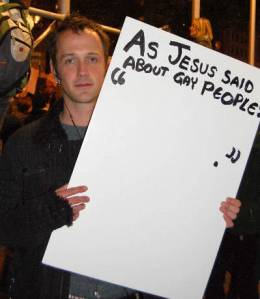
Well, true. But, in Mark 10:1-12 Jesus confirms that the archetype for marriage is one male and one female, as set forth in Genesis 2:24. Though he never made a direct condemnation of homosexuality, he did follow the Genesis teaching of marriage I set out above and that means that he would say marriage is between a man and a woman. Adam and Eve, not Adam and Steve.
The overwhelming biblical evidence is on the side of homosexuality being a sin. Only a dismal one proof text out of eight is found wanting. The person who tries to say that homosexuality is no sin has to ignore an awful lot of Scripture to arrive at that conclusion.
Now we have to consider the obvious objection: These passages are talking about lust; what about homosexual love? To which I say: love is always encouraged in both the New and Old Testaments. The Greatest Commandment is to love the Lord your God with all your heart, soul, and might, and to love your neighbor as yourself (Deut 6:5; Lev 19:18).
All references in the so-called “clobber passages” are references to the act of homosexual intercourse, not to homosexual love. Therefore, homosexual love is acceptable to, even encouraged by, God.
It is homosexual sex that is not accepted. Since it is the act of intercourse that consummates a marriage and homosexual persons can’t lawfully do that, homosexual marriage is not acceptable to God.
It requires ignoring much of the Bible’s passages and underlying assumptions to arrive at the conclusion that homosexuality is not a sin. Therefore, we conclude the act of homosexual intercourse is an abomination to God and homosexual “marriage” is not tolerated by him. The weight of the biblical evidence supports this conclusion. Love between a man and another man, or a woman and another woman, is accepted and encouraged. Leave the lust behind, like all other sins.
A (Reluctant) Response to Rey
Normally, I just ignore Rey, but this time he brought up an interesting point. In a comment on my previous post, he said:
If we are really born at enmity to God and He is causing this to happen as his punishment of Adam’s sin, then He is as much at enmity with us by His nature as we are at enmity with Him by our nature. We both are then equally guilty, and shall not the equally guilty just mutually forgive one another if they are rational?
I agree that our natures are equally at enmity, but it doesn’t follow that we are both equally guilty. To be sure, there is a breach between the nature of God and the nature of man. We need to ask ourselves: who caused the breach?
There is a cause, and Scripture clearly reveals it. Therefore, it follows that someone caused it. Causes, and their resultant effects, follow in a logical chain. An agent caused the Fall, and we turn to the pages of Scripture to find out who caused the rift.
Go back to the text in Genesis 3. Read it carefully. As far as I can tell, humanity bears full responsibility for causing the breach between God and man, and therefore putting enmity between the nature of man and the nature of God. God, in all his wisdom, tried to prevent that and protect us by forbidding us to eat the fruit of the tree of knowledge of good and evil. It was by disobeying him that the rift was created, for up to that moment everything in nature had obeyed God’s commands. The first act of disobedience was man’s fault, not God’s. Man transgressed God, not the other way around.
God is not equally guilty with us, I’m afraid. The text won’t allow that conclusion. But it would be evil for God not to offer forgiveness, a way out of this bind.
God does offer forgiveness, Rey. All those who call on his name will be saved (Joel 2:32). Not just some, but all who call on his name. Isn’t that a glorious promise? Repent of your sins, embrace the totality of Scripture, and call on the name of Jesus (Rom 10:9), for there is no other name by which you can be saved (Acts 4:12).
C. Michael Patton Nails it Again
Many atheists complain that God is a cosmic torture monger (in the words of C. Michael Patton), that he sends people to hell for little white lies and other minor sins. That a mass murderer who repents will go to heaven, while a virtuous atheist will go to hell simply for not believing in God.
C. Michael Patton dispels that myth here. The real problem is that people trivialize sin. Sin isn’t first what we do. Sin is first who we are. We inherit the sin of our forefather Adam, and from this flows a disposition of rebellion toward God.
No matter how we behave, we always have one fist clenched toward heaven’s throne, and are in constant rebellion to God. It is for this that we spend eternity in hell, not for going 27 in a 25 zone. It’s like the Jars of Clay song Two Hands, where the songwriter feels like he’s using one hand to pull God close while using the other to push him away. This is exactly what we do when we let sin rule our lives.
Fortunately, there is good news for those who no longer wish to be in rebellion to the Creator. Believe on Jesus Christ, and your sin is paid for, in full. Then live a life of repentance, a living sacrifice to God (Rom 12:1-2). You will spend eternity with your Father in heaven.
Questions? E-mail me or comment below.
P.S. -> TurretinFan disagrees with this here.
I think that it is worthy to note that sin is both action and nature, and that we are punished more for nature than action. Believing in Christ changes our nature, so that we are capable of not sinning against God as our normal nature would demand.
Grace Does Not Give Us Free Licence to Sin
It’s appropriate that Extreme Theology would reprint this sermon from Martin Luther, since Unreasonable Faith is trying to take a potshot at the Christian doctrine of salvation by grace alone.
Eternal life does NOT depend on works. If it did, we will all be in hell. Christ paid for EVERY sin, so how can I or you be judged BY GOD for a sin when the penalty was ALREADY paid. People judge but that does not matter.
Those are the words of George Sodini, the man who opened fire in a Pennsylvania gym, killing 3 and wounding 9 others. He used the above quote as his justification for the mass murder.
He’s right, of course. Eternal life is based solely on faith in Christ and not on works. However, he left the condition of repentance out of the equation. The sinner must repent of his former sins! This is a message that is left completely out of many churches today. Everyone likes the idea of eternal life with Christ, but not at the expense of the moment.
The above-linked sermon from Martin Luther points out that, while we Christians are forgiven our sins, this isn’t a license to continue to sin. As the apostle Paul put it:
What shall we say then? Are we to continue in sin that grace may abound? By no means! How can we who died to sin still live in it? Do you not know that all of us who have been baptized into Christ Jesus were baptized into his death? We were buried therefore with him by baptism into death, in order that, just as Christ was raised from the dead by the glory of the Father, we too might walk in newness of life. (Rom 6:1-4)
We are dead to sin through our baptism. The apostle wants to make it clear that we are not to still live in sin. What George Sodini did was a clear sin–followed by the taking of his own life. He did not die in a state of repentance. That means that he is not with Jesus, which will likely come as a major surprise to him. But that’s what happens when bad theology mixes with an unstable mind. James White said it, and I’ll repeat it here: THEOLOGY MATTERS.
I think that is simply dishonest of Unreasonable Faith to draw parallells between Sodini and biblical heroes who also killed. The biblical heroes had a clear command from God to kill when they did. God doesn’t speak directly to us today. He has already spoken fully and finally through Jesus and the Scriptures.
Any quick perusal of Jesus or Paul should be sufficient to tell that we are not to take lives in the way that this man did. This is not living peaceably with others (Rom 12:18). This is not allowing the wrath of God to take its full effect (Rom 12:19-20).
Is every encounter with God therefore false? Probably not, but if it contradicts the revelation of the Scriptures then it most certainly is.
The final objection that can be raised is that even a command from God to kill is wrong, not to mention contradictory. But that is simply false. God gave us life and sustains our existence; he is unique in that he can give life. That gives him the right to take it away when he sees fit, and his judgements in such matters are perfect. We humans are not in the position to both give life as well as take it away. We are also not perfect, and therefore do not have a perfect sense of judgement and cannot know for certain that taking someone’s life is the right thing to do.
God, however, is perfect and can make such a judgement.
So, if humans are so imperfect, how do we know that the commands to kill in the Bible came from God? Could our perceptions not have mucked up the whole thing? Well, that would play havoc with biblical inerrancy, which is something that I subscribe to. Not only that, but the ancients were much more biblically literate than we are today, so they were in a better position to know if a command from God was contradictory to Scripture. Finally, Jesus promised that we who are his sheep will know his voice (Jn 10:27). Therefore, if someone is truly of God, that person will recognize God’s direct command.
But that raises another issue. How do you know something like that for sure? Well, the answer lies with the Holy Spirit and with Scripture. If one knows one’s Scripture, and is truly indwelt by the Holy Spirit, one will recognize that direct command from God. In such cases, our hypothetical person will also recognize false commands that don’t come from God because that person will know that they contradict Scripture.
Atheists: Pro-Life or Pro-Choice?
I’m pro-choice. Abortions should be legal, safe and rare. It is simply a milestone of a civilized, modern society. I keep hoping someday that America will be just that. [Atheist posting as zunedita373 at Proud Atheists]
You know that you live in a culture that has lost its fear of God when you read a comment like that one. The brutal murder of an unborn child is called a “milestone of a civilized, modern society.”
As I had suspected, a vast majority of the atheist respondents to the poll posted by Proud Atheists are pro-choice. As Lorena, another commenter, says:
I think many atheists are pro-choice because, once the fear of hell is removed, it makes sense that a woman should have the right to not bring an unwanted child to this world.
I’ve posted before on the fear of hell–I don’t think that Christians should fear hell. After all, Jesus has died for our sins: past, present, and future. Hell is a concern of the unbelieving, not the believing. So fear of hell is not the reason that we should be pro-life.
Even after removing the fear of hell, it still doesn’t follow that a woman has any “right” over another human being’s life, even if that life is disrupting her day-to-day activities. Applied to its limit, this would essentially give any human being the right to terminate the life of anyone who adversely affected him. I don’t think that this is where we really want to be.
It should be noted that most atheists do not believe that life begins at conception, and Lorena is probably among them. Theists tend to share the opinion that life begins at conception, but the Bible is silent about such matters so it is difficult to have a definitive answer. I believe in erring on the side of caution–that is why I firmly believe that life begins at conception. That, and simple logic: a single fertilized cell (zygote) is capable of performing all the necessary functions of life.
There is one alternative to abortion that should be explored: adoption. It amuses me that this option is often never even considered by most atheists when the pro-life/pro-choice debate comes up. The few times I’ve seen it, it is usually thrown aside by the atheist for various reasons, usually centered around the potential for the child to seek out the mother later in life. Abortion, in the atheist’s twisted reasoning, is the only sure way to prevent having to revisit old wounds like a rape or an incest.
That said, there are many couples out there who would love to have a child, even if said child were the product of a rape or incest; especially if the child was the product of teenage imprudence; or if the child were severely deformed or retarded.
Consider the number of unwanted pregnancies in the United States. Now consider the number of couples who are having difficulty adopting because of lack of babies being given up for adoption. It’s almost as if God chooses to bless odd unions with a child just so the adoption industry can find this child a home. Adoption seems to be the logical, God-honoring solution to the problem of unwanted pregnancies.
It isn’t the fear of hell that should keep us seeking God’s will. It is the desire to please God. In the Ten Commandments, God commands us to not murder. It seems pretty straightforward, if you accept that life begins at conception, that God doesn’t want us to end the life of these precious babies. Especially when there are alternatives such as adoption. It pleases God when we obey him, especially if we sacrifice our own comfort for that obedience.
This post from Proud Atheists demonstrates, once again, that our culture has lost its fear of God. It isn’t hell that keeps us in line, it should be the desire to please God and to live out his will for our lives. But this culture wants to do its own thing, apart from God. This society is in love with its sin, and that will be its ultimate downfall.


 Back Rome Again