Category Archives: Bible Thoughts
Daniel’s Seventy Weeks
Daniel’s famous seventy weeks prophecy not only predicts the coming of the Messiah, but the exact date of Jesus’ crucifixion. This prophecy also predicts an “abomination of desolation” in that same timeframe. Here’s the prophecy:
Seventy weeks are decreed about your people and your holy city, to finish the transgression, to put an end to sin, and to atone for iniquity, to bring in everlasting righteousness, to seal both vision and prophet, and to anoint a most holy place. Know therefore and understand that from the going out of the word to restore and build Jerusalem to the coming of an anointed one, a prince, there shall be seven weeks. Then for sixty-two weeks it shall be built again with squares and moat, but in a troubled time. And after the sixty-two weeks, an anointed one shall be cut off and shall have nothing. And the people of the prince who is to come shall destroy the city and the sanctuary. Its end shall come with a flood, and to the end there shall be war. Desolations are decreed. And he shall make a strong covenant with many for one week, and for half of the week he shall put an end to sacrifice and offering. And on the wing of abominations shall come one who makes desolate, until the decreed end is poured out on the desolator. (Dan 9:24-27)
This is a seriously misunderstood passage. The folks in Tim LaHaye’s camp think that this refers to the Antichrist. Actually, it refers to the Messiah. Both Satanic forces and heavenly forces are in view and presented as having a hand in the events. However, the ultimate focus of the passage is Jesus Christ, the Messiah, and his actions are what LaHaye and his futurist school of thought gravely misunderstand. Indeed, they must for their interpretation to even work. Read the rest of this entry
Arguing by Twitter
It’s quite common for atheists to argue by soundbite. They just assert something in a context where it’s difficult to reply at length. That way, they win, because you (the Christian) can’t adequately defend yourself.
Bible contradictions are usually handled this way. The Skeptics Annotated Bible, for example, just points out so-called contradictions and errors without explaining why those would be errors or contradictions. A more recent example is Twitter user @BibleAlsoSays, who tweeted this:
Let’s play which is correct Judges 1:19 or Joshua 17: 17-18 ? Which is correct Psalm 53:1 or Matthew 5:22 ?
I can’t find the original. I only got it as a retweet from @godispretend. I decided to play.
Judges 1:19: “And the LORD was with Judah, and he took possession of the hill country, but he could not drive out the inhabitants of the plain because they had chariots of iron.”
Joshua 17:17-18: “Then Joshua said to the house of Joseph, to Ephraim and Manasseh, “You are a numerous people and have great power. You shall not have one allotment only, but the hill country shall be yours, for though it is a forest, you shall clear it and possess it to its farthest borders. For you shall drive out the Canaanites, though they have chariots of iron, and though they are strong.”
Joshua was talking to the tribe of Joseph in the verses in Joshua. The events of the battle in Judges described things that the tribe of Judah did. If this was a prophecy (I’m not convinced that’s what was happening here–every general, front line supervisor, head coach, etc., tells his team “You will win! You will prevail!”), it applied to the tribe of Joseph, not to Judah. Joshua was, after all, talking to Joseph and not Judah.
Easy enough. Onward.
Psalm 53:1: “The fool says in his heart, ‘There is no God.’ They are corrupt, doing abominable iniquity; there is none who does good.”
Matthew 5:22: “But I say to you that everyone who is angry with his brother will be liable to judgment; whoever insults his brother will be liable to the council; and whoever says, ‘You fool!’ will be liable to the hell of fire.”
 In other words, the Psalmist said that someone was a fool, but Jesus says this is forbidden. The Psalmist sinned! Scandalous. No one in the Old Testament did that, after all! The whole point of Psalm 53:1 is that no one obeys God; i.e. “there is none who does good.” So, if Jesus was giving a blanket prohibition on calling people fools (he wasn’t; keep reading), then the Psalmist sinned in the very song he was composing to say everyone sins, thus proving his own point quite eloquently!
But was Jesus actually giving a blanket prohibition on calling people fools? Look at the context of Jesus’ commands, he specifically says “whoever is angry with his brother,” and repeats “his brother” in the next pronouncement. Jesus is talking about relationships among believers. Many MSS read “whoever is angry with his brother without cause,” which draws some additional lines around the context of this verse. That’s a minority reading, but it appears enough to be worth a mention.
In practice, Jesus himself called many people “fools” and “foolish,” always referring to unbelievers or opponents of his ideology. Brethren, however, in Jesus’ thoughts, deserved more respect than that. Especially in personal, one-on-one exchanges. Public forums are different, which occasionally has to be explained when one Christian calls another out for bad theology (such as the recent James White vs. Ergun Caner situation).
There’s nothing wrong with calling a spade a spade, especially if it grabs the attention of your listener and forces him to see his error. J.P. Holding discusses when parody, sarcasm, or satire is appropriate to use when debating opponents right here. Verses like Matthew 5:22 are not commanding the Christian to become someone’s personal doormat.
Dave Armstrong Nails the Difference Between Denominations
In a conversation with atheist DaGoodS, Dave Armstrong hit a very important truth. DaGoodS highlighted a typical atheist talking point:
Considering one Christian group tells me “that particular Christian group” is wrong, yet “that particular Christian group” tells me the first Christian Group is wrong, and they ALL agree the Mormon Christian group is wrong. The Calvinists tell me the non-Calvinist group is wrong; the Protestants tell me the Catholic group is wrong. The Seventh-day Adventists, Lutherans, Presbyterians, Charismatics…all bickering and fighting as to who the “correct” group of Christians must be.
Every apologist who has engaged with atheists has heard this again and again. Christians have 100 million denominations, each says that the all of the others are wrong, so if you all can’t decide who’s right, how am I supposed to? Dave responds, correctly:
Yes, that is a real problem, and a major reason I am Catholic, but that is not your immediate issue. That comes later. Right now you need to even be convinced of matters that all these groups (apart from rank heretics like the Mormons who reject historic Christianity) hold in common: does God exist; Who Jesus was, etc. First things first.
But in passing, note that Catholics do not claim to be the sole true or correct group. We claim to be the fullness of Christianity, but we don’t deny for a second that other Christians possess large amounts of Christian truth as well. We’re not like the anti-Catholic Protestants who ridiculously deny that we are Christians at all.
And that’s the size of it. Unless they are heretical, all groups of Christianity, from Calvinist to Arminian, from cessationalist to charismatic, all believe in the deity of Christ, the existence of God as a Trinity, and that salvation comes by faith alone in the finished work of the Cross. I believe Dave could attest to everything that I just said.
The atheist has to start there. He has to decide if he believes in God, if Jesus is God Incarnate, and then what to do with that before he can get into doctrinal entanglements. I believe it was C.S. Lewis who urged us to keep our doctrinal entanglements private, as far out of the public view as we can.
Free Sermon Resources?
Today’s sermon was all about giving generously. At my church, “we don’t preach on tithing,” says my pastor. Today’s sermon was, in part, about tithing. But it went deeper than that.
A frequent argument I deal with from atheists and other detractors of Christianity is the ludicrous notion that Jesus wants Christians to give up all earthly possessions and live penniless. They aren’t approaching the text from the perspective of stewardship. All gifts come ultimately from God, and God wants us to wisely use these gifts for his glory. The ultimate summary is Matthew 6:33: “But seek first the kingdom of God and his righteousness, and all these things will be added to you.” Or, as C.S. Lewis put it, “Aim at heaven and you will get earth thrown in. Aim at earth and you get neither.”
The idea is to judiciously use what we have for the good of the kingdom, not to sell everything and live in abject poverty. The trick is that the more we have, the greater the obstacle to true intimacy with God. Or as Jesus famously put it, “For it is easier for a camel to go through the eye of a needle than for a rich person to enter the kingdom of God” (Lk 18:25).
The Eye of the Needle was actually a place in those days. A camel could get through it, but it took a lot of effort and often wasn’t worth it. Jesus isn’t saying that is impossible for a rich person to enter heaven, just that it is going to take much more work than for a poor person. A rich person is expected to give more generously with both time and financial resources to further the cause of the kingdom. Obviously, a poor person doesn’t have as much to give and therefore as much won’t be required.
Bottom line: you can’t be sure of anything in this world except for God. So don’t put stock in material goods–moth and rust can eat and destroy them. Build up treasure in heaven, where nothing can get to it. Material wealth isn’t the same as true security, and we never really possess something we aren’t willing to give to God. Read the rest of this entry
I HATE Cutesy Christian Slogans
Not that long ago, I was driving by a local church and the marquee, appallingly, told passers-by to pray for whatever they wanted, and God would provide it for them. It said this in a cutsey, easy-to-remember slogan. Ironically, I can’t remember the slogan. I had meant not only to blog about it, but to send the pastor a protest letter explaining why that was a bad slogan, and why such propaganda may draw people in for the short term but is very damaging for the long term.
The primary reason for this is simple: what is the pastor of that church going to tell someone who didn’t get what they prayed for? The congregant was “lured” into this church with the promise that God affirmatively answers all prayers, which any student of Bible and/or common sense can tell you is not the case. Any answer given by the pastor is damaging at this point.
If the pastor fesses up to the truth, which is that God will occasionally say “No,” given that God is an agent with a plan of his own that comes before the individual desires of his worshipers rather than an impersonal, wish-granting force, then it appears as though the church is using half-truths to fill pews and get tithe money for its own ends.
If the pastor says that the congregant doesn’t have enough faith in God, that raises the question of how much faith one really needs to receive effective answers to prayer. The congregant immediately concludes he doesn’t have enough faith, wonders what he can do to get more faith, and feels like a failure as a Christian. All the congregant needs to do now is pick up a copy of The God Delusion and guess what happens next.
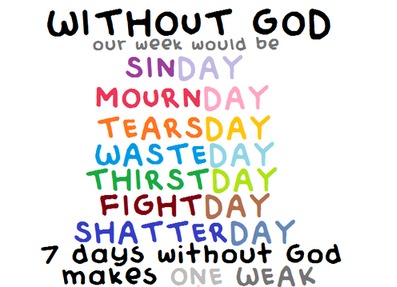 But I never got around to either the post or the letter. What reminded me is a blog post from No Forbidden Questions about a Christian meme that has been making its way around the e-mail circuit, which is pictured to the right. As with all cutesy Christian slogans, I hate this graphic. It only tells a half-truth.
NFQ says this makes it seem as though unbelievers experience these things regularly, while believers are immune to it. Or, as commenter Andrew puts it, “The grass is always browner on the other side of our beliefs.” Read the rest of this entry
Should Christians Celebrate Halloween?
Guest Post by Nate Reid
My brother-in-law, Nate, associate pastor and youth leader at my church, originally wrote this article for my short-lived e-zine. Many Christians, including Nate and I, don’t think that Christians should celebrate Halloween because of its association with the devil and other malevolent entities. Here is Nate’s original article, written in October of 2008 and originally part of this e-zine.
For the Christian today, our diverse American culture poses many real
challenges in determining what he or she should and should not partake in. There is such a blending of belief systems and melding of cultural practices that for those who try to follow closely to the teachings of Jesus Christ, it can be a daunting task riddled with humanly perceived “gray areas.”
In keeping with the season, I would like to address the Christian’s response to the celebration of Halloween. I do not want to go into an exhaustive background, but Halloween began with ancient Druid beliefs that this time of year the souls of the deceased could and sometimes did come back to pester and possess the bodies of the living. Therefore, many of the customs that are still performed today have roots in actual Druid ritual. Carving Jack ‘o’ Lanterns and dressing up in frightening costumes was an attempt to scare away evil spirits. Building giant bonfires (derived from “bone-fires”) was intended to do the same and also eradicate anyone who was believed to be possessed by an evil spirit. Furthermore, today the “holiday” is celebrated by neo-Pagans, Wiccans, and even Satanists as somewhat of a high holiday.
So, if this is the case, what is a Christian to do? What’s so terrible about dressing up as a princess or a pumpkin and going door to door begging for candy? What possible harm can come from carving a pumpkin or bobbing for apples? I would venture to say that these things in and of themselves are not wrong and definitely not the point. The bottom line is this: Halloween today in our culture, no matter how any individual celebrates it, glorifies death, evil, and fear. As a Christian, we know that Jesus came to overcome the power of death, defeat evil, and eliminate fear. Why then would a Christian partake in an event that, no matter what their celebration includes, glorifies the very things Christ came to abolish?
If you argue that our customs for Christmas celebration have pagan roots and therefore would be wrong to partake of according to my argument, then you are right on the first part at least. Many Christmas customs do indeed come directly from pagan practices—the lighting of a tree and the yule log, just to name two. However, I would argue that you are incorrect on the second part of your statement. What, today, does Christmas stand for? Does it not still mark the celebration of the birth of the Savior of the world, Jesus Christ? You would be correct in noticing the need to eradicate the disgusting overemphasis of commercialism and the blatant substitution of the true meaning of Christmas with a certain “Santa Claus.”
Therefore, my analogy goes like this: Celebrating Halloween in the sense of celebrating the harvest and honoring the Saints that have gone before us would in theory be acceptable as a Christian, just as celebrating Christmas as the commemoration of the birth of Christ is acceptable. (The Catholic Church unsuccessfully tried to replace pagan meanings of Halloween, thus “All Hallow’s Eve,” which morphed into “Halloween” with “hallow” having the meaning of one who is hallowed or holy. Think, “Our Father, who art in heaven, hallowed be thy Name…”). Both celebrations go wrong when the pagan is celebrated over the Christian.
In the case of Halloween, glorifying death, evil, and fear is akin to placing the myth of Santa Claus in place of the real Jesus Christ while prioritizing the giving and receiving of gifts over glorifying the Giver of the Greatest Gift of all at Christmas time. I believe it is simply summed up in the following verse: “Do not quench the Spirit. Do not despise prophecies, but test everything; hold fast what is good. Abstain from every form of evil” (1 The 5:19-22, ESV).
As a Christian we have the responsibility to ensure we are thinking through everything we do in general, and specifically in this case with celebrations to make sure we are glorifying God, holding to only that which is good, and keeping far away from anything that is associated with evil. I cannot personally get around the fact that Halloween glorifies death, evil, and fear. It should be obvious that this is the clear meaning behind this day.
Halloween movies more often than not feature brutal massacres, witchcraft as fun and acceptable, and glorification of the demonic side of the very real spiritual realm. The fiction that has been created about ghosts, zombies, and the like have their roots in reality and can only be demons as described in the Bible. There is a spiritual realm that features very good and very bad spirits.
We should not, especially as Christians, make light of this and consequently behave as if the evil is “cute” or “harmless” or anything else other than a terrible offense to God and contrary to everything He is.
We suffer from an epidemic of Christians that behave exactly the same, or at least nearly the same as their non-Christian counterparts without regard for taking a stand for what is pure and holy. We need to not be afraid of looking weird or irrelevant when we speak out against or abstain from celebrating overtly pagan and evil “holidays” such as Halloween. It is time we did as the writer in Hebrews describes when he writes: “…Let us also lay aside every weight, and sin which clings so closely, and let us run with endurance the race that is set before us…” (Heb 12:1, ESV).
I challenge every Christian who reads this article to examine the Word of God, pray specifically, and carefully consider what I present to you even if you initially disagree with my stance. I believe that any Christian absolutely must treat any and all matters of life, not exclusively the “hot button” issues like the celebration of Halloween, in this manner. We cannot afford to slog through life accepting or rejecting doctrine, lists of right and wrong, and in this case celebrations based on our culture at large, what someone we care
about or respect said, or whatever happens to fit our personal references.
There is absolute truth out there, and we all must strive to find it and understand it to the best of our imperfect human ability and live our lives accordingly. Ultimately, we will be held accountable for our actions and what we supported or fought against in the end.
I do not say all this to suggest that a true Christian cannot celebrate Halloween and still be “right with God.” There are godly men and women I know and respect and whose salvation I would not question who advocate at least portions of current American Halloween customs. I do not have a problem with disagreeing with them and personally choosing to abstain, but I only continue to respect their opinion if they have demonstrated that they are convinced that they are doing what is pure and holy to the best of their ability. I do, however, strongly infer that a true Christian will examine their hearts and motivations for celebrating it or not celebrating it and ensure that they have a solid set of reasoning and specific purpose for everything they do.
For Once, I Agree With Vjack

Christine O'Donnell
I normally bash what Vjack has to say, but in this case, I think it’s perfectly justified.
Christine O’Donnell, from everything that I’ve read about her, is making Christians in general look bad. She tried to argue that the phrase “separation of church and state” isn’t in the Constitution, so it’s not a valid concept.
The First Amendment says:
Congress shall make no law respecting an establishment of religion, or prohibiting the free exercise thereof; or abridging the freedom of speech, or of the press; or the right of the people peaceably to assemble, and to petition the Government for a redress of grievances.
What’s clear here is that the Founding Fathers didn’t want any one religion to be the religion in the United States, but I don’t think that they meant to clean all references to God and religion out of the government. They wanted the governing authorities to remain secular and not tied to a specific church or denomination. Different denominations within Christianity often have very different ideas of what constitutes the greater good. To remain free to serve the diverse religious beliefs within the new republic, the government would have to remain clear of heavy church influence.
Since many were religious refugees from the Anglican church, they wanted to respect the rights of other religious refugees to practice their own religion when they emigrated here.
The main problem with O’Donnell’s argument is one of consistency. I’m assuming (dangerous, I know) that she would believe in the Triune God, since she is a Roman Catholic. Well, by opponents of the Trinity, it has been repeatedly asserted that the word “Trinity” is found nowhere in the Bible. That’s one of the main arguments against the Trinity. Yet, the Trinity can be supported with numerous Scripture passages, even if they make no direct reference to “Trinity.”
So it is with separation of church and state. The phrase itself may not appear, but it can be deduced that this is the intent of the Founding Fathers. They didn’t want a single religion or denomination to dominate politics. To support a free exchange of ideas and to arrive at what is really the common good, denominational in-fighting has no place in government.
The Bible tells us to submit to the governing authorities (Rom 13:1; 1 Pet 2:13-17). Nowhere can I see that we are called to be the governing authorities. Rather, Peter tells us:
For this is the will of God, that by doing good you should put to silence the ignorance of foolish people. Live as people who are free, not using your freedom as a cover-up for evil, but living as servants of God. Honor everyone. Love the brotherhood. Fear God. Honor the emperor. (1 Pet 2:15-17)
So, Christians should fine with separation of church and state. All the more reason to witness by our lives that have been changed for the better by Christ, for Christ. Live up to Christian values and morals, leading by example.
Great Quote from Facebook
A friend of mine on Facebook posted a great status that I thought I’d steal–I mean, share:
Nothing is random in His Kingdom. Everything that happens fits into a pattern for good, to those who love Him. Instead of trying to analyze the intricacies of the pattern, focus your energy on trusting Him and thanking Him at all times!
I try to keep things intellectual here at all times, but there’s something to be said for having a child-like faith that doesn’t need a complicated apologetic defense. The problem with most skeptics that I talk to is that they “psych themselves out,” so to speak.
They look at things like starving children in Africa, the candiru parasite, or anything else they don’t like about the world and conclude, “God didn’t make this. No good god would make a world like this one!” Well, there’s an apologetic defense for that (hint: it’s called “the Fall”), but why do I have to recite it? Yes, there are problems in the world. Making me (or any other Christian apologist) defend God against everything in the world that sucks is “analyzing the intricacies of the pattern.”
Instead, let’s trust God to work it out. The world as we know it is a giant Tower of Siloam. What did Jesus say to those trying to analyze the pattern?
Or those eighteen on whom the tower in Siloam fell and killed them: do you think that they were worse offenders than all the others who lived in Jerusalem? No, I tell you; but unless you repent, you will all likewise perish. (Lk 13:4-5)
Focusing on minutia for which I readily admit that I don’t have an answer to is beside the point. Instead, let’s fix our eyes on God, who will work all of these things out for the good of his elect (Rom 8:28). This comes back to the real definition of faith: trust. Trust God to be who he has revealed himself to be in Scripture.
Can Atheists be Moral Without God?
A few days back, I promised that I would discuss the answer to a question that has been raging in the atheist-theist dialogue for a long time. It stirs up controversy wherever it goes. The question: Can atheists be moral without God?
The short answer: NO, absolutely, unequivocally, not. It is impossible to be moral without God.
I had best get to the long answer before I get flamed by my atheist readership, which actually amounts to 99% (if not 100%) of my overall readership. First, I must explain an important, and oft overlooked, distinction that will bring this entire question into focus: the difference between ethics and morals.
When he was learning the art of the psychological autopsy, NCIS’s Ducky was asked by Mr. Palmer to explain the difference between ethics and morals. Ducky said something akin to “The ethical man knows he shouldn’t cheat on his wife, while the moral man would not.” In other words, ethics govern solely the behavior of an individual, where morals begin with the heart and proceed out, modifying the behavior as a result.
It is quite possible for a man to watch rape porn, read erotica featuring rape or non-consensual scenes, constantly fantasize about raping women, and even request that his consensual partners fight him, beg him to stop, and cry real tears during sex. He literally views women as objects that exist solely for his enjoyment. What holds this individual back from actually raping a woman is the threat of jail time, the looming possibility of having to register as a sex offender, and the associated shame and loss of status all of that would bring.
This person actually quite ethical. He doesn’t act on his impulses. He obeys the law. By all outward appearances, he’s a fine, upstanding citizen. But his hidden dark side poses a problem with calling him “moral.”
Ethics are solely concerned with behavior. A person can be ethical and even appear to bear the good fruit associated with the Kingdom of God, but essentially be a “whitewashed tomb full of dead man’s bones.” If you take care to wash only the parts that people can see, while continuing to live a robust life of mental evils, are you really moral?
If my neighbor, the guy with the really hot wife, the awesome job that I could never get in a million years, who paid off his house because he’s a millionaire in his twenties, and owns three fancy sports cars suddenly got divorced, fired from his awesome job, and totaled two of the three sports cars (in one day), how should I react to that?
Externally, if I offered a shoulder to cry on anytime he needed one and offered to help him financially if he needed to pay some debts or bills (no millionaire is completely without debt), and tried to help him get a job; would I still be good if in my mind I kept thinking silently, “I’m so happy! I want to see this S.O.B. fall further into despair. I’m going to nickname him ‘Job.’ May he total the other sports car, too!”
I’m thinking, “NO.”
That example is perfectly within our fallen natures. It isn’t that we can’t do good. We, in our fallen nature, can’t will good. We may do some (relative) good, but privately, we still entertain impure (or even evil) thoughts. Our behavior conforms to the good, but our minds do not.
Contrast this with a Christian, who is a Christian in both word and deed. I hate to say a “true” Christian, so let’s say a “sincere” Christian. Once his faith has been placed in Christ, a transformation occurs. He is a new creation. His inward thoughts are taken captive, to conform even those to Christ. Our carnal minds, after all, aren’t subject to God’s law (nor indeed can be).
Ethics are external. Those are what people see. However, morals work from the inside out. Instead of just doing good, we are good. That’s a far cry from simply acting ethical. Instead of not stealing thousands of dollars from the bank at which I work, the capability of that theft is no longer in my person. That, in a nutshell, is what it means to be conformed to Christ.
That, however, isn’t something that just happens the day of my altar call. It is part of sanctification, which is a life-long process where I work with God to conform both my actions and my thoughts to Christ’s example.
This is hard. But no one ever said Christianity was supposed to be easy.
Did God Dictate Morals, or Did Morals Evolve?
Custador, one of the bloggers at Unreasonable Faith, thinks he’s solved the problem of morals in a single question:
Are right and moral acts and deeds right and moral because God says that they’re right and moral, or does God say that right and moral deeds are right and moral because they are inherently right and moral? (source)
He believes the answer is hidden option number 3: “Human societal norms are evolved and God has nothing to do with it. Doesn’t that rather neatly solve the problems with options one and two?”
It doesn’t solve anything, because the objection raised is seriously misguided:
Option one (right and moral acts and deeds are right and moral because God says that they’re right and moral) logically leads to the conclusion that God could say that anything is right and moral, including (for example) genocide, child rape, slavery, cruel and unusual punishment… Would anybody ever agree that these things are right and moral? I don’t think so – and yet they’re right there in the Bible – some of them as instructions from God himself. I guess that rules out option one!
God neither commanded child rape (this has been repeatedly demonstrated to be eisegesis) or slavery (laws are in place governing it, but are also in place for murder–are you seriously arguing that because laws exist prescribing penalties for murder that God endorses it?). The protection from cruel and unusual punishment is both a Western ideal and subjective. The problem is really one of nature: nothing uncreated exists apart from God; God created everything. This includes natural laws, i.e. what is inherently good is also under God’s sovereign purview. That means that our own conceptions of goodness, rightness, or morality can’t be used to define or judge God. But that is exactly what Custador is doing in this objection.
Instead, God defines those characteristics by his very nature. Goodness, righteousness, and morality proceed from God’s character and are inviolate characteristics of God’s own nature. Evil, unrighteousness, and immorality are the darkness that try to cover the light; they are the absence of the good traits present in God.
This means that God wouldn’t command an unrighteous act. What may seem capricious or cruel to us serves a divine purpose we either aren’t privy to, or we refuse to entertain because of the darkness within us. The second option is more likely.
The darkness refuses to yield so we can clearly see that the “genocide” of the Canaanites (and others) was a righteous judgment of a sinful people, pronounced by a holy God. We know well the depths of our own depravity, and quickly realize that if held to a holy and perfect standard, we deserve nothing less than what the Canaanites got.
Common to objections raised by atheists, Custador posits a conception of God on the level of the creature: bound by time, space, and constrained by inviolate laws woven into the fabric of the universe. This is a subpar definition of God, and leaves wide open the question of who wove those laws into the fabric of the universe in the first place. If it was a force or being superior to God, then God isn’t God at all.
If you start with God, and realize that he, as the good, defines all that is good in relation to himself (rather than be defined by our faulty conception of it), then you realize that God wouldn’t order an unrighteous act and all that he commands is good and holy. But that requires stepping out in faith (read: trust, not “belief without evidence”). If you trust that God is as he reveals himself in the Bible, then this leap of faith is easy to make.
All that said, can atheists be moral without God? I’ll explain why I don’t think so tomorrow.


 Back Rome Again