Category Archives: Bible Thoughts
Holy Week (Saturday): What’s Going On Here?
Holy Saturday is a day of waiting for our Lord to be raised. Many times, he predicted this. Yet, the disciples cowered and hid, not sure of what was going to happen. Their teacher was disgraced. Did they believe a lie?
They certainly didn’t believe the predictions, or else they had no idea what the predictions meant at the time Jesus was making them.
So the Jews said to him, “What sign do you show us for doing these things?” Jesus answered them, “Destroy this temple, and in three days I will raise it up.” The Jews then said, “It has taken forty-six years to build this temple, and will you raise it up in three days?” But he was speaking about the temple of his body. When therefore he was raised from the dead, his disciples remembered that he had said this, and they believed the Scripture and the word that Jesus had spoken. (Jn 2:18-22)
They only realized later what Jesus meant. Jesus predicted his death and Resurrection at other times:
Then some of the scribes and Pharisees answered him, saying, “Teacher, we wish to see a sign from you.” But he answered them, “An evil and adulterous generation seeks for a sign, but no sign will be given to it except the sign of the prophet Jonah. For just as Jonah was three days and three nights in the belly of the great fish, so will the Son of Man be three days and three nights in the heart of the earth. The men of Nineveh will rise up at the judgment with this generation and condemn it, for they repented at the preaching of Jonah, and behold, something greater than Jonah is here. The queen of the South will rise up at the judgment with this generation and condemn it, for she came from the ends of the earth to hear the wisdom of Solomon, and behold, something greater than Solomon is here. (Mt 12:38-42)
On the final trek to Jerusalem, Jesus predicted his death and Resurrection three times:
From that time Jesus began to show his disciples that he must go to Jerusalem and suffer many things from the elders and chief priests and scribes, and be killed, and on the third day be raised. And Peter took him aside and began to rebuke him, saying, “Far be it from you, Lord! This shall never happen to you.” But he turned and said to Peter, “Get behind me, Satan! You are a hindrance to me. For you are not setting your mind on the things of God, but on the things of man.” (Mt 16:21-23)
Then:
As they were gathering in Galilee, Jesus said to them, “The Son of Man is about to be delivered into the hands of men,and they will kill him, and he will be raised on the third day.” And they were greatly distressed. (Mt 17:22-23)
Again:
And as Jesus was going up to Jerusalem, he took the twelve disciples aside, and on the way he said to them, “See, we are going up to Jerusalem. And the Son of Man will be delivered over to the chief priests and scribes, and they will condemn him to death and deliver him over to the Gentiles to be mocked and flogged and crucified, and he will be raised on the third day.” (Mt 20:17-19)
The disciples didn’t believe a lie. They just failed to understand the necessity of a suffering and dying Messiah. Tomorrow is when we will get a full handle on what is going on this Holy Week.
Holy Week (Thursday): The Last Supper
In the final year of Jesus’ life, he celebrated Passover with his disciples and initiated Communion, the Lord’s Supper. I discussed the mechanics of this in a previous post, where an atheist from that horrid Reddit thread so naively asked if eating Jesus’ flesh was cannibalism.
Now, let’s put aside asinine discussions of cannibalism and mediate on the initiation of the New Covenant at the Lord’s Supper:
Now on the first day of Unleavened Bread the disciples came to Jesus, saying, “Where will you have us prepare for you to eat the Passover?” He said, “Go into the city to a certain man and say to him, ‘The Teacher says, My time is at hand. I will keep the Passover at your house with my disciples.'” And the disciples did as Jesus had directed them, and they prepared the Passover.
When it was evening, he reclined at table with the twelve. And as they were eating, he said, “Truly, I say to you, one of you will betray me.” And they were very sorrowful and began to say to him one after another, “Is it I, Lord?” He answered, “He who has dipped his hand in the dish with me will betray me. The Son of Man goes as it is written of him, but woe to that man by whom the Son of Man is betrayed! It would have been better for that man if he had not been born.” Judas, who would betray him, answered, “Is it I, Rabbi?” He said to him, “You have said so.”
Now as they were eating, Jesus took bread, and after blessing it broke it and gave it to the disciples, and said, “Take, eat; this is my body.” And he took a cup, and when he had given thanks he gave it to them, saying, “Drink of it, all of you, for this is my blood of thecovenant, which is poured out for many for the forgiveness of sins. I tell you I will not drink again of this fruit of the vine until that day when I drink it new with you in my Father’s kingdom.” (Mt 26:17-29)
And so the Lord’s Supper was instituted, to replace Passover. By this, we remember what our Lord did for us until he returns to the earth to judge the living and the dead.
Later this night, betrayed with a kiss, Jesus is arrested. Tomorrow, he faces the Sanhedrin and later, Pontius Pilate. It seems Christianity’s darkest hour.
Questions Theists Can’t Answer, the Atonement
I was recently directed to a Reddit thread where the atheists were proposing questions that theists can’t answer. Surprise, surprise, we can answer them, and in many cases have answered them (just not the satisfaction of the atheist). Of course, personal satisfaction isn’t a prerequisite for truth.
That said, what follows are questions from that thread that center on the Atonement. Read the rest of this entry
Saints Alive!
Jimmy Akin has an interesting article about former Pope John Paul II’s progress on getting canonized a saint. Not that JPII is advancing the cause, of course, but that his supporters are pushing the Vatican to name the recently departed pope a saint immediately. As in now.
I wanted to comment because a statement in it ties into my recent post answering questions from a Reddit thread enumerating questions we theists supposedly can’t answer (but we really can). That previous article was on questions that tied specifically to the soul’s eternal destiny, and Akin touches ever-so-briefly on that.
Akin’s article had a statement that dropped my jaw with regard to determining eternal destiny. Before I give my thoughts on that statement, let’s begin with asking why the Vatican would have an interest in thoroughly investigating a potential saint before canonizing him.There are three points to bear in mind. Read the rest of this entry
Questions Christians Hope No One Will Ask, part 3
Former Christian turned atheist DaGoodS (DGS) has compiled a list of eleven questions that he doesn’t think Christians can answer. I’ve decided to take him on, since I’m a sucker for questions that Christians supposedly can’t answer. Hopefully, DGS and I can learn something from each other.
Question #3 embodies two typical atheist objections to Christianity, which I’ve answered in my reply to God is Imaginary here and here. DGS asks:
If you believe your God has phenomenal cosmic power, and is able to sustain the universe, why do you have savings accounts, pension plans, insurance, college funds, stock portfolios and locks? Just in case?
DGS links to his previous article on that topic, which I will now specifically address. The post talks about how a church had armed guards in place, and one managed to halt a tragedy in progress (see this news item).
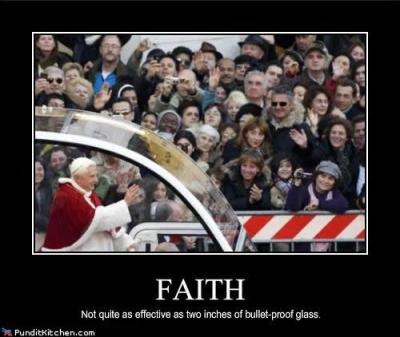 DGS says that when churches put things like this place, they are not acting as if God exists. Kind of like the sarcastic picture on the right. More to the point:
Stores and business put locks on doors. We would say that is wise of them to do so. But is a Christian demonstrating a lack of faith by doing the same thing the world does?
I don’t think that the Christian is. I think that the Christian is displaying good stewardship. More on that in a minute; first, let’s take a look at the so-called biblical support that DGS feels refutes some possible counterarguments.
Christians might say we aren’t called to be stupid. To that, DGS says:
Every church I have ever attended had locks on the door. Every church I attended in the past two decades also has an alarm system.
If God was in control—why would there need to be locks? Oh, we can claim God doesn’t want us to be stupid, and we should use common sense and wisdom, yet this flies in the face of 1 Cor. 1:20-21 which says the wisdom of the world is foolishness.
First Corinthians 1:20-21 is part of a larger argument (1:18-2:16) and isn’t a call to reject all wisdom of the world. It is an argument for accepting Jesus as Messiah despite the fact that he died the most shameful and disgraceful death that a person could die. In the ANE, a crucifixion all but guaranteed a type of public humiliation that we have no equivalent for in the modern world: everything the crucifixion victim did and everyone he was related to suffered disgrace, humiliation, and was ostracized from society. Paul was arguing that God often uses foolishness to shame the wise and worldly. Therefore, I don’t find that this verse particularly supports DGS’s argument that churches shouldn’t need door locks if the faithful who worshiped there truly trusted God.
Just what is God’s wisdom on protecting earthly things, then? Jesus very often told parables where a rich landowner trusts possessions to a steward (usually a servant of some sort). The rich landowner represents God, and the servants (stewards) represented humans. Using this imagery, Jesus is teaching us to be good stewards. Ultimately, everything belongs to God, and he will ask for it back some day. Better to return in better condition than we found it, for God won’t accept it in the same condition (and that probably means he will be outraged if it is worse condition!).
The Parable of the Talents (Mt 25:14-30) is a good illustration. Here, a landowner goes on a journey and entrusts talents to three different servants (v. 15). The first two invest the money wisely and return the original talents with dividends to the landowner (vv. 20-23). The third, however, buried his and thus was only able to return the original talent (vv. 24-25). This enraged the landowner. He told the servant he should have at least put the talent in the bank, that way at least it would have accumulated interest (v. 27).
The point is that God expects us to be good stewards of what he has given us–and it all comes from him, the spiritual (Eph 1:3-4) and the material (Jms 1:17) blessings. In order to fulfill that calling, we must take measures to protect what God has given us; not burying it like the slothful servant in the Parable of the Talents, but locking the door and alarming the building.
Accidents do happen, and therefore the church should take an insurance policy out for fire, theft, or other contingencies. Could the God of the universe stop a fire from hitting a church? Of course he could! But trials come (Jms 1:2-4), and it is through those trials that our faith is made stronger (Jms 1:12). We are just fools if we don’t think it could happen to us.
This isn’t showing a lack of faith in God’s ability to protect us, but is showing our obedience to him in safeguarding what he gave rightfully to us to use. We are the servants who are investing our talents and paying God back the original plus dividends.
Next:
Ever attend a church which has a building project? Perhaps needs a new roof? The same thing—a chart is put up in the lobby in the form of a thermometer, with each “goal” of contribution being a mark, and as the money comes in from the members, it is slowly filled in with red. Does the church say, “We need a new roof—don’t worry—God will provide”? Nope. The church says, “We need a new roof. Let us pray, and pass the plate.”
While the thermometer picture is overused, that’s not really the point here. The tithe is frequently brought up as a lack of faith in God. In reality, the tithe is a test. It is often said that God loves a cheerful giver (2 Cor 9:7). This is true, and we (as Christians) aren’t giving 10% compulsively, under duress or penalty of hell. Rather, we are giving as an act of worship some of which God has given us so that the wealth can be spread. And we don’t have to give 10%; we may give what our hearts (and budgets) allow, proportionate to the wealth God has given us. We could give less, or (better) we could give more.
I’m not Pat Robertson or Paula White. I am not suggesting that giving more than 10% will give you yet more wealth in return. That isn’t promised anywhere in the Bible. Instead, I want to unequivocally say that I believe that the tithe isn’t limited to 10%, nor is it a 10% minimum. Giving what we can afford is the mark of responsible stewardship. This isn’t to reap a material reward, but to reap a spiritual one.
Churches do more than just build buildings: they fund missionaries and assist needy families in the area. All of that is made possible by the tithing of the faithful.
Yes, churches also pay bills and staff members’ salaries out of that tithe, but those are necessary and worthy expenses. The bills enable the building to have heat, running water, and other amenities that a person would expect from a quasi-public building. Which could work to bring in people, and in some cases (as is egregiously demonstrated in a TV spot for a church local to me) keep people coming. (My wife and I were both struck by this TV ad, which asks members of that church why they come to services. Only one of the half-dozen or so interviewees mentioned Jesus. One touted the fact that the church has a rock-climbing wall!)
As for staff salaries, the staff members are domestic missionaries, charged by God with spreading the gospel. Even Paul agrees that paying a church minister is a worthy use of the tithe (1 Cor 9:1-14; yet he himself does not by choice vv. 15-18).
While DGS sees health insurance and requests for tithe money as faltering on the part of the faithful, I believe that both are examples of the faithful’s obedience to God. We give tithes not out of compulsion or fear of hellfire and damnation, but out of love for God–to see the work of the gospel, spread by faithful ministers, continue to touch lives in our local community and abroad. Insurance of all sorts protect what we have, showing that we are good stewards in preparing for the inevitable destruction of earthly goods.
Much more could be said about stewardship. It is a lifestyle, not a formula for managing money. Time, talents (like singing, not the money in the above parable)–everything that is a gift from God should be used for his glory, proportionate with what the Christian can give. This is true obedience, not cowering in fear and lack of faith.
Questions Christians Hope No One Will Ask, Sidebar on 1 Corinthians
The first of today’s posts on DaGoodS’s (DGS) questions will come a bit later, as I wanted to examine a side issue that was raised. The discussion revolves around a specific interpretation of 1 Corinthians 1:20-21. DGS thinks it supports a rejection of all worldly wisdom. However, I believe that in its proper context, it is trying to argue something far different. Read the rest of this entry
Questions Christians Hope No One Will Ask
Through Dave Armstrong, I’ve found an ex-Christian atheist who goes by DaGoodS (I’ll call him DGS). He runs a blog discussing (naive) critiques of his former faith (don’t all ex-Christian atheists?) called Thoughts from a Sandwich.
Scanning his blog, I discovered this entry from November of last year. He has picked up a book called The Questions Christians Hope No One Will Ask. His description is apt:
The author referred to a survey where 10,000 Christians were asked, “What Questions do you find difficult to answer?” and compiled a list of the top ten; the author kindly provides Christian responses.
DGS doesn’t think that the questions in the book are very good, and I’m also guessing that he finds the answers lacking as well.
Since I’m a sucker for questions that Christians allegedly can’t answer, I thought I’d take a shot at DGS’s list. Starting today, I’ll take a poke at two questions per day, posting one first thing in the morning and one in the late afternoon.
I’m hoping we can learn something from each other. Read the rest of this entry
Slavery in the Bible Revisited
In the previous post, I quoted 1 Corinthians 7:17-24 in order to make a point that the Bible doesn’t endorse church-hopping. That passage has Paul urging Christians to stay in the situation in which they were called. Most often, candidates to enter seminary for full-time ministry are told to reflect on that passage.
As much as Christendom (both Roman Catholics and Protestants) needs preachers, we are loathe to have people enter the ministry who are needed elsewhere. God doesn’t call everyone to be ministers in the sense of being in the full-time employ of a local church. Consider 1 Corinthians 12:4-11. Paul specifically tells us that everyone receives different spiritual gifts, and each is therefore called to different duties within the church.
However, the passage from 1 Corinthians 7 I quoted in the previous article contains an extensive discussion of slavery, urging slaves to remain under their masters (unless they gain an opportunity to be freed). Any mention of slavery in the Bible disgusts and outrages critics of Christianity, and unless I deal with the potential objection now it will be raised. I will probably be accused of being pro-slavery unless I deal with it now.
Slavery in the Bible is seriously misunderstood. Check Glenn Miller’s contextualization of ANE slavery here. Slavery in the Bible was closer in nature to the modern employer-employee relationship. There were significant areas of difference that would make slavery far less desirable than a modern at-will employment contract, don’t get me wrong. I’m not suggesting that no differences exist. Skeptics normally think of the African Slave Trade when faced with passages about slavery in the Bible, but that’s not what the Bible means by “slavery.”
This is another example of the skeptic’s outright refusal to understand the Bible on its own terms. They are reading a modern idea into an ancient document. The writers of the Bible knew nothing of the brutality of the African Slave Trade, which involved the kidnapping and forcible transplanting of an indigenous people–a practice that is forbidden in Mosaic Law.
Slavery was first eliminated in the Roman Empire and beyond in the early part of the first millennium by Christians because they saw it as a moral evil and an abomination in the sight of God.
Slavery was resurrected over strenuous papal opposition with the African Slave Trade of the 1700 and 1800s. This would not have been endorsed by the Bible. The end of the African Slave Trade in the mid-1800s marked the second time slavery was abolished from the world–and it was also accomplished by Christians. Atheists have made every effort to cast non-Christians as the key players in abolition, and often cite sermons of leading pastors that endorse slavery. They do everything to isolate Christian abolitionists from Christianity. But the fact remains that abolition was a Christian movement.
For a document that endorses slavery as much as skeptics claim, the Bible was somehow used twice to denounce and eliminate it. Funny, that.
Knowing How to Live Righteously
Paul made the following forceful statement about knowing God:
For what can be known about God is plain to them, because God has shown it to them. For his invisible attributes, namely, his eternal power and divine nature, have been clearly perceived, ever since the creation of the world, in the things that have been made. So they are without excuse. (Rom 1:19-20, emphasis added)
In other words, we know God is there, and his attributes are revealed to us by God and perceived in all that he has made. There is no excuse for being an atheist.
How clear are these attributes? How clear is God’s plan for living a righteous life? Flipping back to Genesis, I was somewhat intrigued by the story of Cain and Abel.
Now Abel was a keeper of sheep, and Cain a worker of the ground. In the course of time Cain brought to the LORD an offering of the fruit of the ground, and Abel also brought of the firstborn of his flock and of their fat portions. And the LORD had regard for Abel and his offering, but for Cain and his offering he had no regard. (Gen 4:2-5)
The sacrificial system wasn’t in place yet. That wouldn’t be codified for over 1000 years. God accepts the offering that Abel gives, but not the one that Cain gives. This angers Cain (v. 5). God, however, offers interesting consolation:
Why are you angry, and why has your face fallen? If you do well, will you not be accepted? And if you do not do well, sin is crouching at the door. Its desire is for you, but you must rule over it. (Gen 4:6-7)
God is indicating that it isn’t about the sacrifice, it’s about doing well and ruling sin rather than letting sin rule you. It’s not about the religious offering. It’s about freedom from sin.
What happens next? Does Cain heed God’s advice? Does he live a godly life worthy of acceptance? Nope–Cain kills Abel in a jealous rage. He’s upset that God accepted his brother’s sacrifice and not his.
Cain is told by God to live virtuously. God is trying to explain that it isn’t about the sacrifice at all. It’s about living free of sin in the first place.
But there’s something deeper here. Cain was simply told to live in a worthy manner, without being given any rules or regulations. The Law, which codifies living in a worthy manner, was centuries away from being written down by Moses. This indicates that Cain already knows how to live virtuously!
And so, I believe, do we. It’s just that we don’t. And therein lies the problem, which Paul discusses in Romans 7:
For we know that the law is spiritual, but I am of the flesh, sold under sin. For I do not understand my own actions. For I do not do what I want, but I do the very thing I hate. Now if I do what I do not want, I agree with the law, that it is good. So now it is no longer I who do it, but sin that dwells within me. For I know that nothing good dwells in me, that is, in my flesh. For I have the desire to do what is right, but not the ability to carry it out. For I do not do the good I want, but the evil I do not want is what I keep on doing. Now if I do what I do not want, it is no longer I who do it, but sin that dwells within me.
So I find it to be a law that when I want to do right, evil lies close at hand. For I delight in the law of God, in my inner being, but I see in my members another law waging war against the law of my mind and making me captive to the law of sin that dwells in my members. Wretched man that I am! Who will deliver me from this body of death? Thanks be to God through Jesus Christ our Lord! So then, I myself serve the law of God with my mind, but with my flesh I serve the law of sin. (vv. 14-25)
Matthew 24: A Very Misunderstood Passage
Matthew 24 is called the Olivet Discourse. It is Jesus’ own discussion of eschatology and is often the center of criticism. In this sermon, Jesus makes the single most controversial prediction of his earthly ministry: he predicts the end of the age and says that it will occur within the lifetime of his hearers.
Obviously, we’re still here so many contend that this prediction didn’t come true. Faced with that dilemma, the leading prophecy experts (Tim LaHaye, Thomas Ice, and others) say that “generation” doesn’t refer to Jesus’ hearers at all but some far distant generation.
I read LaHaye’s book Are We Living in the End Times? (Tyndale House Publishers, 2000) many moons ago. I didn’t know anything about prophecy and only a tiny bit about hermeneutics. If I knew then what I know now, I would have realized just how poorly LaHaye’s arguments are constructed. Let’s focus just on the issue at hand: did Jesus predict that the hearers of his prophecy in Matthew 24 would see the fulfillment?
LaHaye answers that with an emphatic no. Through some hideously complicated eisegesis, LaHaye argues that “this generation” in Matthew 24:34 isn’t the hearers of Jesus’ message, but the generation alive when Israel is reformed as a nation. That happened in 1948. A biblical generation is around 30 years. Obviously, 1978 also came and went and LaHaye recognizes and addresses that problem. He says that “generation” refers to the length of the generation at the time in history when Israel reforms. People are living a lot longer nowadays and therefore 50 to 100 years from 1948 is the more likely timeframe.
Standard biblical hermeneutics teaches that the first consideration in understanding a passage is the audience to whom it is directed. Ask, “How would this audience have interpreted Jesus’ words?” And with that in mind, there is no other conclusion that you can possibly come to: Jesus meant that his hearers would see the fulfillment of his prophecy.
Again, since we are still here, that interpretation seems to present a serious problem for Christianity. After all, I’m not a Jehovah’s Witness because the founder of that organization made numerous failed prophecies. It would be a double standard to say that I reject a religion purporting the same basic message as Christianity on the basis of a failed prophecy by its founder if I excuse Christianity’s Ultimate Founder on his failed prophecy.
The trick is that Jesus isn’t a failed prophet. Let’s start at the beginning of the Olivet Discourse to find out why Jesus isn’t a failure. Read the rest of this entry


 Back Rome Again