Category Archives: Bible Thoughts
Renewed Denial of the Roman Catholic Church, part 1: The Temptation to Become Catholic Again
 Back in June, I confessed in a conversation on Facebook that much of Protestantism annoyed me. Longtime readers will know that I believe in consistency — hermeneutics should be consistent, interpretations of passages should incorporate what has gone before, and your bar of acceptable proof should be even across all areas of your life.
Protestantism just isn’t consistent. Protestants throw out whole swaths of Christian tradition and invent new things. They claim they follow the Bible closer than Catholics, but do they?
No, as it turns out. Most Protestants tell you that faith alone saves you. Yet the Bible, held to be the word of God, forcefully argues that this isn’t the case. The sentence “You see that a person is saved by works and not by faith alone” actually appears in the Bible (Jms 2:24)!
Another example is that most Protestants reject Catholic Tradition on the grounds that it developed later than apostolic times. Interesting. So, Marian dogmas originated in the mid to late second century, while the papacy developed over a few hundred years to solidify in the sixth century, and clerical vestments were developed in the tenth century. All of those are rejected for the alleged late development.
Now, if Protestants were consistent, then there a few of our own cherished doctrines that should go. Some came over 800 years later than the latest dogma of the Church rejected as a “late development.” The 6,000 year old earth concept was developed in the sixteenth century. The Rapture wasn’t mentioned until around 1850 in any literature that I’ve ever seen. Altar calls are from the late 1800s, too.
The early Reformers came up with the idea of the seven Catholic Sacraments as symbolic of Christ rather than literal dispensers of grace over and against Tradition. The Eucharist was no longer a true sacrifice in the sense of being the literal body and blood of Christ and one with the first sacrifice on Calvary, but now becomes a symbol of the death of Christ (see the Catechism of the Catholic Church, p1365-1367; cf. the Westminster Confession XXIX.2). Again, this is over and against not only Tradition, but the Bible (see 1 Cor 11:23-32).
The universal church was founded by Jesus Christ, not by Martin Luther or John Calvin. So it is wholly inconsistent to throw out vast quantities of Sacred Tradition just because you feel like it, or because you lack the historical understanding of the evolution of the Christian faith. The teaching functions of the Church have been eliminated or minimized in Protestantism–to its detriment, I believe. What we end up with a range of possibilities, from no central teaching arm to a carbon copy (but less effective) of the Catholic hierarchy.
My own Grace Brethren denomination has no higher authority other than the individual pastors of individual churches. Presbyterian have a constitution that can change through a majority vote from the individual presbyteries; but members must abide by the Westminster Confession of Faith, which cannot change. The Anglican/Episcopal church has monarchical bishops, but no central Pope figure (though the Archbishop of Canterbury has certain “primacy” over the larger church, but not nearly what the Pope has over the Catholic Church).
The lack of a centralized teaching authority in Protestantism sorely tempted me to rejoin the Catholic Church. In the next post, I want to discuss high church. It is both biblical and necessary for the body of believers to remain in union with one another. But that alone cannot bring me to be Catholic, as it turns out, and we will see why in part 3.
Practical Application of Yesterday’s Theory
Yesterday, I presented a theoretical post. I said that the Euthyphro dilemma could be solved, as William Lane Craig observes, by the ontology of God. God is the ultimate source of good, and therefore the dilemma creates a false dichotomy. God neither commands something because it’s good, nor is it good because he commands it. God is good, and therefore his commands are good since they flow from his nature.
However, I observed, this wouldn’t satisfy most skeptics because they don’t think a syllable of the Bible is either true or reliable. Most believe that the Bible has been completely disproved by every discipline of science:
- Paleontologists and geologists have shown that the earth is older than the Bible declares (my buddy Mike disagrees, as does this website)
- Archeologists have shown that most of the sites mentioned in the Bible don’t exist (check out some discoveries that attest to the veracity of the Bible)
- Historians have demonstrated serious contradictions between what the Bible claims and what is reported in other historical documents (begs the question; why couldn’t the Bible be right and the other documents wrong?)
- Biology shows us that the Bible reports nonsense about animals; hares don’t chew cud, bats aren’t birds, humans aren’t fundamentally different and therefore not special creations of any god (the last has to do with the rejection of the soul, so I won’t give a specific defense)
And on the list goes.
Now, all of those have logical answers. I’ve linked to what others have said (I haven’t actually addressed any of those claims in depth) if you, the skeptic, would actually care to read them.
But let’s get to a practical application of yesterday: the Resurrection. This is the central tenet of Christianity, but if the skeptic believes that the Bible is as riddled with error as many believe (above), then how are they ever going to swallow something as improbable and unbelievable as the Resurrection?
And make no mistake: It is both unbelievable and improbable! Read the rest of this entry
On the Euthyphro Dilemma
Is it moral because God says so or does God say so because it’s moral? False dilemma. It’s moral because that’s the way God is. — William Lane Craig

I think that this an excellent and adequate response to the Euthyphro dilemma. I believe that the answer is rooted in the ontology of God as perfectly good.
However, I don’t think that the skeptic would ever be convinced by such an answer.
He’ll just ask how we know God is good, and when we way “the Bible,” he’ll mention that the Bible also says to sacrifice turtledoves to “clean” women during their menstrual cycles, confirms the existence of unicorns, and prohibits football.
Now, all of those things are hyper-literal readings of the text and have simple responses. My point here is that the skeptic doesn’t accept the Bible’s description of anything, let alone God.
To illustrate, archeologists give the benefit of the doubt to ancient documents when a site contradicts a document. The thought is that the ancient writer was closer to the events and probably knows better than we do thousands of years later. Not to mention that its possible that a site might have been altered, destroyed, rebuilt, or built upon between the composition of the document and our discovery of the site.
However, when that ancient document is the Bible, then the error is automatically assumed to be with the Bible, and not assumed to be one of a myriad of possibilities like the ones I just mentioned. To recap, random ancient document contradicts a site: “There’s probably an explanation. Let’s assume the document is right and find out the reason for the contradiction.” The Bible contradicts a site: “Bible’s wrong, it’s complete fiction, God doesn’t exist. Three cheers for freethought!”
While I think that the answer to the Euthyphro Dilemma lies in God’s ontology, I think that in order to get the skeptic to see that, he must be willing to step out in faith and trust the Bible. However, given all of the skeptical attacks on the Bible (despite it previously thought to have been very reliable), there’s a long way to go on that.
By the way, I’m not the only one that sees this. The Bible has yielded much good archeology in the past, and if we would continue to rely on it I have faith it will produce much more good in the future. However, there is a serious prejudice against the Bible not only in archeology, but in every academic discipline.
History and archeology aren’t my thing, but I hope that other apologists who feel called to that area work hard to counter some of this anti-Bible sentiment in those fields. If the Bible can be believed again as a reliable ancient source of history, then we will have taken a good step toward resolving some of the theological questions being raised as well.
A Day at the Office
I thought that an occasional short story might illustrate certain points better than a straight article. It’ll be good practice for that novel I’m hoping to write.
Rob dreads coming to work, but he has goals and ambitions. First, moving out of his dreary apartment into a house. Then, marrying Rachel. At some point, a nicer car would be great.
Wedding expenses and honeymoon expenses, as well as down payments for houses, require money. Unfortunately, they require more money than this pencil-pushing low-level administrator’s position pays, but that’s what Rob’s night classes are for.
It really wasn’t so much the repetitive job that gets to Rob as Terry. Every office has someone that is into something weird and puts it out there. Terry is the guy that does that here. His weird thing: atheism. Read the rest of this entry
On Harold Camping and the Rapture (May 21, 2011)
Harold Camping predicted that the Rapture will occur, with certainty, on May 21, 2011. Well, it’s May 22, 2011, and we’re all still here. Why? Because Mr. Camping ignored Scripture to get where he did.
Chief among texts ignored by Mr. Camping was Matthew 24:36-44:
But concerning that day and hour no one knows, not even the angels of heaven, nor the Son, but the Father only. For as were the days of Noah, so will be the coming of the Son of Man. For as in those days before the flood they were eating and drinking, marrying and giving in marriage, until the day when Noah entered the ark, and they were unaware until the flood came and swept them all away, so will be the coming of the Son of Man. Then two men will be in the field; one will be taken and one left. Two women will be grinding at the mill; one will be taken and one left. Therefore, stay awake, for you do not know on what day your Lord is coming. But know this, that if the master of the house had known in what part of the night the thief was coming, he would have stayed awake and would not have let his house be broken into. Therefore you also must be ready, for the Son of Man is coming at an hour you do not expect.
In other words, we simply don’t know when the Judgment is coming. But, we can be assured in the words of Jesus that he will return. Therefore, we should stay vigilant and live as though it could happen at any time.
But this gets better and better. Mr. Camping arrived at the date using numerology, which means he ignored the texts condemning sorcery, and Deuteronomy 4:19:
And beware lest you raise your eyes to heaven, and when you see the sun and the moon and the stars, all the host of heaven, you be drawn away and bow down to them and serve them, things that the LORD your God has allotted to all the peoples under the whole heaven.
Since Mr. Camping has ignored or rationalized so many Scriptures, then one more shouldn’t be a problem for him. This next one is a doozy. He now has to explain to us why, in light of Deuteronomy 18:20-22, that anyone should remain his follower:
“But the prophet who presumes to speak a word in my name that I have not commanded him to speak, orwho speaks in the name of other gods, that same prophet shall die.” And if you say in your heart, “How may we know the word that the LORD has not spoken?”— when a prophet speaks in the name of the LORD, if the word does not come to pass or come true, that is a word that the LORD has not spoken; the prophet has spoken it presumptuously. You need not be afraid of him.
Camping predicted the date of the Rapture, said it was a certainty, and it didn’t come to pass. Therefore, he has met the biblical definition of a false prophet, and we need not pay him any mind. Why should anyone continue listening to him? I await his reply.
Fallacious Argument Against Homosexuality
Author of Unprotected Texts: The Bible’s Surprising Contradictions about Sex and Desire, Jennifer Wright Knust has written an article on CNN’s Belief Blog that uses a really fallacious argument against the sin of homosexuality. Several fallacious arguments, actually.
Okay, every argument she presents is fallacious, but I’m not going to get into that right now because I’m going to be reviewing her book in its entirety very shortly. I need a break from atheism, so I thought I’d briefly turn to liberal Christianity.
The argument I wish to highlight is:
“I love gay people, but the Bible forces me to condemn them” is a poor excuse that attempts to avoid accountability by wrapping a very particular and narrow interpretation of a few biblical passages in a cloak of divinely inspired respectability.
You may as well say “I love murderers, but the Bible forces me to condemn them.” “I love liars, but the Bible forces me to condemn them.” “I love rapists, but the Bible forces me to condemn them.” The Bible doesn’t force you to condemn anyone; the fact that what they are doing is against God and nature is why you condemn them. Not every single human behavior is (or should be) acceptable.
No, the Bible has specific reasons for condemning homosexuality. (Bookmark that article; I’ll be referring to it throughout my review of Dr. Knust’s book.)
The hole? The argument assumes that homosexuality is natural, perhaps even desirable. But, history tells us that is not the case. Few (if any) cultures accepted homosexuality. Some turned a blind eye (the Greeks and the Romans, for example, “trained” young men by letting an older man “adopt” him and do sexual things to him), but it wasn’t just “normal” in any but the most depraved societies. Marriage has always been between the sexes, a man to a woman (or sometimes man to women or woman to men).
If Dr. Knust wants homosexuality to be okay, she has to prove that it is. Her argument is just another reason why Christians can’t have a meaningful debate about homosexuality. We’re just backwards bigots, don’t you know?
An Interesting Philosophical Conundrum
The Christian band Texas in July is going on tour with numerous other acts to raise money for a website called sexetc.org. According to Bryan Kemper, this website is staunchly pro-abortion despite purporting to present a “balanced view.” In fact, it only provides links to organizations that encourage abortions, and derides pro-life organizations in blanket statements.
Basically, the site promotes values contrary to Christianity and shouldn’t be supported by persons who call themselves Christians. Yet, Texas in July is a very vocal supporter.
A commenter to Kemper’s article, Jordan W., raises an interesting philosophical question:
As if any of you -author included- knows what’s best for the band. It’s pretty clear that this tour is serving the purpose of getting their name out there and promoting One Reality. I love this band, and I am a faithful Christian as well. Who are we to judge what they do? If you want to actually support the band, support them by going to shows.
Need I remind you that August Burns Red went on this exact tour with The Human Abstract a few years back? Cmon now, be supportive and quit your judging.
Kemper didn’t even touch on a philosophical response to what was raised here, but I wish he would have. He talked about the practical implications, responding that Texas in July was actually raising funds for sexetc.org, where the other Christian bands mentioned weren’t specifically doing that. Jordan kept up the “Stop judging!” reply, which isn’t really what Kemper was doing. He was, as he put it, “It is not about being offended, it is about calling out an injustice.”
But, the broader and more philosophical question not pondered is, “Can I do what’s best for me, even if it spits on the face of the God I claim to serve?” Read the rest of this entry
Twitter Facepalm: @biblealsosays
 I’ve been engaging a Twitter “twit” who goes by @biblealsosays. In one of our conversations, he insisted that he knew the Bible better than any Christian, especially me.
After reading a recent tweet from him, I respond (with all due respect to Brian Van Hoose): “You are wrong, now let me tell you why!”
The tweet in question:
https://twitter.com/#!/BibleAlsoSays/status/64852405308768256
How could Billy Graham possibly know that? Likely, Billy read this:
But someone will ask, “How are the dead raised? With what kind of body do they come?” You foolish person! What you sow does not come to life unless it dies.And what you sow is not the body that is to be, but a bare kernel, perhaps of wheat or of some other grain.But God gives it a body as he has chosen, and to each kind of seed its own body. For not all flesh is the same, but there is one kind for humans, another for animals, another for birds, and another for fish.There are heavenly bodies and earthly bodies, but the glory of the heavenly is of one kind, and the glory of the earthly is of another.There is one glory of the sun, and another glory of the moon, and another glory of the stars; for star differs from star in glory.
So is it with the resurrection of the dead. What is sown is perishable; what is raised is imperishable. It is sown in dishonor; it is raised in glory. It is sown in weakness; it is raised in power. It is sown a natural body; it is raised a spiritual body. If there is a natural body, there is also a spiritual body. Thus it is written, “The first man Adam became a living being”; the last Adam became a life-giving spirit.But it is not the spiritual that is first but the natural, and then the spiritual.The first man was from the earth, a man of dust; the second man is from heaven.As was the man of dust, so also are those who are of the dust, and as is the man of heaven, so also are those who are of heaven. Just as we have borne the image of the man of dust, we shall also bear the image of the man of heaven. (1 Cor 15:35-49)
That’s pretty clear. And it’s in the Bible that @biblealsosays insists he knows better than Christians like Billy Graham! The Bible unequivocally states that, in the Resurrection, we will receive new bodies–bodies that aren’t corrupted by sin like the ones we wear now.
So, kids, our lesson today is as follows: “Please read carefully that which you wish to criticize. Otherwise, you run the risk of looking really stupid.” Class dismissed.
Happy Easter!
It’s Easter, the celebration of the Resurrection of Jesus Christ. The disciples had no idea what was coming. The first reports came in: they didn’t believe it. But then more reports. Soon, they saw for themselves.
The importance of Easter cannot be overstated. Paul said it like this:
Now if Christ is proclaimed as raised from the dead, how can some of you say that there is no resurrection of the dead? But if there is no resurrection of the dead, then not even Christ has been raised. And if Christ has not been raised, then our preaching is in vain and your faith is in vain. We are even found to be misrepresenting God, because we testified about God that he raised Christ, whom he did not raise if it is true that the dead are not raised. For if the dead are not raised, not even Christ has been raised. And if Christ has not been raised, your faith is futile and you are still in your sins. Then those also who have fallen asleep in Christ have perished. If in Christ we have hope in this life only, we are of all people most to be pitied. (1 Cor 15:12-19, emphasis added)
Fortunately, that is not the case!
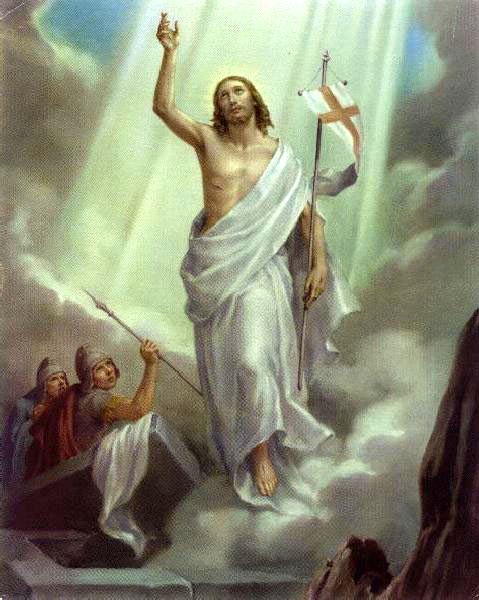
But in fact Christ has been raised from the dead, the firstfruits of those who have fallen asleep. For as by a man came death, by a man has come also the resurrection of the dead. For as in Adam all die, so also in Christ shall all be made alive. But each in his own order: Christ the firstfruits, then at his coming those who belong to Christ. Then comes the end, when he delivers the kingdom to God the Father after destroying every rule and every authority and power. For he must reign until he has put all his enemies under his feet. The last enemy to be destroyed is death. For “Godhas put all things in subjection under his feet.” But when it says, “all things are put in subjection,” it is plain that he is excepted who put all things in subjection under him. When all things are subjected to him, then the Son himself will also be subjected to him who put all things in subjection under him, that God may be all in all. (1 Cor 15:20-28)


 Back Rome Again