Category Archives: Apologetics

Why Be Catholic?

Godless Girl tweeted:

I’ve noticed a trend: points that atheists make seem to make a lot of sense on the surface.  But, once you dive below the surface and actually think about what they say, you realize how stupid it actually is.

Atheists own Twitter because their arguments are best kept to 140 characters.  More importantly, their opponents should have the same limitation because it takes more letters to unpack and understand a concept fully.  In this way, they sound superior to us ignorant Christians.

But this time, Godless Girl seems to have a point.  I mean, why should anyone remain Catholic?  After all, there was worldwide abuse and this institution just covered it up, shoveled priests to different parishes or dioceses, and then paid out their butts in settlements to keep some of the more damning stories out of the media.

If a corporation had that kind of record, people would boycott its products and services and drive the company out of business.  Why would anyone want anything to do with such a corrupt organization?

Except that’s not really true, is it?  Think about Jack-in-the-Box.  They purposely designed their cooking procedures to emphasize speed and not food safety.  They didn’t cook their ground beef to a proper serving temperature and as a result made hundreds sick.  Children and elderly died of E. coli poisoning.

And they’re still in business.  Evil corporate money-grubbers slayed children with bad hygiene and food safety standards — why would anyone support that institution?

Because the products, services, and messages are separate from the messenger — and the public knows that.  It appears to have escaped Godless Girl.  Jack-in-the-Box revised their cooking procedures and now serve safe food.  It was really never about the food — it was the process, the lax enforcement, and lack of food safety standards that were to blame.  The product was still good, and people were willing to give it another go when Jack-in-the-Box had fixed the real problems.

The Catholic Church, like all Christian churches, has been entrusted by Jesus with a message of salvation to mankind.  None of us are perfect; only Jesus had the mantle of sinful flesh but remained unstained from sin.  We only point the way to him that saves you; we don’t save anyone.

The Catholic Church is the mechanism of this message, but it isn’t the message nor is it mankind’s salvation.  It merely points the way, without being the Way.  Christ himself said that only he is the Way (Jn 14:6).

Another example should suffice.  Let’s say you were sitting on a crate that you really didn’t know the pedigree of.  It’s ticking; could be a bunch of clocks, right?  Then a guy comes up to you, frantic, and screams, “Get off!  Get off!  That’s a bomb, and it’s set to go off!”

You recognize this guy from a database of registered sex offenders.  So you remain on your perch and resolutely declare, “You’re a registered sex offender!  So I know this isn’t a bomb.  I know you’re lying because rapists are liars!”

It’s usually the concussive force that kills people like you, not the shrapnel.  You won’t even feel the broken boards or nails, therefore.  Your insides will already be soup from the explosion.

Judge the message on its own merit, not the merit of those who bring it.  The Catholic Church isn’t perfect.  My church isn’t perfect.  We are, however, co-laborers for one who is perfect; and we point to him, not ourselves.

More Dumb Tweets: Belief and Morality

Juan A. Raposo put up a fascinating tweet:

The implication being that theists are only moral because our belief in God keeps us moral.

So if not for that belief, we’d be vicious killing machines.  That thought misses a grand contradiction: Ask yourself, “What restrains the atheist from raping and pillaging?”  Belief that those things are wrong.

Is that belief fundamentally different from belief in God?

The atheist would say yes, but if he were consistent he’d be forced to admit that it differs very little.  After all, the Atheist Mantra is that there is “no evidence” for God and  God can’t be scientifically proven, right?

And that means that belief in God is worthless.  The underlying principle is a form of logical positivism, variously called empiricism or scientism.  It accepts only that which can be proven scientifically (scientism) or that which can be experienced by the senses (empiricism) as valid evidence.  Most atheists use this to disqualify evidence or argument that God exists.

The flip side is that morality can’t be scientifically proven, either.  So the belief that it is immoral to rape and pillage local towns is on the same grounds as God.  If one accepts the implied tenet that only that which can be scientifically proven is worth believing, then one cannot be consistent and also believe that raping and pillaging are morally wrong.  One has to prove that case.

So we both believe, without empirical evidence, that something restrains us from committing grievous harms against our fellow humans.  And that, by Raposo’s estimation, means neither of us are moral — but that’s the whole point of needing a Savior, isn’t it?

On Rational Discussion

The following meme is making the Facebook/Twitter rounds that shows how to have rational discourse:

rational-discussion

As usual, I think that this is incredibly simplistic.  When you unpack some of these, red flags start to go up.  The person who created this, I think, has an agenda and is so focused on that agenda that he is no longer concerned with truth.

Can you envision anything that will change your mind on the topic?  The key word here is “envision.”  I can’t envision anything that would change my mind on the existence God.  That, however, doesn’t mean I will be irrational in a discussion.  Perhaps during the conversation we can find something I had not thought of that would change my mind on God.

Just because I can’t envision it doesn’t mean it isn’t there.  I have an open enough mind to accept that I may be wrong about the existence of God, while being confident that I’m not.  Aristotle observed, “It is the mark of an educated mind to be able to entertain a thought without accepting it.”  I can entertain thoughts I don’t accept — my goal is truth, not comfort.

As a further point, I think that it is easy to use this as a crutch to end an inconvenient discussion by equivocating irrationality and passion.  I passionately believe in God, which is why I can’t envision anything changing my mind on that.  But that is not the same as irrationality.

Are you prepared to abide by the basic principles of reason in discussing this topic?  Two rules are given as an example:

  1. The position that is more reasonable and has more supporting evidence should be accepted as true.
  2. The person who asserts a position bears the onus of demonstrating its truth.

With regard to (1), “evidence” is (as it always is with atheists) left undefined.  Empirical or peer-reviewed scientific evidence aren’t the only forms of evidence.  Only accepting empirical or peer-reviewed scientific evidence is a form of logical positivism called either empircism or scientism (depending on which form you accept).  Neither position is consistent with itself, since there is no empirical or scientific evidence that would support a belief in those position.

Both positions, in fact, rule out the knowledge we gain from history, mathematics, and philosophy.  They also exclude eyewitness testimony from discussion.

Meaning that we accept things as true without “evidence” all the time — if that’s what is meant by “evidence.”  Remember that when we get to the farcical rules of discussion below.

I agree wholeheartedly with (2) provided you understand atheists share a burden of proof.

Once entered, four additional rules are given to govern the discussion:

Do not introduce a new argument while another argument has yet to be resolved.  I don’t, but every atheist I’ve had a discussion with has done this to me.  So, I won’t start doing this but please, atheists, don’t do this to me, either.

Do not move on to another argument if it is shown that a fact you have relied upon is inaccurate.  I’ll just admit my mistake, but this doesn’t happen to me often.

Provide evidence for your position or arguments.  Again, atheists should be doing this, too.  Atheists seldom back their own unbelief in God up with evidence or arguments.  This is both lazy and a direct violation of one of the basic principles of rational discussion (that the true position is more reasonable and has more supporting evidence).  Argue it’s reasonable.  Give me the evidence.

Do not argue that you do not need evidence.  Again, the obsessive requirement for evidence is logically inconsistent, because there is no evidence for accepting it as a true premise — and atheists say they only believe that which we have evidence for.

While I accept the spirit of this meme, I still find it the product of a simple mind concerned with winning online debates rather than seeking truth.

2012 in review

The WordPress.com stats helper monkeys prepared a 2012 annual report for this blog.

Here’s an excerpt:

4,329 films were submitted to the 2012 Cannes Film Festival. This blog had 44,000 views in 2012. If each view were a film, this blog would power 10 Film Festivals

Click here to see the complete report.

I now rescue an old post from the archives. It is germane to the recent discussion I’ve been having on homosexuality as it relates to the Catholic priest who denied a young proponent of same-sex marriage confirmation. It is my answer to the question of why homosexuality is considered a sin.

Cory Tucholski's avatarBack Rome Again

In my posts on homosexuality, I merely assert that it is a sin without providing theological reasoning for why. Since I have been challenged on that point several times, I will now explain once and for all why I believe that homosexuality is a sin.

I have discussed the nature or nurture question and a theology of homosexuality. In this post, I am only considering the Scriptural evidence on whether or not homosexuality is a sin.

There are five passages of Scripture used to directly condemn homosexuality, and three that are used to indirectly condemn it. Let’s consider the direct condemnations first, then move on to the indirect ones.

The first direct condemnation is Leviticus 18:22: “You shall not lie with a male as with a woman; it is an abomination.” It doesn’t get much clearer than that. This passage clearly has homosexual behavior in view, and it…

View original post 1,457 more words

But, You Really DO Hate Gay People!

As I figured I would be, I’ve been called out on this post.  A blogger named Jessica Sideways insists that I really do hate gay people and seek to deny them rights.

The whole post in which she does this is, frankly, a waste of the bits and bytes used to store it on her server.  Those could have been used for something far more worthwhile, like a nice virus or maybe another iteration of a Socially Awkward Penguin meme.

Before I respond, an open note to Jessica:  I have a feeling I know how this back-and-forth is going to go.  Therefore, this post only will be in a Minimal Sarcasm Zone.  Only truly inane points you make will be subject to scathing, ironic humor.  If you choose to respond and show the same remedial grasp of philosophical issues I’ve already seen, you will be subject to sarcasm that will make you think of J.P. Holding as a nice guy.

You’ve been warned, now class is in session. Read the rest of this entry

Must Catholics/Christians Hate Gay People?

I put a link to this article on my Facebook page.  I wondered why people who hold beliefs antithetical to Christian doctrine would want to be Christians.  One of my friends responded:

so you have to hate gays to be catholic or christian? if you in don’t agree with everything the church tells you then you can’t be christian or catholic? not trying to debate the issue just making sure I’m clear that’s what you mean by NOT for you a little intrigued by your post for some clarification of your point of view that you mean if you think like this you can’t involved in church? courious

I hear this again and again: Christians hate gay people, and we’re not allowed to disagree within ourselves because if we disagree then what we have isn’t from God.

No and no.  Let’s lay this out:

  1. Homosexuality is a sin.
  2. Marriage is between a man and a woman.

These are both eternal truths defined by God clearly in Scripture. These truths are to be upheld by the Church, and therefore the membership of the Church.

To be Catholic, you cannot be in favor of same-sex marriage. That is not the institution of marriage that is spelled out in Scripture by the Lord himself. The long and the short of it is that we humans don’t get to define marriage or church sacraments — God, who is eternally and perfectly good, is the one who defines those things.

Our nature is fallen from grace, and therefore we don’t really understand what “good” is or what it looks like. God is who we need to look to for that, not ourselves. If we look at homosexuality as something innate to us and think that is somehow “good,” then we are missing the mark by a lot. Remember — we are not good by nature; we are sinners by nature. What we do or what we are cannot be the standard for “right.”

When we use ourselves as the standard for “right” or “good” or “fair,” we will never get to the essence of those terms because no one consistently treats others “right” or “fair.” No one is consistently “good.” Better to ask instead, “What standard are we using for good?”

Every time we judge something moral or immoral, right or wrong, good or bad, we use some kind of standard. The standard cannot be society, for society changes far too often. Opinions and social mores are up for grabs, and differ every generation. Worse, this prevents us from judging any society as “wrong” or “immoral.” Implications?  The Nazis were on solid ground when they did the Holocaust!

For reasons I’ve already discussed (fallen nature), the standard can’t be what is in our own nature.

Therefore, the standard is God.  God is outside of ourselves, and therefore not subject to a fallen nature.  God also is not a part of society, and therefore not caught in the sweeping changes of morality we see as a society.

Read God’s Word — homosexuality is condemned throughout. Read Catholic doctrine — again, homosexuality is condemned throughout. Early Church Fathers were divided on many, many issues — but this was not one of them.  (See some selected writings here.)

Homosexuality is a sin, but not everyone in our pluralistic society shares the view that sin is a problem.  Does that mean we seek to deny them equal marriage rights using our religion?  We deny them nothing.  They have the right to marry a member of the opposite sex, just as I do. Men can only marry women; men joining to men or women joining to women is not marriage. Homosexual “marriage,” therefore, is the homosexual community asking to change the entire sacrament of marriage, thereby perverting its original intent.

Fine, homosexuality is a sin.  Homosexual marriage isn’t marriage, so it’s not a denial of a right.  Does that mean I hate gay people?  On the contrary, I have gay friends (one of whom owns a lesbian bar and is the founding member of Toledo Pride), I’m a huge Elton John fan, and I’ve been to a lesbian wedding (such as it is; gay marriage is still illegal in Ohio).  Where’s the disconnect?  Well, most people are tired of this expression, but I’ll say it anyway: Love the sinner, hate the sin.

“But I was born gay! If homosexuality is a sin, and if you hate the sin, then you hate me!” Absolutely right! I’m not even going to deny that.  But I’ve already covered this: Sin is innate to all of us, and we’re all sinners.  However, each of us are susceptible to different sins. The challenge as a Christian is to learn to hate that part of ourselves, to crucify it with Christ, and live in a manner worthy of our calling. Is it hard? Yes! I’ve heard it said that Christianity isn’t tried and found wanting; rather, found difficult and left untried.

Could someone in favor of homosexual marriage become involved in church? Could gay people become involved in church? Absolutely to both!! Hopefully through church they will learn that homosexuality is a sin and that it is something that they need to put to bed (no pun intended), not a part of themselves they should explore. No different from any other sin. We wouldn’t exclude adulterers or murderers from our congregations, but Catholic priests would certainly deny sacraments to ones that remained unrepentant.

Christ came to heal the sick, which is why he is sometimes called the Great Physician. The unrepentant sinners among us are the ones who need Christ’s love the most, and therefore they need church involvement that much more.  We should never deny church attendance or involvement to a sinner, because then no one would qualify for membership.

I’m not saying I’m perfect. There’s a lot for me to work on. A lot. I don’t practice what I preach here, so trust me this applies equally to me as it does to any gay person.

The point is that we all have our challenges with living as Christ did, and this life is about that journey to becoming more Christ-like. God promises to get us there, and he works differently on each of us. Homosexuals have their challenges, as I have mine. Church is about giving each other that accountability. It’s about helping each of us on the journey. That’s the point of fellowship.

But, before we can offer the needed accountability, we have to be clear on what constitutes a sin, which is (in my view) the real reason the young man in the article was denied confirmation. If you give approval to those who practice a sin, then you aren’t modeling Christ for unbelievers. Worse, you’re inviting the same judgment on yourself.

I hoped that would clear things up for my friend.  She’s a dear friend and I’d hate to lose her over what I would actually consider a non-issue.  Fortunately, she enjoyed that treatment and said she learned some things.  So kudos for remaining open-minded to other perspectives!

Mega-Facepalm!

Sometimes, some things are so stupid that I don’t think they really warrant a serious reply.  Case-in-point:

Then I remember the horrid truth.  Most people have so little discernment that stuff like this would actually convince them that the critics of religion have made some kind of point.

Does that crucifix qualify as making a god out of cast metal?

In one sense, yes.  Jesus is God, and the maker of the crucifix has manufactured an image of Jesus out of cast metal.  Therefore, he has sinned.  But does that feel right to you?

The passage forbids us from making a god out of cast metal.  The real Jesus, of course, is cut from the same cloth as the Father and as the Spirit.  He’s not made of cast metal, but this crucifix is a symbol designed to remind us of the Savior.

So, what this passage is actually forbidding, for example, would be me designing an elaborate Staunton-style chess king out of brass with some custom engraving and decorations.  Then naming it George.  Then worshiping George as an all-powerful God of Chess, who has endowed me with both the interest and the acumen to play the game of kings.

Get it?

This passage is forbidding inventing a god out of workable materials.  God isn’t a being you manufacture from earthly things, he is one that you seek through heavenly things.  God is to be sought, not invented.

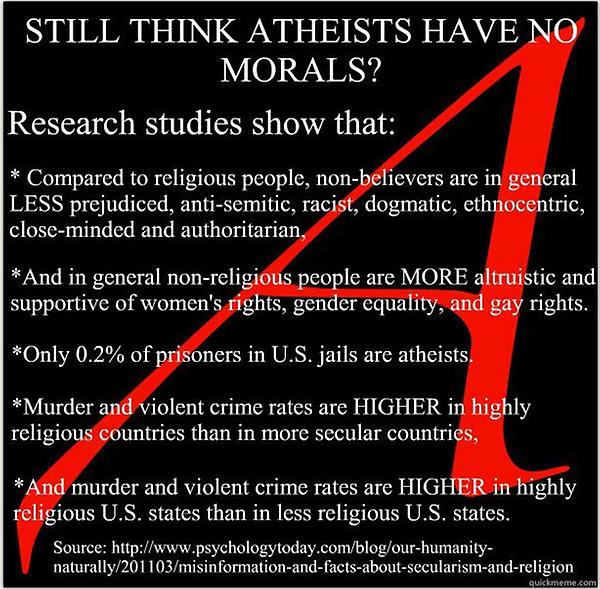
Surprise: Atheists Don’t Lack Morals!

Did I say atheists have no morals? I don’t THINK I said that…

Atheists really like to fight against us ignorant theists who say they have no morals.  We’re the backwards hicks who take instruction from a book written by ignorant goat-herders who believed the earth was flat and that the sky was a dome that contained the sun, moon, and stars (all of which circled the earth!).  What do we know about morality?

Atheists are so enlightened that they’ve thrown off the shackles of God-belief and are doing the right things because they’re the right things, not because some ancient patriarch shakes his finger at you from 1,000 years ago and says, “Do it or I’ll spank you!”

So of course they don’t lack morals!  In fact, they’re more moral than religious people — the vague statistics quoted above don’t lie!

Sensing the sarcasm yet?

I hope so.  Because I don’t know how to lay it on thicker than what I just did.

Atheists are not immoral.  They are amoral.

Difference?

Immoral means acting contrary to established morality.  It is a question of ethics, not ontology or epistemology.

Amoral means lacking morals.  It is a question either of ontology or epistemology, not ethics.

Morality represents the essence of good behavior.  Ethics represent the execution of good behavior — in other words, the pudding that the proof is in.

In Plato’s dialogues, Socrates asks the good priest Euthyphro what piety is.  Euthyphro comes up with several examples, which Socrates says were good but that only covers pious acts.  Socrates wants to know what piety is.

By giving him extensive examples, Euthyphro wasn’t actually answering Socrates’ question.

The above graphic does the same thing — it only shows that atheists behave more ethically than religious people.  But why do they do that?

They can’t tell you — there is no ground for morality given atheistic naturalism.  That’s where the difficulty starts.  Ethics can change; sometimes dramatically.

It was once legal to bet on (or against) your own team in professional sports.  Professional sports also allowed the use of steroids or other performance-enhancing drugs without batting an eyelash.  Now, both practices are deemed cheating in most professional sports.

What we need is something to ground our ethics in; something immutable that we can return to to see what goodness looks like.  That way, when we find something new, we can create a code of ethics for it patterned after that which gave us the example of good ethics in the first place.

If morality is an immovable anchor and ethics are a boat on the rough, unforgiving seas of our culture, the boat is free to move about within the radius of the anchor.  It might go adrift, it might even do something unacceptable, but it will remain in the range of the anchor.  Conversely, without the anchor, the ship is free to be tossed around the sea of possibilities, moving unflinchingly into uncharted, dangerous waters with nothing to bring it back to safety.

The nature of God is that immutable ground of ethical behavior for the theist.  The atheist has none.  We are the boat that will return to safe waters, they are the one that will be tossed out to sea without a guide.

I have no problem with considering atheists ethical; the above examples show they are.  However, they have no ultimate ground for the morality that informs their ethics and that means they will go seriously adrift.

Tim Keller on Apologetics

I’ve heard plenty of Christians try to answer the why question by going back to the what. ‘You have to believe because Jesus is the Son of God.’ But that’s answering the why with more what. Increasingly we live in a time in which you can’t avoid the why question. Just giving the what (for example, a vivid gospel presentation) worked in the days when the cultural institutions created an environment in which Christianity just felt true or at least honorable. But in a post-Christendom society, in the marketplace of ideas, you have to explain why this is true, or people will just dismiss it.

— Tim Keller

Design a site like this with WordPress.com
Get started